Lakayana Yotoma Drury poses for a portrait at OPB in Portland, Ore., on March 4, 2026, when he was interviewed on "Think Out Loud." His new "503" magazine-style publication is a collection of essays, photos, poems. He calls it a kind of "love letter to Portland."
Eli Imadali / OPB
Lakayana Yotoma Drury is an educator, social entrepreneur, community advocate, writer, poet, filmmaker — and now an editor-in-chief. He’s published a new magazine-formatted publication with a collection of essays, poems, and photographs he calls a “defiant anthem of Black joy and resilience against a backdrop of gentrification, community violence, miseducation, and white supremacy.”
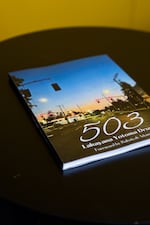
Lakayana Yotoma Drury's magazine, as seen in at OPB in Portland, Ore., March 4, 2026 at OPB.
Eli Imadali / OPB
It’s called “503“, and Yotoma Drury says the magazine is dedicated to Portland youth and also describes it as a “love letter to Portland.” We sit down with him to hear more about this new collection and its compelling themes — including Black history and stories, educating Black children and youth, and “Black Portland transplants” and their relationship to historic Black Portland.
Note: The following transcript was transcribed digitally and validated for accuracy, readability and formatting by an OPB volunteer.
Dave Miller: From the Gert Boyle Studio at OPB, this is Think Out Loud. I’m Dave Miller. Lakayana Yotoma Drury is an educator, a social entrepreneur, a community advocate, a writer – and now an editor-in-chief. He recently published “503,” a new magazine-style collection of essays, poems and photographs that he calls “a defiant anthem of Black joy and resilience against a backdrop of gentrification, community violence, miseducation and white supremacy.” He says it’s a love letter to Portland that is dedicated to Portland youth.
Lakayana, welcome back to Think Out Loud.
Lakayana Yotoma Drury: Dave, thanks so much for having me.
Miller: I was hoping we could start with having you read us the first part of the title poem in this new collection?
Yotoma Drury: Absolutely. “503.”
[Reading his poem, “503”]
Dear 503,
I wrote this letter to say thank you
I never told you how I really feel
I think it’s time we talked about it
to share my appreciation for the gifts you’ve given me
I came to this city of ancient rainforests and raindrops with no expectations
You showed me unconditional love
from a hotel on 82nd to a homeowner in the North
under endless gray skies
You nurtured me from a boy with a dream
to a man confident in his purpose
In the so-called whitest city in America
I found a pure Black love story
Buried in the rainforest of the Pacific Northwest
In the intentionally unacknowledged footsteps of York
A story of trains and tribulations
About porters and protests
A story of a people who survived a flood
Built a garden between red lines
And held on through the hurricane of gentrification
The Nation of Black Portland
I call them the Children of the Sediment
They came from far and wide
from Arkansas, Mississippi, and Florida
to name a few
Me, I came from Philly
by way of the Midwest
608 to be exact
I arrived unemployed
my whole life packed into four suitcases
with a notebook full of chicken scratch dreams
Who would have thought
I’d find my tribe amongst the kids on Killingsworth
The youth of the city that they gave up on
considered unteachable
they told me on my first day
This isn’t a real school.
and I knew then I had found my people
Miller: We’re gonna get to that school that made you realize you’d found your people. But before that, what did bring you to Portland from, as you say, Philly by way of the Midwest? And it’s Wisconsin in particular, that area code that you mentioned.
Yotoma Drury: That’s right, Madison, Wisconsin. A desire to see the world. I was on a road trip while I was unemployed ...
Miller: You took your mom’s car.
Yotoma Drury: I took my mom’s car, against her wishes, a Honda CRV that’s still parked in my front of my house right now but no longer is quite running after 300,000 miles. And I wanted to see the world, and I also wanted to find my place. That’s been a theme of my life. So I stumbled upon Portland, and came back and started teaching, and that was kind of the start of my journey in Portland.
Miller: Can you tell us about that first job here? You taught at Rosemary Anderson at an alternative high school in Portland?
Yotoma Drury: I graduated high school with a 2.3 GPA, so I was just beginning my teaching career when I moved to Portland. I’d actually been fired from my previous job and almost gave up on teaching. But when I was looking for jobs in Portland, I typed in “alternative high school” and the first one that came up was Rosemary Anderson High School. I taught there, and the students told me on the first day, “this isn’t a real school,” because they were just like me when I was in high school. The education system had given up on them, so they gave up on education.
So when they told me that, it just made me dig in. I knew that if I could reach them and unlock their minds, I could reach them. And I was teaching them social studies. But what they told me was the neighborhood that you’re teaching in is known as Albina. They showed me streets where their cousins had been killed, and corner stores where they would shop at, and malls where they were chased out of. So it was an exchange. They told me stories of the underground Portland, and I gave them hope and education.
Miller: Could you read us part of a poem that you wrote about that time, about teaching at Rosemary Anderson?
Yotoma Drury: Absolutely. This is called “Classroom 201.” It was the first poem I wrote when I was in Portland.
[Reading his poem, “Classroom 201”]
You see, I don’t do this for the money.
I do this for the Black boys that society wants to send to jail.
The Black boys who grew up like me without a father.
I do this for my students who live in a world that won’t accept their identity.
I do this for the Latina girls who could be first-generation college students.
I do this for the white kids so they aren’t in history.
I do this for the “alternative kids.”
I do this for little me, who never would have imagined I’d be a teacher.
Welcome to Classroom 201.
So what do you want to be, young king?
Young queen?
The million-dollar question.
Yeah, you’re ight at rapping, but what about being a teacher?
I mean, hooping is cool, but what about being a doctor?
I know you like to do hair and nails, but what about being a social worker?
What about the kids like you?
What about the next generation?
What about beating the odds?
What about all the times they told you you wouldn’t amount to anything?
They told me the same thing.
Welcome to Classroom 201.
Where grades don’t matter.
Where failure is your ticket to success.
Where trying isn’t allowed.
Where dogma is avoided.
Where “I don’t know” is never acceptable.
Where circumstances are understood, but greatness is demanded
Where the curriculum is unapologetically Black
Where Black history isn’t a month, it’s all year
Where we go beyond 55 minutes and a 9-to-5
Because this isn’t a job, this is a way of life.
Where it’s bigger than you, or me or them.
This is about us all.
This is where it all goes down.
In Classroom 201.
Miller: What were your expectations for your students? What did you ask of them or demand of them or expect from them?
Yotoma Drury: I told them to take the word “try” out of their vocabulary and to show up as themselves. I told them on almost a daily basis I didn’t care about their grades. My 2.3 GPA had no bearing on my trajectory. So I wanted them to come back to learning, in the way that we do when we’re kids. And I know how the school system can just pull that out of us. I know so many students, currently even in Portland, that have that love for education just snuffed out of them. So I’m seeing students at that place where they no longer wanna participate. I wanted to breathe life back into their bodies.
Miller: You touched on this briefly before, but I wanna dig deeper into it. What did you think you were learning from your students?
Yotoma Drury: They were telling me a story about Portland that most people don’t know. I say in the beginning of this book, this book is dedicated to the underground Portland, to those whose stories never rise to the surface. Portland is framed as this liberal progressive city, and it is for some. But there’s an entire other world, this underground world of youth, stories, rich culture and experiences. That’s what they imparted on me that framed everything that I would go do in the 10 years since I’ve been here.
Miller: That included starting a nonprofit called Word is Bond, which we’ve talked about, but it’s been a while. The last time you were on with one of your students was five years ago. For folks who missed that, can you tell us what Word is Bond is? What the mission and the idea is?
Yotoma Drury: The mission of Word is Bond is what if young Black men were empowered to their fullest potential? We empower young Black men through dynamic programming to reach to the stars. When I was growing up, I had no Black teachers, kindergarten through 12th grade. I met my father when I was 10 years old. So what I was told about being a Black boy or being a Black man was very limited.
So in creating Word is Bond, we’re showing them their fullest potential. Our programs take you all the way through high school, through Portland. Since we first came here on OPB to now, we now have programs that send them all the way to Ghana, to go back to the source of where all the greatness started.
Miller: You’ve been doing this for long enough, I imagine that some of the people who you were teaching when they were in high school or mentoring and helping to respond, they’re young adults now. What’s it like to now be seeing the successes of some of the people that were struggling when you first encountered them?
Yotoma Drury: It’s like planting a tree that’s still beginning to bear fruit. Word is Bond’s work is not fast paced, it’s slow growing work. Some of my first students in Classroom 201 are now my age when I first moved here. Some of them told me five years ago “I’m never going to college,” and now they’re seniors at PSU. They’re graduating. They’re beating expectations. My original Word is Bond ambassador is now married and a parent. So it’s just a beautiful experience and just part of the incredible journey that I’ve been on here in “503.”
Miller: A lot of this new collection is about your experiences as a Black man who did not grow up among Portland’s generations-long Black communities. You’re a transplant, as am I. What did you want to explore about being a transplant, a relatively new arrival?
Yotoma Drury: So one of the first things when I came to Portland as a Black transplant was being immersed in Black Portland’s experience, which was imparted on me by my students, and noticing the divide. Because Black Portland is so unique, their story is very different than other communities of Black people around this country. So I quickly recognized that there was a way in which I had to approach in order to be a part of this community.
Miller: Were you made to feel like an outsider?
Yotoma Drury: The interesting thing is, not at all, from the very beginning. From my mentorship under Joe McFerrin to my students, but it was because I was in a community-based organization that kind of facilitated my learning. I’ve always felt welcomed in Portland. Which is crazy, because I came from Philly, the city of brotherly love, a predominantly Black city. But I felt more connected here in ways I just can’t describe.
Miller: Could you read us another excerpt? This is from that first poem we talked about earlier, “503.” To me, this gets at the question of belonging, and also maybe just becoming a Portlander.
Yotoma Drury: [Reading an excerpt from “503”]
Your stories became my stories
From the youth, from the elders, from the activists
I brought my stepbox to Union Station
I worked the shipyards of Vanport
I sang in the church choir on Sundays in Albina
I drank moonshine to Jazz melodies in Jumptown
I remember the great ones who came before me
Beatrice Morrow and Charles Jordan
I ate a hot plate at House of Umoja
As the neighborhood changed, so too did I
and when they pushed me back East
I took the 72 back to Killingsworth
with all my Blackness.
Miller: I was really moved by that. I mean, there’s so many wonderful parts in the new collection, but in that one, you’re telling the story about earlier aspects of Black migration here or Vanport, things that happened before you were born, or more recent parts of Portland history that happened before you grew up here. But you’re putting yourself in those moments. How did that happen, that those earlier stories of Black experience in Portland became your stories?
Yotoma Drury: When you sit in a classroom full of students with beautiful and broken stories, they start to seep into your bones. When you’re mentored by people like Chappie Grice – rest in love to him – and he tells you the stories of the community, and you sit with people like Lakeitha Elliott or Rukaiyah Adams – who wrote the foreword for this book – those stories impart on you. I’m a storyteller. When I hear them, they inspire me. I wish I could have lived back in those times when Albina was the community that we’re working to reconnect and make it be, or Vanport. It all just inspires my imagination.
Miller: You mentioned you talked with Lakeitha Elliott, and you include an interview with her in this collection. She’s the head of the Avel Gordly House. She was on our show recently talking about Jefferson High School issues.
One of the questions you asked her is this: “What does the Black community need to work on?” That’s the kind of question that’s most comfortably asked within a community, not by a white person like me. But it’s a question you asked somebody else. I’m curious if somebody asked you that, how you would answer it?
Yotoma Drury: What does the Black community need to work on? I would say taking ownership of our youth. The community can’t do it for us. I know a Black boy at Faubion Elementary right now that’s been suspended twice in the last week and he’s 6 years old. The education system cannot do for us what we can do for ourselves, so we cannot rely on an outside system.
So grab hold of our youth, each one teach one. In the way that we used to do it back in the day, stop them, ask them where they’re going, pour love onto them. Lakeitha shares a beautiful story in her community in this interview, where she talks about a neighborhood man that used to give them snacks and candy, and always talk to them on their way to school. So I think we need to return to that, and to really embrace our youth and help them rise to their fullest potential.
Miller: The second part of that question to her that I mentioned, you asked her what needs to be healed in the community right now? I’d love to turn that one back on you as well. Where do you see the need for healing?
Yotoma Drury: I think we need more closed-door spaces where it’s just us. A lot of time, Black Portland is convened by white power structures. We need to convene ourselves. We need to heal ourselves. We need to give ourselves grace. We need to share our stories with the youth. Ariana, the final person I interviewed in the title essay of this book, talks about a block party. And it’s such a beautiful concept. It’s not a lot of money. It’s not a lot of razzamatazz. It’s certainly not DEI structures. It’s returning to community and to the roots.
Miller: At the end of the magazine, you offer directions for how to make what you call the North-Northeast Portland Afro-American community platter, with a tasty looking picture. Can you describe this idea of yours?
Yotoma Drury: It kind of happened spontaneously when I was at Good in the Hood. I stepped out and went to Jack’s Chicken down the street and got a six-piece of wings, and then I went next door to the Ethiopian restaurant, and I got some doro wat, and I put the chicken wings in the doro wat, and made this Afro-fusion dinner.
Miller: And wrapped it up in injera.
Yotoma Drury: Exactly, because Black Portland isn’t just Black Portlanders who were born here, but it’s also the immigrants too. And I think that’s another thing we could do, is unite more of the full diaspora of Black Portland. So it’s a kind of little fun play on bringing community together in a really tasty way. And at some point, I’d love to invite you to grab it with me one day.
Miller: That sounds tasty, that sounds good. You write at one point that the truth is that you never felt like you belonged anywhere – not in your skin, not in schools, not with the people of either race that you write make you “a half.” Why do you belong in Portland? Why do you feel that you belong here, in a way that, if I understand you correctly, you didn’t feel that belonging earlier in your life?
Yotoma Drury: I’ve been moving around this world all over the place, literally. I lived in China for a year, I lived in Philly, Madison, Wisconsin where I grew up, DC where I was born. I’m biracial, so I’m born between two worlds, as I often like to say. And no way would I have ever thought in the so-called whitest city in America that I would find something that resonated with me so deeply in my soul. Honestly Dave, I can’t say what it is. But I’m here, I’m willing to be a part of the change and I’m just embracing the moment.
Miller: What are your hopes for your own work going forward? Your bio is long, and I’m curious what you see for yourself in the next chapters?
Yotoma Drury: I want to write more. I wanna become a father and heal that chapter of being what it’s like to be in a child’s life from day one. And I want to build Word is Bond into a national and international organization with chapters across this country.
Miller: Where can people pick up a copy of “503?”
Yotoma Drury: Right now, you can pick it up on my website lakayanadrury.com, and also starting tomorrow at Chess Club down in Old Town, and hopefully some other retailers coming soon.
Miller: I’m curious what kinds of responses you’ve gotten to this? It’s only been officially out for a little bit, but it’s a magazine that’s deeply embedded in the idea of community. You’ve called it a love letter. What have you heard about it so far?
Yotoma Drury: It’s resonated with people in so many different ways. “Classroom 201” has kind of been the sleeper hit, which brought me back to my original time in Portland. But I think people just feel uplifted by the stories. I had one woman who said a comment in here about sex work really felt her feel seen. And those are the types of stories that I am shining light onto the underground Portland, the other world, whether it’s in the Lloyd Center community, Albina, Cully. “503” is here to uplift those stories.
Miller: Lakayana, thanks so much.
Yotoma Drury: Thank you, Dave.
Miller: Lakayana Yotoma Drury is writer and editor-in-chief of “503.” He is the vice chair of the Oregon Commission on Black Affairs and founder and executive director of the nonprofit Word is Bond.
“Think Out Loud®” broadcasts live at noon every day and rebroadcasts at 8 p.m.
If you’d like to comment on any of the topics in this show or suggest a topic of your own, please get in touch with us on Facebook, send an email to thinkoutloud@opb.org, or you can leave a voicemail for us at 503-293-1983.