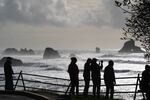
FILE - Crowds gather to watch the king tides at Indian Beach in Ecola State Park, Ore., on Friday, Nov. 7, 2025.
Saskia Hatvany / OPB
A recent study in the scientific journal Nature says many forecasters are underestimating how much sea level will rise due to climate change in the years ahead.
But predictions for the Oregon Coast are much more accurate than in some areas of the globe, according to a researcher in the state.
Peter Ruggiero is a professor at Oregon State University and the director of The Cascadia Coastlines and Peoples Hazards Research Hub, a federally-funded research project.
He says the main lesson of the new research, which he didn’t participate in, is that understanding large-scale sea level change requires accurate data and an understanding of how the ocean works.
“It’s a reminder that when you’re doing these kinds of hazard assessments, there are a lot of things to keep track of,” Ruggiero said.
The Nature paper, written by scientists from Wageningen University & Research in the Netherlands, found that areas in the global south often have less data collection and need better scientific assessments of sea level change.
Related: The sea is higher than we thought and millions more are at risk, study finds
Meanwhile, Oregon — and the U.S. West Coast — have pretty good data sources, thanks to a network of tide gages that give consistent measurements of where the ocean meets the land, Ruggiero said.
That means we generally have a good sense of what sea level rise looks like so far — and what it might look like in the decades ahead
But any sea level forecast is imprecise, and the Cascadia Subduction Zone makes it especially hard to predict how rising seas will affect the Oregon Coast in the short run.
A subduction zone is a large area where two plates of the Earth’s crust collide, with one sliding under the other.
The Cascadia fault line runs roughly parallel to the shoreline underneath the ocean from Northern California up to British Columbia.
As its tectonic plates rub against each other, the Oregon Coast is actually being pushed higher in some places — and that’s sometimes happening faster than melting Arctic ice is causing the ocean to rise, especially in Southern Oregon.
“But that’s not going to happen forever,” Ruggiero said. “Eventually sea level will outpace vertical land rise — but how much or how soon is imprecise.”
Imprecise — in that sea levels might climb by just a foot by the year 2100, or might climb as much as three feet, he said. But anyone born in a coastal community today will see much higher oceans by the time their grandchildren reach old age.
Researchers also know with certainty that, in places where the land is not rising due to plate tectonics, the sea level is already higher now than when Oregon started tracking it.
For example, the South Beach tide gage in Yaquina Bay has seen sea levels rise by several centimeters — roughly an inch or two — since 2001, Ruggiero said.
Related: Double threat of Cascadia earthquake and sea-level rise could change Pacific Northwest coast forever
There is one looming threat that could invalidate all of these forecasts, however: The Big One. Massive Cascadia Subduction Zone earthquakes of magnitude 8 or 9 have shaken the region in centuries past, and another is due — possibly within the next 50 years.
When that happens, the land will drop, tsunamis could erode still more soil, and the impacts will be far more severe than a rising sea from climate change. It will be devastating and catastrophic, Ruggiero said.
But that’s a local geological risk outside the scope of the study published in Nature — and the timing of a future megaquake is impossible to predict.
Meanwhile, if the recent study doesn’t teach us much about the fate of Oregon’s shores, it can still serve as a reminder of what is to come, Ruggeiro said:
Beaches will get smaller. Habitat will erode. And communities along the coast are already exploring how to adapt — with engineering, nature-based solutions, or even an intentional managed retreat.
“There’s a whole bunch of adaptation options we’ve known about for a while, and they are slowly being implemented along the Oregon Coast.”
Correction: An earlier version of this story used an incorrect term for the instruments used to measure coastal sea level. They are called tide gages. OPB regrets the error.