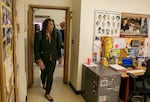
New Portland Public Schools Superintendent Kimberlee Armstrong visits teacher Lionel Clegg's first-grade classroom on the first day of school at Woodlawn Elementary, northeast Portland, Ore., Aug 27, 2024. Armstrong says that, while the district has faced struggles, "when I walk through these doors, I see excitement and passion."
Anna Lueck / OPB
Portland Public Schools Superintendent Kimberlee Armstrong announced this week the district may need to close five to 10 of its 74 elementary, K-8, middle and alternative schools by the fall of 2027. Steadily declining student enrollment and rising costs are tied to the funding crunch, which amounts to $50 million for the next 2026-2027 academic year. And now, the district recently discovered a $10 million dollar budget gap for this year. The district is moving forward with staff cuts and other reductions to shore up the current budget by June 30. We sit down with Armstrong to get more financial details and what she sees as the way forward.
Note: The following transcript was transcribed digitally and validated for accuracy, readability and formatting by an OPB volunteer.
Dave Miller: This is Think Out Loud on OPB. I’m Dave Miller. Portland Public Schools announced this week that the district may need to close five to 10 of its schools by the fall of 2027. That came on the heels of some bad budget news. The district announced at the end of February that it had recently discovered a budget gap for the current year. It says it now has to reduce costs by about $14 million, but even that won’t make a dent in the $50 million budget hole for next year.
Kimberlee Armstrong is a superintendent of Portland Public Schools. She joins us now to talk about these challenges. It’s good to have you back on the show.
Kimberlee Armstrong: Thank you. I’m excited to be here.
Miller: What are the reasons for the shortfall within this school year?
Armstrong: Yeah, we’ve identified about 2.5% of our expenses running higher. So when that was discovered in January, we had to go back and look and say, why are we trending so high? Some of those things were transportation costs. We’ve had some facility emergencies that we’ve had to respond to. And there were also rising costs with … Well, I guess I would say, when you think of our property and our property tax, the decline in that would mean that we would access less of our levy funds. So that has definitely been impactful as well.
Miller: In a statement that the Portland Association Association of Teachers – the teachers union – sent us today, they wrote this: “We urge Doctor Armstrong to be the leader PPS needs. One courageous enough to make systemic changes to the deep-rooted culture of incompetence and administrative overspending that predates her time within PPS. We believed her when she told us during her first year that we should judge leaders on how they deal with quote ‘prolonged incompetence.’ We want to see those words reflected in her actions.”
So let me ask this straight. Given their language, do you see this midyear budget shortfall as the result of incompetence?
Armstrong: Oh, absolutely not. I will say that we have a new administrative team. The previous leadership went over five years without even having a full financial leadership team. So I was excited this year to finally be able to fulfill all those positions that exist within the financial team, if you will. I believe in the people that we have, and I also know that for a district our size, we need to reduce individuals and we’ve taken the actions to do that.
Miller: I want to talk more about that, but are you saying that the budget shortfall that we’re looking at now, that’s a result of the current team, or the decisions made by the earlier, you’re saying maybe not even a fully-staffed team?
Armstrong: Well, I think there’s always always impacts when you have a lot of transition, a lot of turnover, and you struggle to find a CFO. We were excited to find our CFO who is an experienced CFO, one of the most experienced in the state and is a mentor to many across Oregon. So I don’t feel like any of our situation is because of any of our current employees. I wouldn’t say former either, just speaking to the reality of the transition that has happened with the financial leadership team.
Miller: Well, how many of the issues that led to the shortfall could have been foreseen? I mean, I imagine any financial plan, it has to take into account some of these costs may go up, some of them may go down, and you have to have contingencies in mind. I’m still trying to figure out how it is that in the middle of a year, a shortfall this big could develop?
Armstrong: There’s always this prediction that happens when you’re managing a budget, just like our own personal, right? We sometimes have set revenue that comes in and we can count on that, like a paycheck, if you will. But some of the expenditures are sometimes a little different. You might have some fixed costs about how much you’re going to spend on groceries, what that monthly mortgage or rent payment is, but then there are also unforeseen things that happen.
So when I stepped into Portland Public Schools, there was already a plan from the previous budget team to spend down the fund balance, which is like a district savings account, to 5%. Our board’s expectation is that we don’t go below 5% in our savings account – that’s about one month of operating expenses for our district. So imagine coming into a district in an urban area with a tremendous amount of need and not having funds that you can access, unless, of course, it’s, oh, we have some vacancies with teachers and so that created a pool of some money that we can tap into. So that’s been impactful.
Miller: Before we talk about the cuts that you’ve already put forward and the ones that you’re planning, I’m just curious about your overall priorities. What do you see as most necessary when you’re talking about something that has to be cut and what do you think is most expendable?
Armstrong: Well, all that we do across Portland Public Schools is for the benefit of students in their classrooms, whether it’s about the transportation and getting them to where they need to be, making sure that they have nutritious meals, that the support is in place. So it’s really hard to say or think that there’s something that is not as significant as the other.
What I will say, and what I’ve always said, is that we prioritize what happens in the classroom, right? So I want to make sure that our teachers are equipped with all the things that they need … They have the instructional materials, they have the learning, they have the support, they have the mentorship, if they’re new to the profession, to be able to deliver the quality instruction. I think that’s what our families depend on.
Miller: So what are you considering cutting right now for the current year, between now and the end of June?
Armstrong: There’s a few things that we are looking at reducing. So the first is about the spending controls. We have tightened those controls. Think of a budget sweep, if you will, like supply budgets and some reductions around travel. We have teams that would go off for learning; we’ve had to cancel that. We have also gone in and reevaluated our transportation. Our transportation was projected to end the year $5 million more than what we budgeted. So we’re looking at those costs.
Now, what I will say is transportation is reimbursed about 70% from the state if it’s about students traveling on those buses, not the maintenance and upkeep of those vehicles. So those are some of the things that we have looked at and have changed practice on for this year.
Miller: You haven’t mentioned furloughs or fewer days of instruction, but doesn’t that have to be part of the mix?
Armstrong: Yeah, absolutely. As a central office team, we have our senior leaders taking five furlough days. I’m taking six. Even when you think of the senior leaders that we have across the district, including mine, we’re still looking at under $1 million of what those furlough days will bring in, in terms of revenue or cost savings, if you will. We are in conversation with our labor partners and hoping that we can land an agreement where we have all of our labor partners agreeing to furlough days
Miller: Because all that has to be collectively bargained, even if there’s some kind of financial emergency?
Armstrong: Right. It’s a collective bargaining issue. The only one that isn’t is if you’re unrepresented or an administrator.
Miller: In a statement yesterday, the teachers union called for bold moves to significantly reform district administration. For example, they wrote, “There shouldn’t be a director of professional learning, and a director of teacher professional learning, and an assistant director of leadership development, and an assistant director of staff development and pathways all under a senior director of professional leadership and learning.” Do you agree?
Armstrong: Well, I think that we have some pretty significant priorities in what it is that we’re trying to do. We have just recently announced a reorganization for our licensed administrator that reduced 13 positions. And the amount of thought and care we put into prioritizing what is needed to support the learning that’s happening in buildings are what we stand behind. Of those 13 positions, 13 fewer positions will be significant across our organization. Now, I get that folks may have opinions about, hey, why that position and not this? We’re constantly evaluating what we’re able to support and how we support it, and that’s not going to stop.
Miller: Those positions I just mentioned, that’s just sort of one part of a much larger org chart. But the union did make a broader point in their statement yesterday. They said that if you exclude principals and assistant principals, “PPS appears to have double the number of administrators that Beaverton School District has, despite relatively comparable student population numbers.” What’s your response?
Armstrong: Well, first, I will say that Portland Public Schools is an urban school district, the only urban school district in the state of Oregon. And what that means is not that it’s the diversity it talks about. What that means is the things that are unique to an urban city when we talk about homelessness, when we talk about high levels of poverty, when we talk about the access and the impact to drug and alcohol that impact our city are things that …
Miller: Are those really fundamentally different than what Salem schools, Eugene schools or even Beaverton schools deal with? I mean, we’ve had tons of conversations on this show with teachers and administrators, superintendents of all across the state who talk about all those issues.
Armstrong: Yeah, we all have our unique needs. And I will say and stand by that being in an urban school district is different.
Miller: And is the next point you’re making that because of that, it makes sense that you would have a much higher percentage of administrative staff per student than other districts?
Armstrong: Well, I wouldn’t say higher. And we actually went through an audit to look at how we compare to others. We have taken a significant reduction this year because we were trending a little higher. We were maybe less than two percentage points higher than some of our neighbors. We wanted to address that, which we have done this year, and it’s something we’re going to continue to do.
Miller: Is there anything that the district agreed to in the most recent contract with teachers before you got here, but that now seems to you to be unaffordable?
Armstrong: I will say that I definitely believe in a high quality workforce. And one of the things that is unique to Portland, when looking across our state on how we compare to others, is that we have a more experienced team of teachers and we value experience. And, of course, when you have more experience, you have higher salaries, which means that your costs as a district, especially when 90% of your budget is on people, is a bit higher. But that’s an investment that we would make time and time again, right? We know that in order to continue to improve student learning and the work that’s happening in Portland, we want our staff to be well compensated. We want to be competitive with our pay and we want to continue to support our teachers.
Miller: Let’s turn to another huge issue, which is related, but it is separate: school closures. You said earlier this week that the district could close five to 10 schools within the next year-and-a-half, meaning before September of 2027. How will the district decide which schools to close?
Armstrong: Right now we’re leading the board through an exercise of identifying their guiding principles, which are like, what are big deals to you as individuals, and then where do you land as a board, as a collective on those guiding principles? We’re going to take those principles and we’re going to create a framework on the way in which we evaluate schools, which would then allow us to create a list, look at the unique needs of our schools across the city and engage the board in a conversation. Because at the end of the exercise, we need a board vote on the list of schools that I’ll present.
Miller: Can you give us even the basics of how you think this is going to go down, in terms of what kinds of schools are most likely to be targeted for closure?
Armstrong: Well, I can tell you that I think our board will be looking closely at the repairs, the seismic concerns with the building. I think they’re going to also overlay enrollment with that. And then also opportunities for growth will be, I believe, a huge factor. We have affordable housing being constructed in many areas in our city and that has to play a part, right? So how many families might be accessing our schools a year or two from now?
Miller: What kind of pushback are you expecting from families in places where schools will be on the list, on the closure list?
Armstrong: It’s going to be difficult. I think folks who have been in Portland for multiple decades understand that at one point, Portland Public Schools served over 80,000 students. School closures have happened in this city before, and as we continue to decline, we’re going to need to reduce the number of schools. And I think schools and communities, it’s personal. They find their schools as key areas that’s centered in their lives. So it’s going to be hard. It’s going to be a loss.
Miller: Elementary schools, middle schools, K-12, alternative schools, all of those are on the possible list for closure, but not high schools. Does it make sense to you to spend close to half a billion dollars on a refurbishment or a full renovation of a place like Cleveland High School when district-wide enrollment is expected to keep declining?
Armstrong: Yeah, and I think that’s also relative too, right? So we’re building schools not for what is happening in this current moment, but for 100 years from now. And I say that because many of our schools are 100 years old. We have some of the oldest facilities in the United States when it comes to public schools. So we need to build for the future. And while we’re in a decline right now, we also know that there could be some significant world event that could quickly change that. We are confident that all of our high schools will be populated with well over 1,000 students, no matter what that decline happens to be, at least over the next five [to] seven years.
Miller: Now, to be clear, you’ve acknowledged that closing schools does not necessarily save a ton of money because most teachers who would be in a closed school would just move along with students to another school. So what will be accomplished by these likely closures?
Armstrong: They’ll give us the opportunity to consolidate our resources, to make sure that we’re staffing schools based on the needs of not only our students but our staff that we serve. So not only do we serve students but also staff as well, and making sure that they have working conditions that support the learning that needs to happen.
Miller: PPS has long been one of the urban school districts where middle class and wealthier families have chosen to send their children, but in recent years that does appear to have weakened. Part of the enrollment loss is pandemic related, but also some families say that we’ll send our kids to a parochial school or a private school. How do you prevent the school and staffing cuts that are stemming from declining enrollment to not snowball into more declining enrollment?
Armstrong: Yeah, well, I do believe in our individual schools and I know how important our schools are to the community. I know that there are programs, private or charter, out there that can be a draw for some of our families, but I also know in our classrooms, we have amazing teachers. We have leaders who are working hard every day to create the conditions that welcome families in and make sure that they have all the things that they need to thrive.
And we will continue to support. We won’t compromise high quality education. We want the students that leave Portland Public Schools to be as competitive as those who are graduating out of California schools, Washington, New York or wherever else on the map. And we’re confident in being able to deliver that.
Miller: Do the district’s own enrollment projections show increasing numbers of parents opting their kids out?
Armstrong: We haven’t seen that, but we are continuing to review that. And I think as we go through the process of growing our great schools, we will be able to pull data points and share with our board so that they can understand our problem statement and where we’re headed next.
Miller: Kimberlee Armstrong, thanks very much.
Armstrong: Thank you.
Miller: Kimberlee Armstrong is superintendent of Portland Public Schools.
“Think Out Loud®” broadcasts live at noon every day and rebroadcasts at 8 p.m.
If you’d like to comment on any of the topics in this show or suggest a topic of your own, please get in touch with us on Facebook, send an email to thinkoutloud@opb.org, or you can leave a voicemail for us at 503-293-1983.