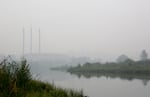
FILE- The Old Mill District in Bend, Ore., seen through wildfire smoke on Sept. 12, 2022. The city of Bend is considering changing its building code to require fire-resistant materials in new homes.
Joni Auden Land / OPB
The city of Bend is considering changing its building code to require fire-resistant roofs, siding and other materials in new homes. As reported in the Bend Bulletin, the proposal comes after a surge of interest in wildfire preparedness assessments after the devastating Los Angeles wildfires in early 2025. The Bend City Council is set to consider the measure at its meeting on April 1.
Melissa Steele is the city’s Deputy Fire Marshal for Wildfire Preparedness. She joins us to talk about how using fire-resistant materials could make Bend more resilient in the face of more frequent and intense wildfires.
Note: The following transcript was transcribed digitally and validated for accuracy, readability and formatting by an OPB volunteer.
Dave Miller: This is Think Out Loud on OPB. I’m Dave Miller. The city of Bend is considering changing its building code to require fire resistant roofs, siding and other materials in new homes. As reported in the Bend Bulletin, the proposal comes after a surge in interest in wildfire preparedness assessments, following the devastating wildfires in Los Angeles last year. The Bend City Council is set to consider this on April 1.
Melissa Steele is the city’s Deputy Fire Marshal for Wildfire Preparedness. She joins us now. It’s great to have you on the show.
Melissa Steele: Thank you so much. I appreciate you reaching out.
Miller: Before we get to the current proposal in Bend, I want to start with what’s at stake here. You lost your own home during the Camp Fire that destroyed Paradise, California in 2018. How does your experience inform the way you think about these policies now?
Steele: So not only having a house that was destroyed but an entire community, seeing that there are no resources for any of the people that lost anything in that fire, kind of puts it in perspective that this is a community approach and that we are all at risk.
There are things that every homeowner, every resident, can do to prevent a catastrophic urban wildfire. It’s important to use what I’ve seen, my 25 years of wildfire, everything that I have compiled for prevention and preparedness more than, “Here’s our community fire engines and we’re gonna respond.” We can totally save more homes and lives with preparedness than we ever can with response.
Miller: I mentioned there was a gigantic increase in interest in readiness assessment requests at the city level. Have you been able to actually meet that demand?
Steele: Yeah, we had to get creative. Just to kind of put it in context, the city of Bend receives about 115 wildfire risk assessment requests annually. And in 2025, starting the day after the firestorm in Southern California, the influx started coming in. I had multiple emails and calls of people saying, “I have some kind of connection to Southern California, my parents live there, I’m from there.” So by about May or June, we had over 1,000 requests.
So we had to get creative, since there’s only one of me and I’m the only one currently doing these assessments. We had to call on our community. Again, I’m going to use that word community. We have several Firewise communities, the NFPA Firewise USA program in Bend. And we called on these, I guess you could call them “spark plugs,” throughout the community to get trained up as an educator and assessor, to go and actually respond to all these requests. And it actually ended up working out so well. We were able to get into communities and have these assessments, because they’re all educational. I have to remind you, they’re not inspections. So we were able to meet all of the demands of those in 2025.
Miller: I should mention if folks want to actually hear what it’s like to have one of these inspections, we went to Jackson County last year. If you search “Think Out Loud Firewise‚” you can actually hear what it’s like when folks go through and look at defensible space, look at siding, look at the intakes for air, to actually hear the questions that homeowners are asked.
I want to turn to the current proposal. What would this code change require builders to do when they’re building new single-family homes?
Steele: So there are two different code proposals right now in our area. The first one is the R327 home hardening code for new construction. What that means is any new construction moving forward would have to be built with these, like you said, ignition resistant materials, have a Class A rated roof, have the eighth inch metal mesh screening on even foundation vents, all of these different things. Currently, there’s nothing. This is a code that’s in the Oregon residential specialty code, and basically this would be all new construction. So that doesn’t apply to existing.
Deschutes County has already adopted this, actually on an emergency order, so any new construction moving forward after April 1 is going to have to comply to that in unincorporated areas. So the city of Bend has said, do we want to look at this code? Do we want to make this something that is specific to our city? And the answer is yes, we absolutely do, and what does that look like moving forward? The biggest question right now is when are we going to have that in effect? So we will be going to city council April 1 and talking about the next steps moving forward. I have had amazing support from city councilors to move this forward. It’s just a matter of when we’ll actually get this adopted into code.
Miller: I’ve seen various descriptions of what this might mean for overall building costs. Do you have a sense for the impact this would have on cost?
Steele: Yeah, I can give you a little bit of that. I would say right now builders are actually very proactive and they are doing a lot. I would say 75% of these materials are already being used. The things that aren’t currently being used or required are, like I mentioned, that eighth inch galvanized metal mesh screening so that embers don’t enter through the home. In the footage we saw from Southern California, you have a stucco home with a metal roof that’s essentially a non-combustible building. However, it’s on fire, and the reason for that is because of those embers entering through vents. So I would say 75% of the builders are already using these supplies and these materials. It would just be a few extra items.
Now, there’s been studies out there that have said this will increase anywhere from 2% to 5% in cost. At least homebuyers can spread that out throughout their entire loan, which is great, so it doesn’t seem like a huge impact to homeowners. And then there’s also been studies in other states that are saying they actually saw a decrease, because builders have gotten kind of creative and decided to use things like recycled metal instead. So we’re kind of just seeing how this is gonna play out as well.
Miller: There’s another piece of the overall cost of home ownership, which is insurance premiums, which have been skyrocketing throughout the West in recent years. Could buildings with more fire-resistant materials lower home insurance premiums, or at least slow down the rate of increase?
Steele: I think that’s the overall idea and objective, but I can’t speak for the insurance companies. What I can say is that we have over 100 different insurance companies in the state of Oregon, so we have so many different parameters that they can set that we’re looking at. For instance, one agency is saying you have to have this metal flashing on your deck or we’re gonna drop you. One is saying you can’t have a tree within 30 feet of a home or we’re going to not renew. That’s very different. There are one or two agencies out there that are giving a discount for being an NFPA Firewise USA recognized community. I would think that with the building materials and the home hardening that that would also play a role, but we have to make sure that insurance agents aren’t going to be so regulated that they don’t pull out of the state of Oregon, because then we’ll be at a worse place than we are now.
Miller: I should note that there was a proposal in the Oregon Legislature this session to require insurance companies to take into account these kinds of home hardening or wildfire prevention technologies. That bill did not advance, but there may be tweaks to it in future sessions.
Now, we’re just talking here about single-family residential homes. What’s happening right now with apartments or commercial buildings?
Steele: So this also applies to townhomes as well. But as you start to get into the development of larger apartment complexes, two, three-story multi-family homes, they are actually already regulated by the Oregon State fire code, meaning that they’ve got internal sprinklers, they’ve got certain types of building materials, they are already set to a different standard. The only buildings in Oregon that are not set to any standard are residential one- and two-family homes, as well as townhomes.
So this is actually a step in the right direction so that we have some type of fire code to keep people safe throughout all types of buildings.
Miller: How do you think about pre-existing homes in the city that were not built with these fire-resistant materials?
Steele: That is such a great question. So that is the second code that is being proposed, a defensible space code. We do not have a defensible space code here in the state overall. There is a model code going to be coming out for local jurisdictions to adopt, which is great, but currently there’s nothing. We know that older construction, older communities, these homes are not built to any such standard as home hardening standards. Also, over time, these older communities acquire things. People have things in their yard, they’re just more flammable, flat out just more flammable. So we have a greater fire risk with these older communities.
That being said, it is important that we have some type of defensible space code that will regulate the combustibility of these homes, because overall we are trying to decrease structure-to-structure ignition. We are not talking wildfire, we are talking urban conflagration, where it’s a structure-to-structure ignition. I like to tell people that I would actually flip this around and not say that we have a wildfire problem, because all of our state and federal resources are doing a fabulous job out in the woods. I am more worried of where people congregate. That’s where the ignitions happen. And so I’m more worried about a fire happening in a building or in the city limits, and then expanding out to the woods, out to the forest.
So, it’s very important that we harden these homes, we have our defensible space code, so that we are basically stopping these large wildfire conflagration, urban conflagrations.
Miller: Melissa Steele, thanks very much.
Steele: Absolutely. Thank you.
Miller: Melissa Steele is the Deputy Fire Marshall for Wildfire Preparedness for the city of Bend.
“Think Out Loud®” broadcasts live at noon every day and rebroadcasts at 8 p.m.
If you’d like to comment on any of the topics in this show or suggest a topic of your own, please get in touch with us on Facebook, send an email to thinkoutloud@opb.org, or you can leave a voicemail for us at 503-293-1983.