

Left, the proposed site for BrightNight’s proposed battery storage facility, is adjacent to Tualatin River National Wildlife Refuge pictured to the right and accross Pacific Highway West on March 14, 2026 in Sherwood, Ore. The proposed power line would run near the stretch of the reserve south of the Highway.
Saskia Hatvany / OPB
A Florida-based developer has proposed a battery storage project southwest of Portland that could boost the electrical grid’s reliability at a time when demand for more renewable energy is climbing.
But local environmental advocates say its location, directly across from the Tualatin River National Wildlife Refuge, could impact wildlife, and they are calling for more transparency and public input.
Renewable energy company BrightNight’s proposed Nottingham Storage Project would build a 200-megawatt battery story facility in unincorporated Washington County.
BrightNight senior vice president of external affairs Scott Bolton said this specific project was identified as a need by Portland General Electric as its customer base continues to grow — and to help PGE meet the state’s carbon emission reduction goals. BrightNight is under a 20-year contract with PGE and will develop, own and operate the facility. In turn PGE customers will benefit from the additional renewable energy stored at the facility.
Bolton said the project will deliver affordable and reliable electricity and improve grid reliability. Battery storage can help electric utilities deliver more power than they generate when there’s a surge in demand — like when more people turn on air conditioning on abnormally hot days. It can also store excess power from wind and solar generation, and then supply that electricity back to the grid when the sun sets or the wind dies down.
BrightNight also has permits to build up to ten 130-foot tall poles to carry high-voltage power and distribute the stored energy. The poles are similar to the wooden or metal poles that distribute electricity to homes, Bolton said. He expects the company will need fewer than five new poles, even though the permit allows more.
“It’s something we’re continuing to look at — how we can reduce the amount of structures — as we get to final design,” he said.

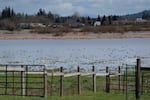
The waters of the Onion Flats area of the Tualatin River National Wildlife Refuge is seen from a dirt road bordering the location of a proposed battery storage facility on March 14, 2026. The driveway leading into the wildlife preserve is where the new powerline would touch refuge land for about 19 feet as it crosses the road and driveway to connect to the Portland General Electric's substation nearby.
Saskia Hatvany / OPB
Those new poles and the site chosen for the battery storage project are causing major concern for local environmental advocates — who disagree with BrightNight officials about some details of the plan.
Glenn Fee, executive director of the Tualatin Riverkeeper, said he is concerned the power lines could run directly across the Onion Flats at the Tualatin River National Wildlife Refuge, a key resting area for thousands of migratory birds and waterfowl.
“It’s one of the best places in all of Oregon, in our region, to see bird species,” he said. “Especially during the migratory bird season, which is right now, there are hundreds of migratory birds, different bird species that come through the refuge.”
But Bolton said the proposed line does not go across the Onion Flats wildlife area, even though it does touch refuge property. For about 19 feet the line might go over a dirt road and a driveway into the refuge, he said.
“The only federal interface whatsoever with this current design is that we would cross the road that leads into the refuge,” he said.
Engaging with the public
Environmental advocates also differ with BrightNight on its approach to public input.
Fee with Tualatin Riverkeeper said the company has not engaged with community members about its plans, and he is not aware of any public meetings about the development.
When asked about its engagement and outreach efforts, BrightNight’s Bolton acknowledged that the company has not held public meetings or forums. But he said it has had one-on-one meetings with local groups, including Friends of the Tualatin River National Wildlife Refuge.

Sandy Boisen, center, and Jack Boisen, right, observe wildlife from an observation deck at the Tualatin River National Wildlife Refuge on March 14, 2026.
Saskia Hatvany / OPB
The company has been working on this project for a few years and has received the necessary permits from the local government to move forward on the project, he said.
“We went through the special use permit process, which is robust. It invites public comment. It has an appeal period to that permit. We went through that permitting and got to a final order in 2025,” he said. “So we’ve kind of played by the rules as far as land use and getting permission to establish this project in this area and have largely not had much opposition.”
Still, environmental advocates say they feel left in the dark about what Fee has called a “very secretive project.”

As they challenge BrightNight to build farther from the refuge, some have also criticized PGE for its relationship to the Florida company.
PGE’s Drew Hanson, however, said the Portland company is not involved in developing the battery project.
BrightNight’s proposed battery project would connect to the electrical grid through the power lines it plans to build, and that would happen at a PGE-owned substation.

A map showing renewable developer BrightNight's 200-megawatt proposed battery storage project. The red line indicates the company's proposed power line, which would connect its battery facility to the Sherwood Substation. Environmental groups say the new power line would be too close to the Tualatin River National Wildlife Refuge.
BrightNight / BrightNight
Separately, PGE is making upgrades to an existing 15-mile transmission line that connects to the substation BrightNight is building power lines to. Those existing PGE power lines already cross part of the Tualatin River Natural Wildlife Refuge.
When asked about PGE’s effects on the environment and wildlife in the area, Hanson said the company monitors the area and “there have been no reported bird collisions with the transmission line along the southern portion of the Refuge over the last several decades.”
BrightNight’s Bolton said his company has also studied potential avian impacts of its planned work, and found minimal impact to wildlife and birds. That research included discussions with other electric infrastructure owners in the area, like PGE.
“Our view is that this isn’t a trade-off between wildlife and green space and critical clean energy infrastructure,” Bolton said. “We believe that both can be compatible and can live side by side.”
A push for a different route
People associated with Tualatin Riverkeeper and Friends of Tualatin River National Wildlife Refuge say they do not oppose renewable energy, which BrightNight’s work would support. What they do oppose is running new power lines so close to federally protected land.
“Our concern are the power lines and the impact that they’re going to have on the wildlife, and our objective is to have an alternative that does not impact the wildlife that we have a mission to protect,” Bonnie Anderson, executive director of Friends of Tualatin River National Wildlife Refuge said. “It’s not about the project itself that we have the objections to.”

Portland General Electric transmission lines run through a field between the Tualatin River National Wildlife Refuge and the PGE substation. The company says there have been no reported bird collisions with the transmission line along the southern portion of the refuge in decades.
Saskia Hatvany / OPB



Anderson said her group found out about the project in September and has been in talks with BrightNight about alternative routes.
For example, she said the company could bury its power lines or move them next to an already existing transmission corridor.
A map provided by BrightNight suggests that moving those lines could be a challenge: It shows the company’s battery project site on the north side of a Home Depot, PGE’s substation on the south side of the hardware store. The proposed power line would go around a field owned by Home Depot on the west side to connect directly to the substation — potentially crossing the wildlife refuge’s driveway along the way.
“We are asking them to do not the easy way, but the right way, and that it could be a combination of a lot of different things,” Anderson said.
More public input
Bolton said BrightNight is ready to listen — and could explore potential modifications to the project.
“I think we do have some misperceptions and miscommunication,” he said.
“The best way to address that is to take it head on and to invite people who have concerns and questions and points of view to directly engage and help us figure out how we can do better,” he said.
Meanwhile, PGE — caught in the crossfire of criticism surrounding BrightNight’s battery project — is holding a public meeting about its own work in the area. It will discuss its Westside Upgrade Project at 6 p.m. Wednesday, March 18, at the Sherwood Middle School.