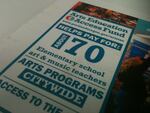
FILE - A Portland Arts Tax reminder flier pictured in a file photo. The tax has long been criticized for its unusual collection system.
Rebecca Roberts Galloway / OPB
Portland isn’t effectively managing its arts tax, according to a report released Wednesday from City Auditor Simone Rede.
“We found the city has not measured quality arts education nor ensured that grants improve access for students and underserved communities, as it promised Arts Tax funds would do,” Rede said in a news release. “These conditions increase the risk that Arts Tax funds are not used as intended.”
The report comes 10 years after a city audit drew the same conclusion and recommended changes. It also drops as Portlanders receive mailed reminders to pay their arts tax — and as city leaders propose changes to the unpopular funding mechanism.
The Arts Education and Access Tax, commonly called the arts tax, is an annual $35 tax on any Portlander who earns over $1,000 yearly. It was passed by voters in 2012 as a way to fund arts education programs by paying the salaries for public school arts teachers and grants to arts nonprofits. The goal was to specifically connect kids and “underserved communities” to arts programming.
According to auditors, that mission has been hard to meet, in part “because the city never identified which communities were underserved with respect to arts access or developed a plan for how grants should improve access.”
The Office of Arts & Culture began working on a plan to define and better provide for underserved communities in 2024. But that work ground to a halt in July 2025, when Mayor Keith Wilson issued an executive order to ensure city grant programs don’t attempt to prioritize recipients based on protected classes like race, nationality or gender. Wilson’s directive was in response to the Trump administration threatening to withhold hundreds of millions of dollars from cities with policies that support diversity, equity and inclusion.
In the absence of these guidelines, the audit found the city gave far more money to arts organizations with larger budgets than those with less financial support. This disparity is central to a recent campaign by Portland arts nonprofits, which say the city’s arts tax dollars haven’t been spent equitably. Last week, a group of 50 arts organizations sent a letter to city leaders demanding they distribute some of the arts tax reserves to nonprofits that’ve seen arts tax funding decline in recent years.
The audit also identifies vague guidelines for how arts tax funds support public schools. The fund is meant to pay for one arts teacher per 500 students in a K-5 public school within Portland city limits. That applies to six school districts. In the 2023-24 school year, the fund paid the salaries of 111 arts teachers across all districts. But the type of arts education each district and school receives varies.
In that 2023-24 school year, some schools had a weekly average of 23 minutes of arts education, while others had more than two hours. Some offered music, dance and visual arts classes, while other schools just offered one option: music.
The report says this wide disparity is the result of the city having no specific goals or metrics for arts education, “such as school level targets for the number of students that arts teachers see a week and instructional minutes.”
Auditors also found a flaw in how the city pays for arts teachers. According to the report, the city determines how much money to give each district based on the average teacher salary across districts. However, this number is different and often higher than the average arts teacher salary.
The overpayments varied, from just over $8,000 districtwide to more than $1.3 million in the 2023-24 school year.
Under city code, arts tax revenues are first dispersed to schools, with the remaining funding distributed in grants to nonprofit organizations.
“As a result,” the audit reads, “there was less money available for grants in the fiscal year we reviewed because the city paid most districts more than the cost of hiring arts teachers.”
According to City Administrator Raymond Lee, these issues will be addressed soon. In a response to the audit, Lee wrote that the city will have updated guidelines on arts education standards for schools in place by the fall. And the Office of Arts & Culture will establish new metrics for how it distributes grants to “underserved communities” by June. Lee said the city’s revenue division will also reevaluate the salary-based funding model for public schools.
A 2015 city audit of the arts tax identified similar problems, noting that the fund isn’t meeting voters’ expectations and lacks oversight. That audit focused closely on the collection issues. Portlanders are required to pay the arts tax independent of their annual tax return process, often resulting in people forgetting they need to pay and missing the deadline. That’s historically led to declining revenues.
In 2015, only 72% of people were paying the tax on time, compared to the Internal Revenue Service yearly average of 85% compliance.
On that metric, the city has improved. According to the city, 82% of Portlanders who owe the tax paid on time in 2024 -- the most recent year with data the city has access to. (The IRS compliance rate remains the same.)
City leaders are currently exploring new ways to address the arts tax. Earlier this month, Council President Jamie Dunphy shared plans to reconfigure the tax to ensure it’s more equitably distributed among arts organizations and doesn’t financially harm low-income taxpayers, along with a proposal to introduce a new fee on streaming services that operate in the city.
In his response to the audit, Lee acknowledged other issues with the tax that need addressing beyond what was identified in the report. That includes the fact that, due to inflation, the $35 yearly tax isn’t able to support as many grants or teachers as it once did.
“While the audit provides recommendations to advance sustainable grantmaking,” Lee wrote, “if the city implements the audit recommendations without addressing the structural flaws of the tax, grantmaking will ultimately not be sustainable.”