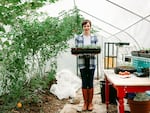
In this undated photo provided by Dusti Arab, she poses for a picture with at her edible-plant nursery and CSA in Vancouver.
Jacquelyn Tierney
Spring has sprung!
And Hearth and Hollow owner Dusti Arab is passionate about helping people grow their own food.
She sells what she cultivates herself in her edible-plant nursery and is also a Community Supported Agriculture (CSA) grower. She says planting and growing food isn’t just for spring — it’s an all season activity.
Her entire operation is run out of her home in Vancouver, Washington, essentially in her backyard. She doesn’t have a brick and mortar retail outlet, focusing instead on selling at the Vancouver Farmer’s Market on Saturdays and growing the edible-plant CSA.
Arab also teaches workshops and maintains a food access resource guide for Clark County.
She joins us to share more about her edible plant work and her hunger relief efforts.
Note: The following transcript was transcribed digitally and validated for accuracy, readability and formatting by an OPB volunteer.
Geoff Norcross: This is Think Out Loud on OPB. I’m
Geoff Norcross. Happy spring. This is a time when many of us venture out into our winter-ravaged outdoor spaces and try to figure out what to do with them. Our guest today wants to make a pitch for making those landscapes edible. Dusti Arab runs Hearth and Hollow. It’s a nursery in Vancouver, Washington that teaches people how to grow food in any kind of dwelling and at any time of year. Dusti Arab now joins us in our Portland studios. Dusti, welcome to Think Out Loud. It’s good to have you.
Dusti Arab: Yeah, thanks for having me.
Norcross: What goes through your mind when you’re in your garden?
Arab: Oh my goodness, usually I’m just so happy to be outside. In my last gig, I was in front of a screen all the time, so being able to just be outdoors and enjoy the Pacific Northwest is about as good as it gets for me.
Norcross: What was your last gig that had you in front of screens all day?
Arab: I was an online marketer.
Norcross: And how does that play into what you’re doing now?
Arab: Well, it’s made sharing it a lot easier.
Norcross: Why did you change?
Arab: The biggest reason, honestly, was the inauguration. When that happened last year, it really hit me like a lightning bolt. I knew that social programs were going to be gutted, and more than anything else, I knew that people were gonna go hungry and that didn’t sit right with me. So I did what anyone with a large backyard, I feel like should be doing, and I stuck up the cheapest greenhouse I could find without asking my husband. And I planted every seed that I had.
Norcross: Can you describe your operation?
Arab: Last year I had just one of those big hoop plastic covered greenhouses, like a 10 by 20 foot unit there, and I got myself a bunch of seed-starting trays like you see in the grocery store, and today I have two of those as well as a big old grow room in my closet inside where seeds are getting started now for the season.
Norcross: What do you grow?
Arab: Only food. We only do edible starts, herbs and companion plants. So marigolds, things like that to keep them off your other plants.
Norcross: How does a marigold act as a companion plant to your food plants?
Arab: Well, it keeps the slugs off your other plants.
Norcross: I see. OK, it’s all about the slugs. You have a CSA. This is a Community Supported Agriculture plan, where people pay a subscription and then get a box. How does that work?
Arab: It’s the same idea. So instead of getting your transplants at the big box stores where they tend to be sick – they come with pests and things like that, you can buy them from somebody like me, local in your community.
And you can either choose your own plants, I have a seed catalog of like 300-some-odd seeds. I’m also happy to get seeds from you, if you have a very particular variety you want grown, and then I have a list of things that I recommend. So right now it’s like early spring options, and then later on we’ll have summer and then into fall as well.
Norcross: Could you be specific? What grows in early spring? What can you look towards in the later spring and early summer?
Arab: Right now I have peas and carrots going in. I have garlic that I put in last fall, so that needs to overwinter, and because we didn’t have a real winter here, nothing in my yard actually froze over so I also have a lot of spinach and celery and things like that overwintering. You can also be doing lettuces right now, that’s a great option.
Norcross: We asked some of our listeners to comment on what they grow in their gardens. On Facebook, Daniel Whitinger said, “We usually grow the same stuff every spring and summer, give a bunch of it away to friends and neighbors and are still left with enough to cut down the grocery bill for a few months.” He lists many fruits, many vegetables, but goes on to say, “But my real passion is our ever-expanding berry patch. We only buy blueberries in the offseason since the eight bushes we have keep us overloaded through the summer. Black and red raspberries, black and red currants, red and blue huckleberries, saskatoons, wild alpine strawberries to round out the mix on our two acres in Sandy.” Just reading that made me hungry.
Arab: Oh, delicious. I’m a huge berry fan myself. I have a massive raspberry patch and I heard that Costco is running a sale on blueberry plants right now so that’s my plan after this.
Norcross: Awesome. What grows really well here? And by here I mean the western part of the state.
Arab: Honestly, everything. We are so lucky to live where we do for so many reasons, but all of those berries, perennials, especially, if you don’t want to have to plant things every single year or you want to do just a little bit more maintenance. I know a lot of friends of mine are very big on set it and forget it, and that can be very much how raspberries, for instance, are. They have a tendency to take over if you’re not careful, but who cares? They’re raspberries, they’re amazing.
Norcross: Of course. What doesn’t grow here, if anything?
Arab: Things that require really hot, dry weather, like peppers can be a little bit more challenging, but I’ve got peppers in my grow room right now and it’s going to be three months before I put them in the ground. You just have to be willing to maintain facilities for them or keep them indoors until it’s time for them to go out.
We’ve actually had our gardening zones change in the last couple of years, so we can grow things here that before you would have had to bring inside, things like specialized Meyer lemon trees, olives, there’s a lot now that you can start to grow here as long as you’re keeping an eye on the weather and we don’t get any real hard freezes. So really, you can grow pretty much anything here as long as you’re willing to pay attention.
Norcross: These are actual zones that the USDA has established that this is a good zone for growing this and this is a good zone for growing that, but you’re saying that we changed recently?
Arab: Yes, just in the last couple of years. We went from being 9A to 8B.
Norcross: What does that tell you?
Arab: It means that things have gotten hotter. So climate change is impacting us, and what we can grow and when is all being impacted by that as well.
Norcross: Same question, what can grow, what can’t, but on the other side of the mountains, Central and Eastern Oregon?
Arab: Central and Eastern Oregon, you can grow a lot of the same stuff. It just requires really mitigating for the fact that it’s so much drier over there. My best friend lives over in Madras and she came last weekend and dug up a bunch of my extra raspberries and took them back home with her, and we’ve had some success with that. But I ignore mine. I don’t water mine, I don’t do anything with them, whereas she’s gonna have to have some lines, even beyond getting them established she’s gonna have to make sure those are well watered this summer.
But because they are drier over there, anything that can adapt to that kind of climate. So, again, peppers are a good option, different varieties of beans. Beans can grow on either side but beans like it a little drier.
Norcross: Christine Amanda Marie just posted, “I eat like a wild rabbit, so I can outlive the haters.”
Arab: You know, I think we all have different goals for growing our own food, and all of them are valid.
Norcross: What is your advice for someone who’s just getting started?
Arab: Start small. I know how wonderful those seed catalogs are, and how you get so excited, but even if you do have a large amount of space, if you’re just getting started make life easy on yourself. Try and grow some easy stuff. Again, I like going back to peas and beans because those ones do direct really well versus using transplants. Transplants are an easier way to get started, but peas and beans don’t like having the roots messed with, so you can just pop those in the ground, have your kids help, whatever, and they tend to be really, really productive.
Norcross: How does this practice alleviate food insecurity for people?
Arab: In so many ways. I feel like right now we have a moral obligation, if we have space, to be growing gardens, to be growing food, any of that. So if, for instance, you are already a gardener and you’re already growing a lot of food and you’re giving it away, you can also donate to most food banks.
So in the summertime when you have the endless zucchini plants and tomatoes and everything else, you can be donating those to the food bank. You can be learning food preservation. So making that surplus in the summer last all the way into next year. Like, I know I’m still eating my cans of tomatoes and making spaghetti sauce out of them because I grew way too many last year. But it’s all the idea of, we have so much abundance here we need to be capturing it at the right time, at the peak – the way you’re supposed to – and saving it for later. It’s a great opportunity.
Norcross: You just reminded me that bags of zucchini are on the way. They’re going to be showing up in our kitchen any day now. I can hear people saying, “This all sounds great, but I live in an apartment. There’s nowhere to grow around here.” What is your answer to that?
Arab: One of the things that I like growing especially are varieties that are meant for apartments. There are lots and lots of people who are in apartments, and I was too, for a really long time. I’ve only been in a house for the past five years. The only growing that I was doing prior to this was all focused on anything I could do in a container or indoors in my window.
So my answer for them typically is, if you really actually have no space, no balcony, no anything, grow microgreens because you actually grow them in the dark. So you can get fresh greens. You could be in the tiniest little apartment with no windows and you could still grow microgreens, and they also have options now where you can have little hydroponic units that are completely self-sustained. I have a couple of them for indoor greens through the winter and everything, but they have lights, they’re on a timer. You don’t have to do anything with them except put the seed in there and keep adding more water. It is wonderful.
Norcross: Nice. We’re asking folks on Facebook how much of their own food they grow, and Adrian Haas says,
“Not enough, but I’m working on learning and to become more educated and prepared to increase production.”
Stacey Humphrey says, “I have a small urban lot in Portland with my kiddo and a person in the ADU in the backyard. Together we raise hens, about 2 ½ dozen eggs per week. We have enough berries to make jam to eat all year, pies and smoothies, grow enough tomatoes to make freezer spaghetti sauce, have a variety of fresh herbs including basil for seasonal pesto, and grow salad greens, green beans, etc. As to why, it feels really good to be connected to where my food comes from. I enjoy transforming berries to jams and the like, and allows me to be more attuned to natural cycles.” I’m sure that’s true for you too, Dusti. Can you talk more about that?
Arab: Absolutely, and I can relate to a lot of that. I do make my own jam. I have a little booth at the farmer’s market where I sell all my plants and everything, and I also do jam because it’s fun for me. I don’t know, it just brings me so much joy, being able to share something that
I’m so passionate about with other people and being able to help educate around this stuff; especially right now, because so much of commercial food production all goes back to oil. Fertilizer costs are going through the roof right now because of everything happening in the world, and I firmly think that that is going to impact food prices further come this fall. So one of the best things that people can be doing is preparing for that now.
Norcross: I get the sense that people are hearing this message more and more, maybe because of the oil issue, maybe because of how agriculture is run in this country, maybe because of the food that they’re eating not really making them healthy. In fact, maybe actively making them sick. Are you feeling that too? More and more people are coming to you with these questions?
Arab: Absolutely. It’s very, very important to me. Everything that I grow is all in… I know it sounds wild to call soil organic, but there is organic soil versus not organic soil. I don’t buy bags of Miracle-Gro or things like that. Everything that I use is OMRI certified, which means that it’s allowed to be used in organic practices.
But all of the farms that I partner with, all of the people who really understand what I’m trying to do, it’s incredibly important to them that their food is clean and I don’t blame them. I don’t want to be feeding my family chemicals. I don’t want to do it.
Norcross: I’ve been thinking about “gardens,” and I’m using this term in air quotes here, “gardens,” because I just got back from the UK, and Brits will talk about their gardens like we talk about our yards. Maybe there’s food out there, but there’s also plants for the pollinators or maybe just things that are pretty to look at.
And I’ve been wondering about this American impulse to look at a landscape and think, “What can that place do for me? What can I pull out of that for me?” And I wonder if you think about that yourself, like “What is this landscape for?”
Arab: I feel like I come at it from both perspectives because if there are no pollinators there’s no food. So in addition to all of the different edible things that I’m planting, I’m also… the Clark County Conservation District just finished up their annual plant sale and you’re able to buy all of these native plants.
So I planted elderberries and serviceberries and all of these other varieties that pollinators just go absolutely nuts for. I’ve got red flowering currants all over my yard and I just saw hummingbirds in there. So I think it’s allowed to be both. Like, I have a section of my yard, if you could see my yard, you would be amazed at how much grows back there because my entire south fence has fir trees on it and big fir trees, like 200 feet tall, aging, they’re very large...
Norcross: And it’s a problem because of the shade?
Arab: Because of the shade, exactly, they shade a big portion of my yard. The majority of my yard is only partial sun so I have to get very creative, but as a result of that there’s a whole corner of my yard that I just let go nuts. It has Oregon grape, it has other native varieties, but it’s for all the raccoons and the possums and the birds that come through my yard.
I get to see all of them. We have a Cooper’s Hawk that comes and nests up in one of our fir trees every single year. And so we get to be a part of that. We’re part of the ecosystem too.
Norcross: What can cities, counties, municipalities, whoever the local government is, what can they do to help?
Arab: Listen to farmers. They can listen to farmers.
Norcross: What is a farmer?
Arab: Oh, that’s such a great question, and it’s something that I wrestle with, because sometimes people will call me a farmer, and I’m like, I’m really not. I have a backyard nursery. I’m not seeing food to completion. I’m helping people get the plant started. So for me, I’m a grower.
I don’t consider myself a farmer, at least not at this point. I think anyone who is actively producing food for more than just themselves on purpose and has a farmer certification is probably a farmer.
Norcross: Excellent. So if people are interested, what kind of resources would you point them toward?
Arab: I actually put together a bunch of things for this in particular. If you go to my website at hearthandhollow.org/opb you’ll be able to find a whole bunch of links there.
In particular, there’s a link there for Flat Tack Farm, that is a local farm that is working on a full-diet CSA that I’m excited to be a part of, and I would recommend going and taking a look at that and seeing how you might change where your food is coming from this year.
Norcross: Dusti Arab, it was great to talk to you. Thank you for coming in.
Arab: Thank you so much.
Norcross: Dusti Arab is a grower who runs Hearth and Hollow, an edible plant nursery in Vancouver.
“Think Out Loud®” broadcasts live at noon every day and rebroadcasts at 8 p.m.
If you’d like to comment on any of the topics in this show or suggest a topic of your own, please get in touch with us on Facebook, send an email to thinkoutloud@opb.org, or you can leave a voicemail for us at 503-293-1983.