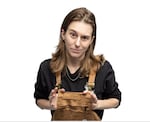
Portland Comic Ash Allen poses for a promotional photo for her first solo storytelling show, "Big Feelings Baby," which opens March 27, 2026.
Courtesy Ash Allen
Portland storyteller and comic Ash Allen is on something of a roll.
She’s won the Moth’s StorySLAM multiple times. Willamette Week recently named her one of its Funniest Five, and in 2025, she was a Best of Portland Comedy finalist.
Allen has headlined festivals including Pickathon, Fire and Story, and Hell Yes Fest.
She says this debut solo storytelling show, “Big Feelings Baby,” is “rooted in queer identity, grief, humor, and the act of reclaiming one’s voice.”
She explores what it means to “grow up different” in the Mississippi woods, “to be asked to quiet that difference, and to eventually choose to live out loud.”
Allen joins us to share more details about her upbringing and her show that premieres this weekend.
Note: The following transcript was transcribed digitally and validated for accuracy, readability and formatting by an OPB volunteer.
Geoff Norcross: It’s Think Out Loud on OPB. I’m Geoff Norcross. Ash Allen is known for telling tall but true tales, and she’s really good at it. Ash is a repeat winner of the Moth’s StorySLAM and this year she was named by Willamette Week as one of Portland’s Funniest Five. She’s performing her first solo show. It’s called “Big Feelings Baby,” and it’s about her wild and feral childhood as a Mississippi tomboy. It premieres this weekend at Framework PDX.
Ash Allen now joins us in our Portland studios. Ash, welcome to Think Out Loud.
Ash Allen: Hi, thank you so much for having me.
Norcross: We’re just a few days out from the show. How are you feeling about it?
Allen: We’re getting down to the point where I have a clock with hours counting down, emotionally. We’re doing great though. It’s my very first show. This is my first big effort to do something like this and I’m going to film it. So there’s a lot of anticipation going into the weekend. I also just want it to be here.
Norcross: So when did you first have the idea of it?
Allen: I have wanted to do and planned to do this show, in some ways, forever. I’ve always wanted to tell these stories. This is a love letter to where I grew up. The place, Mississippi, the people, my mom, dad and my grandma, and my immediate pack growing up. I’ve always wanted to write, or talk, or share. I’ve wanted to do that, but to really know that it’s going to be this form and it’s going to look like this, I would say about a year.
Norcross: What was your upbringing like and why do you think it’s worth telling?
Allen: First, I think everyone’s upbringing is interesting and I want to know about everyone’s, very much so. But mine in particular, I grew up an only child. Just a little tomboy, barefoot, no shirt, looking for a big stick, running around the woods. My first friends were squirrels, deer, all the critters around me. And I felt free. I believe it’s important because as a little gay kid – you know, I’m a lesbian – and being a little queer kid in Mississippi sounds like a bad situation, perhaps.
And of course, Mississippi is very complicated. But in the woods where I grew up, it was heaven to me. It was my whole world. So it’s a story about a place that I love dearly, but also my family. My grandma, who was my only neighbor growing up, just up the road, she was also the first and only gay person that I knew. So I didn’t think that I was different at all. I didn’t think that anything about me was remarkable. I just loved my family. It wasn’t until I left … In my story, I go to camp for the first time out of state and I realized that Mississippi is, in fact, a bit of a pariah. To be from there, people either feel sorry for you or they assume a lot about you.
Norcross: What were you told at camp that made you think that?
Allen: This was an all-girls camp in Virginia. It’s actually the oldest all-girls camp in the country. So a lot of Richmond, Virginia area kids go there. But I was sent there for a month and was told that I said things weird. First off, I had a stutter. I knew I had one, of course, but I didn’t know how noticeable it was until I was around that many other kids my age, that many other girls on the edge of middle school.
So they made fun of how I talked, what I said. Instead of saying family, it was “famly” or “ol” instead of oil. I didn’t know that there was a right or wrong way to say anything. I didn’t know what to do with my hair. I didn’t know that we were putting things in our hair. I was just taking things out of my hair, like sticks and stuff. They were grooming themselves in a way that … I just wasn’t a girl like that. So they were the first time I had a reflection back of myself and the place where I was from. [It was] the first time I also understood class differences, that was the first time.
Then the show is also about the return. What’s it like to return back to a place? Can you return back to a place, with you and the place being different? Then it’s also how to live, how to live big. My grandma, the one that was up the road, she lived her life in all caps. She’s just a big, larger than life personality. She is her own weather system. So I learned from her how to be myself, how to be big. So yeah, it’s about all those things.
Norcross: Had you told parts of those stories in other forums?
Allen: I have. I’ve been working these stories in different pieces. They’ve been told in different ways with different lengths of time over the past four years. I love talking about where I’m from and I love talking about my grandma in particular, Diane Coleman. I call her Mimi. And Mimi is very close to me and I keep her close with my stories.
Yeah, I’ve been working on these pieces and now they’re one thing that on its own. I thought originally I was going to be more of stitching stories together and finding transitions, but this process of creating a show that has 50 minutes, how do we really make this into its own living thing? It’s now its own unique piece that is unlike the other things I’ve done.
Norcross: Nostalgia has a way of making us remember things different than they actually were. I can’t help but wonder if you have really explored what it was really like growing up, and maybe it wasn’t as good as you remember it?
Allen: Oh, absolutely. And that’s the thing. I’m a comedian, but I’m also a storyteller. I believe that a lot of the times, the funniest stuff, the saddest stuff and the realest stuff, it’s all in the same lightning strike. It’s all in the same moment. They are touching, they are not a field, a football field apart. These things all exist in the same breath, in the same space.
So when I was trying to remember, it is tough to really think back. When I was 10 or 11, what was my favorite thing to wear? What was my favorite food, my favorite thing, what music was playing? For me to help go back and try to create a composite of that time, I do an exercise that I actually love doing that I learned from Frayn Masters at BACKFENCE, where I learned how to tell stories. [It] was how to use the five senses and to spend … Like, if you know you’re setting. Like, OK, my childhood bedroom in 1995 and I’m 10, what does that room look like? And then spending just two minutes, put the time on your phone, but write down for all the five senses. Just start with smell, what do you smell? And don’t look back to edit. Don’t change, just pen to paper. What do you smell and then what do you see? And then by the end of that exercise, when you’re done with your 10 minutes of all the five, you look back and then you have remembered things that you would have completely forgotten and, in this sense, reminded you of this. And then now that room that is now alive to you again, other stories come up.
So it’s this unlocking, it’s a reaching. I find that the more I try to knock on the door of a memory, if I stay there and don’t give up on it, if I come back day after day, it’ll then open up for me. So again, with the stuff that’s harder too, I have a lot of love for my little kid self. I think this whole process has given me a lot more compassion for a little kid’s self, making mistakes and doing things that are cringy at the time. And it’s like, oh, she was just a baby. She just was a little …
Norcross: Well, the show is called “Big Feelings Baby.” What does that mean?
Allen: I had a lot of big feelings. I felt like they were big feelings. But with my stutter, with my inability to really express them, plus what it is to be a girl growing up in the South and at camp, seeing how the things I said and did were not quite “up to par,” or were things that could become fodder to be bullied by. I learned – as a lot of girls do in middle school – how to get small. You learn to, “OK, there are some things that I should be ashamed about myself. Here are the things that I need to really tuck away, hide, camouflage,” and pretend to be, start to perform in a way I’ve not been doing.
For me, that’s a part of it, that the “big feelings” is just returning to that original self, going back, just unpacking all those little boxes that I put myself in. And then just realizing that they’re not even big feelings. They’re just feelings, baby. There’s no such thing as a big feeling. They’re just feelings. Just because you’re a girl having them, just because you’re a kid having them doesn’t mean that they’re big.
Norcross: This is the experience of a girl in deep Mississippi in the deep South. Why do you think this story is going to play here [in Portland]?
Allen: I think it’s going to play here because first, even just talking about my story and talking about being a feral tomboy in the woods, I’ve had so many people look at me and be like, “That was me! I was also in my own version of my own woods, my own finding myself at that age.” I think that is such a universal feeling that is outside of a state line, that just exists, no matter where you grow up, or if you grew up in the woods or in your own emotional woods, not literal.
But I also feel that the stories about belonging, having your original pack – I call a pack because there’s a whole wolf pack thing in my story – and then finding your chosen pack, as an adult, finding chosen family, I think all of that is something that Portland, that anyone could really connect to.
Also I think it’s fun to show that gay people are everywhere. We are all over the place. If you think that we’re not in Mississippi, in the woods, you’re incorrect. Because just on the one acre that separated my grandma and I, that’s a really gay acre. [laughter] Like just the percentages, just the survey of the per capita on that property, 50% gay, right there. So I think people think that certain things exist only in certain places and just showing people that we have been out here, we have always been out here. This is not new and we’re also just looking for belonging. We’re looking for our people.
Norcross: I’m listening for an accent and it’s there. It’s very very subtle, but there’s definitely a little bit of a twang. And the reason I glamp onto this is because I grew up in a little town in West Virginia. There was this whole team, led by my mother, whose whole job was to get that out of my mouth. Because they thought that I would be looked down on if I went out into the world and did that mountain talk. I’m wondering if you had to go through the same kind of process, like how much Mississippi is too much Mississippi?
Allen: I also love what you just said about getting it out of my mouth. Like, get that accent out of your mouth. That’s such a great way of saying that.
Norcross: By force, if necessary [laughs].
Allen: Yes I used to say, “oh, I’m glad I don’t really have an accent.” Because then I can tell people I’m from the South, but they don’t judge me immediately when I say Mississippi. But the reason I talk the way I do is not just that I’ve been out here in the Northwest since college – so over 20 years – it’s because when I was little, I had some hearing issues on the left side of my ear. I had 70% hearing loss when I was little, little on my left side. So when I was learning the alphabet, learning sounds, learning how to speak from the grown-ups around me, I wasn’t hearing the letters in the way that would be helpful to say. I couldn’t say “wise” and I couldn’t do “yellow.” I could just do “lellow,” which I think is cuter, to be honest. [laughter] So let’s promote lellow.
So I then got that hearing stuff fixed. I can hear now, but I had to go to speech therapy. My speech therapist was from the Midwest and did not have an accent at all. So she taught me the alphabet all over again. And then I luckily caught a stutter, so I got to stay longer and really hang out with her throughout the years. But I re-learned how to speak from her. My parents have great accents. I wish I had more of one now.
Norcross: Might it come out on stage when you’re talking?
Allen: A little bit. My partner says it comes out when I talk to my parents and if I’ve had some Bud Lights or something. [laughter] That’s where you kind of relax. And I do say, “y’all.” I think y’all is just one of the prettiest words that we’ve come up with. But anyway, that’s what happened to the accent.
Norcross: Were there ever any doubts that this is a story that was worth telling?
Allen: No, no, no. There’s not many things I’m certain of, but that’s not one of them. This is really my story, but it’s also my grandmother’s story from my relationship with her, from my point of view. But the world needs to know about Diane Coleman. She needs to be just known. Everyone who knows her and has known her is better for it. I just want to raise her up and her big stories because she is the big feelings baby in many ways. And she is just a force. I think that we all need some Diane in our lives.
Norcross: Ash Allen, beautiful conversation. I loved it. Thank you so much.
Allen: Thank you for having me.
Norcross: Ash Allen is a comic and storyteller performing in her first solo show this weekend at Framework PDX. It’s called “Big Feelings Baby.”
“Think Out Loud®” broadcasts live at noon every day and rebroadcasts at 8 p.m.
If you’d like to comment on any of the topics in this show or suggest a topic of your own, please get in touch with us on Facebook, send an email to thinkoutloud@opb.org, or you can leave a voicemail for us at 503-293-1983.