
Collector Fred Mitchell, center, and Confederated Tribes of the Umatilla Indian Reservation Board of Trustees Chair Kat Brigham, right, watch a drum circle at a ceremony commemorating the transfer of the Fred L. Mitchell & Family Collection to the Confederated Tribes of the Umatilla Indian Reservation at the Nixyaawii Governance Center in Mission, Ore., March 31, 2026.
Antonio Sierra / OPB
On Tuesday, a small audience assembled for a signing ceremony at the Nixyaawii Governance Center as collector Fred Mitchell officially signed over his collection to the Tamastslikt Cultural Institute. It represents a watershed moment for the Confederated Tribes of the Umatilla Indian Reservation.
The museum has worked to preserve and share the history of the Umatilla, Cayuse and Walla Walla tribes for the better part of 30 years. Their collection will now feature thousands of historic artifacts.
Standing in the heart of the Nixyaawii Governance Center Tuesday, director Bobbie Conner summarized the items that would be returning to the tribes.
As a part of an agreement with the Fred L. Mitchell & Family Collection, Conner said Tamastslikt is acquiring roughly 15,000 “ancient stone and metal items,” more than 1,250 historic photographs and over 800 beaded bags and pouches.
The collection she added also includes 70 pairs of beaded gauntlets, 50 beaded dresses, 15 cradleboards and “many, many, many other items.”
Conner said the tribes began planning Tamastslikt in the 1980s, eventually opening the museum and interpretive center’s doors in 1998. She said it was a marvel that the tribal government was willing to commit millions of dollars to the project at the time.
“Here’s one of the really big reasons it was such a leap of faith: The museum started with zero collection. Zero,” she said, cupping her hand into the shape of a zero. “No lithics, no beadwork, no woven goods, no photos, no archives.”
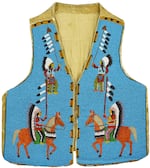
A horse rider vest that is being transferred to the Confederated Tribes of the Umatilla Indian Reservation and the Tamastslikt Cultural Institute.
Courtesy of Tamastslikt Cultural Institute
Conner said the reservation wasn’t always thought of as a landing place for tribal artifacts and artwork. When a private collection of items from Columbia Plateau tribes went up for donation in the early 1990s, they ended up far from its origins to the High Desert Museum in Bend.
When Tamastslikt opened, Conner said the museum relied on loans from a private collection managed by the nearby city of Pendleton.
Losing these artifacts and artworks could be a traumatic experience for tribal families.
Items were lost to fires and floods, or by even more “unceremonial, possibly illegal and unapproved” means, Conner said. Some items were sold by tribal members suffering from addiction or by financially unstable members preyed upon by “unsavory” collectors.
Conner contrasted those collectors with Mitchell, whom she called “a man of integrity.”

Tamastslikt Cultural Institute director Bobbie Conner distributes signing paperwork during a ceremony commemorating the transfer of the Fred L. Mitchell & Family Collection to the Confederated Tribes of the Umatilla Indian Reservation at the Nixyaawii Governance Center in Mission, Ore., March 31, 2026.
Antonio Sierra / OPB
Mitchell was born in 1935 in Walla Walla, Washington, the ancestral home of the tribes of the CTUIR. A firefighter by trade, Mitchell was also civically involved, serving as both a city councilor and a mayor.
Mitchell held a lifelong interest in American Indian artifacts and culture, beginning with an arrowhead collection he started when he was 5 years old. He bought his first item at 19 and began amassing his collection.
Conner said she first visited Mitchell’s house in 2016 to work on a couple of historical projects, and as Tamastslikt got serious about acquiring his collection, a sense of mutual respect grew.
“We are so grateful that every time Fred saw something that was exquisite, that was the finest of its kind, he kept it for us,” she said. “He didn’t know it was coming here then, but he’s been taking care of these goods, many of them, for more than seven decades, and we are so proud of that.”
After Mitchell signed the documents that transferred his collection to the tribes, tribal officials wrapped him in a blanket they gifted him.

A drum circle plays at a ceremony commemorating the transfer of the Fred L. Mitchell & Family Collection to the Confederated Tribes of the Umatilla Indian Reservation at the Nixyaawii Governance Center in Mission, Ore., March 31, 2026.
Antonio Sierra / OPB
Raymond Huesties, the treasurer for the CTUIR Board of Trustees, pointed out to the audience that it was raining the day of the ceremony.
“All of those people that made these things are gone, but the rain’s washing their tracks away because they came home,” he said. “All of these things come home.”
