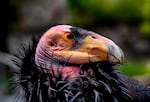
FILE - A California condor named Hope is seen at the Los Angeles Zoo on May 2, 2023. Condors released into the wild are believed to be tending to an egg.
Richard Vogel / AP
California condors, the largest land bird in North America, almost went extinct in the late 1980s. But successful breeding programs such as the one at the Oregon Zoo have helped raise their worldwide population from a low of 22 birds to roughly 600.
Since 2022, the Yurok Tribe has partnered with Redwood National and State Park to release condors bred in captivity into the wild. A pair of those birds is believed to be tending the region’s first egg in more than a century. The nest is too remote for wildlife managers to see the egg itself, but they say the birds’ behavior is consistent with nesting and incubation.
Marti Jenkins is the lead keeper at the Oregon Zoo’s Jonsson Center for Wildlife Conservation, which hosts its condor breeding program. Chris West is the manager of the Northern California Condor Restoration Program and a senior wildlife biologist with the Yurok Tribe Wildlife Department.
They both join us to talk about the significance of returning California condors to the Pacific Northwest.
Note: The following transcript was transcribed digitally and validated for accuracy, readability and formatting by an OPB volunteer.
Dave Miller: This is Think Out Loud on OPB. I’m Dave Miller. California condors, the largest land bird in North America, almost went extinct in the late 1980s. At their low point, there were only 22 birds left in the world, but successful breeding programs like the one at the Oregon Zoo have helped raise those numbers to roughly 600, most of them in the wild. Now there is more good news. It comes from Northern California. Since 2022, the Yurok Tribe has partnered with Redwood National and State Parks to release condors into the wild.
Now, a pair of those birds are believed to be tending the region’s first egg laid in the wild in more than a century. Chris West is the manager of the Northern California Condor Restoration Program and a senior wildlife biologist with the Yurok Tribe Wildlife Department. Marti Jenkins is the lead keeper at the Oregon Zoo’s Jonsson Center for Wildlife Conservation, which hosts its condor breeding program. They both join me now. It’s great to have both of you on the show.
Marti Jenkins: Thank you. Good to be here.
Chris West: Thank you for having us.
Miller: Marti first, can you tell us about the California condor? What should everybody know about these huge birds?
Jenkins: Well, I think the most important thing is that the California condor has been, it’s an iconic Western species, much like sage grouse or bison. It’s been a partner of man on the landscape in North America for many, many hundreds of thousands of years. It’s a really intelligent species. It’s a long-lived species, and it’s incredibly adaptable. At one point, the California condor ranged across the entire continent of North America, but in more recent history, it was on just the western side of the United States, Canada, and Baja Mexico.
It’s like you said, at one point in the 1980s, in 1987, the last wild California condor was captured, and at that point, the condor was extinct in the wild and they only existed in captivity. And since then, with a low of 22 birds in the entire world, the population has been on the increase, and we currently have over 600 birds in the world, with more than 400 of them living in the wild and around 200 of them living in captivity.
Miller: Chris, what drove these birds to the brink of extinction? I mean, essentially extinct in terms of wild populations and almost none in captivity?
West: Well, it’s not known precisely, but there was probably a lot of contributing factors at the time of Euro-American arrival to the west coast of what is North America. There was a lot of urge to kind of establish the human footprint on the landscape, bringing with them a lot of livestock. And with livestock and the need for livestock with the settling of the west, there was also a drive to remove a lot of the large predators from the landscape, so there was active poisoning of predators on the landscape. People were putting out carcasses with strychnine and other toxins to eliminate predators.
So obviously when you’ve got large carcasses on the landscape, you’re not just eliminating the predators, but the whole scavenging community. So that probably took a heavy toll on condors. At the same time, the Euro-American settlers brought with them firearms to hunt the wild animals on the landscape. And those firearms predominantly used lead ammunition as a source of projectiles, lead ammunition performing very well as a projectile, and dumping its energy into whatever you shoot with it through the process of mushrooming and fragmentation. And then the energy translates into a shock wave but that puts the animal down. Those fragments are highly toxic, especially to condors and other avian scavengers. So there was a combination of those impacts. And then right on the heels of that, as people got to know that condors were out here, egg collection and actual collection of animals themselves, shooting up condors for private collections, for museum collections was also quite a pressure on the species.
Miller: Marti, what are the challenges of raising a condor in captivity when the plan the whole time, from hatching on, is that you’re going to release them into the wild?
Jenkins: Yeah, the primary challenge is just making sure that you are raising a healthy bird that is suitable for release into the wild, and that requires a lot of effort on our part to protect the environment they’re being raised in and make sure they’re not exposed to a lot of human activity. They don’t associate humans with anything good or comforting like food, comfort, water…
Miller: Even as humans are providing, creating that environment with the food and the water, making their lives comfortable, but doing it in an invisible way?
Jenkins: Exactly, yeah, it’s a little bit like a magic show, like behind the curtain we’re working, we do as much as we can to protect them from seeing any human activity. So when we feed them, it’s behind a closed door. The food goes in, the door opens. As far as the bird is concerned, the food arrived. It just showed up inside the space.
Miller: And just to be clear, these are scavengers. So the food arriving means a carcass of some dead animal just appears somewhere.
Jenkins: That’s correct. And then we work really hard too to make sure that all of the California condor young that we’re rearing are raised by adult California condors. And that really helps too, that way their first impressions when they’re learning and trying to make sense of their world are related to condors and adult condors feeding them, caring for them, comforting them, and then their only interaction with us, as far as they know, is usually negative. It’s when we intrude in their nest to give a young condor a vaccination or we catch them in a trap area and move them to a different location. It’s all association with humans is negative.
Miller: So that way they will be afraid of you or at least not want anything to do with humans when they’re eventually in the wild.
Jenkins: Exactly, they’re a very curious animal. Being a scavenger, an obligate scavenger, they’re incredibly curious and intelligent. And so like all scavengers, they’re going to look for the easiest, most reliable way to survive and that automatically is going to draw them towards human activity, which is important for them to find food sources, but we want them to be really suspicious and uncomfortable around human activity as much as possible. So when they get released in the wild, they’re going to tend to veer away from any human activity as much as possible.
Miller: How do you know that they’re ready to be released into the wild? What are the graduation requirements?
Jenkins: Well, age, for one thing. We release them at 1 ½ to 2 years old. That way they are a little more mature. They’re really, hopefully, good flyers at that point, and more important than anything, they have to have appropriate behavior for the social structure of a condor flock. Social interaction is so important to condors, almost as important as food and water. Like that social hierarchy that exists in the flock is what helps them to survive in the wild. So they have to have a good understanding of the social hierarchy and how to interact in that so that they can join a flock in the wild successfully.
Miller: Chris, you’re the place where some of these condors are graduating to when they’ve passed all those benchmarks that Marti’s talking about and they’re 1 ½ to 2 years old. How has reintroduction in Northern California been going?
West: I think it’s been going really well. We get these birds from the zoos and Marti and her team and the other teams at the other rearing sites and breeding facilities have done their part. Now we’ve got birds that we’re putting into a field pen that are looking out into the wild for their first time. And so the work that they’ve started, the journey that they’ve started these birds on continues at our site. We’re making sure that the birds aren’t seeing people and all that sort of thing, but now we’ve got wild condors that are flying in the area coming in and visiting them through the mesh of the flight pen. So we try and do as soft a release, as we call it, as possible, which means we can stage birds in side pens by manipulating doors with remote controls, remote pulley systems.
And we can isolate birds from from the rest of the group that seem like they’re ready to go, that seem like they’re really well socialized, and then we just open an outside door and let them kind of walk out and usually we have carcasses on the outside so that they can walk right into a feeding event with the wild birds. And that really kind of softens the release instead of it being kind of a jarring thing where they’re all of a sudden released into the wild by releasing them from a dog kennel or something like [what] used to happen 20 years ago. Now they can just walk right out of the pen into a feeding event, start socializing with the wild flock.
And it’s been going really well. Obviously it’s hard for the first couple of birds out there, but now that we’ve got an established flock, it’s a lot easier for the newly released birds now to walk right into that group, engage with the social structure that Marti was talking about that’s so important to them. And really they can just start to work themselves into the social structure and then they can follow those birds around as they’re, Marti said learning to fly, which in the pen is flapping from perch to perch, but now they’re going to be soaring over tens or hundreds of miles on the thermals, so they’ve got to learn that side of flying also, but they’ve got a group to kind of follow and know where they should be going to roost and how to navigate the landscape to get back to the release pen to get food and that sort of a thing. So now that we’ve got that really established flock, I think we’ve got a really solid base for all the continuing releases.
Miller: So let’s turn to this egg, and Chris, starting with how you and others came to believe that there is an egg, despite the fact that it is way too remote, way too high up to actually see it with human eyes. So what tipped you off that there might be an egg?
West: Well, it all started actually last year. We were watching a couple of the oldest birds that we have at our site. They were leaving the social structure of the flock, which is not super common. Usually the birds all stick together pretty tightly, and they were roosting together as a pair, so that kind of tipped us off that they may be actually looking to pair. It was about the right time of year for establishing nests, so we were watching them pretty closely trying to see if if they would be maybe moving into an incubation pattern where we’d see one bird show up at feeding events but not the other one, and then a few days later the other one would show up but then not the one that had been showing up previously. So we didn’t see that they were showing up together.
And it got really to the point where it was beyond the breeding season, and then we were like, OK, it’s not going to happen this year, but maybe next year. Sure enough, this year, they started going off on their own again, spending time at several different locations which seemed like maybe they were checking out potential nesting spots. We did hike down to one of those areas and we saw a large old growth redwood with a cavity in it, and we saw the birds hanging out in that tree and copulating in the upper branches, so we were pretty sure at that point, OK, something’s happening.
The next indication we got was a mortality signal for the male bird, which was worrisome. So we sent out a crew to try and find him. They couldn’t reach him. He was on the far side of a river and then some of our partners started saying, hey, wait a minute, maybe he’s just not moving and his transmitter is sending out a mortality signal, which they do if they haven’t moved for a long period of time because he’s just sitting so tight on an egg. So that was the first thing that really clued us in.
And that was only the first nest swap, or the first incubation swap, so then we started really paying attention to the GPS locations and what we’re seeing when they go into a cavity, their GPS unit that they have mounted to one of their wings can’t communicate with the satellite anymore, so all of a sudden we’re not getting any data points for locations for the bird. And then when that bird comes out of the nest and the other one, all of a sudden the bird that had been incubating we start getting GPS locations for, through the satellite system, and the other bird goes dark. We can’t get any signals from that bird.
So that’s a really good way to see if there’s incubation switches going on where you’ll get multiple days with one bird where you’re not getting any satellite locations and the other bird is getting good locations and then all of a sudden it switches. So we’ve been seeing that pattern now since about February 4, 5 is when we think that the egg was laid, when the female’s signal first went dark, and then we’ve had regular switching patterns all the way since then.
Miller: So if from February 4 or 5 to now, what is it, April 2, how long is a normal gestation period?
West: That’s probably something better for Marti to answer. I think it’s about 57 days. Marti?
Jenkins: Yeah, that’s right, it’s about 57 days. Some eggs can hatch a day early, some can hatch a day or two late, but on average it’s 57 days.
Miller: So my math, I can’t do it on the fly, but it seems like we’re right around there.
West: Today is the day that we slated as potential hatch day if the egg was laid on the 4th or 5th of February. So we’re right in there. So now we’re going to be looking for a change in behavior hopefully from the parents, where now they’ll be wanting to feed the chick daily. So we’ve actually changed our feeding regime that we’re using at the release site, making sure that there’s always food available, and we’re going to be watching really closely to see how the parents now are coming into the food and going back to the potential nest site to see if it looks like they’ve shifted into a chick feeding behavior pattern. If we don’t, if we continue to see incubation carrying on through the next week or so, then it could be that we did not have a fertile egg, but we won’t know that until we observe the parent’s behavior.
Miller: Marti, let’s hope for the best here, assume the best and say that there is a successful hatching in the coming days. What are the challenges that a young condor would face after that in the coming months or years?
Jenkins: Yeah, well, some things are similar to a captive environment, but some things will be different in the wild. I think the primary concern to start with is that this pair is relatively young and they’re inexperienced. And so that inexperience can sometimes lead to failure, just that they’re not aware of necessarily what their chick needs may be, but hopefully they’ll be successful. We’re hoping for the best, even inexperienced pairs can succeed in their first attempt.
And then the things that in the wild will really be of concern is, are the pair finding enough food to feed the chick? Are they able to keep the chick safe from the elements like cold and wet? Have they picked a good nesting site where they’re able to protect their kiddo, are they able to protect that nest from other predators or scavengers? Are they able to protect it from maybe, is it too close to the ground where land predators like black bear or coyote or mountain lion could access it? Or is it too close to a golden eagle’s nest, or if they can provide the cover and protection that chick needs and they’ve picked a good nesting location, and they are able to find food and keep that kid well fed, then they should be able to be successful.
Miller: Earlier, Chris mentioned lead poisoning from bullet fragments as one of the reasons that condors almost went extinct. Is that still an issue?
Jenkins: Absolutely, it’s still the primary issue. California condors really served as sort of a canary in the coal mine for us, and by investigating the primary reasons for their decline, the scientific community learned, like once again, how easily and unintentionally we can contaminate food sources, not just for wildlife like eagles and hawks and other scavengers, but also for ourselves. Lead is still the mitigating factor as to whether California condors will survive in the wild in North America. If we can’t reduce the amount of lead on the landscape, they’re going to always be at risk.
Miller: Chris, just briefly, even though we could probably spend a long time talking about answers to this question, what will it mean to all of us to have wild condors back on our land?
West: Well, I think it’s really a milestone for humanity if we can start to bring species back that were heading to the brink of extinction because of anthropogenic or human caused factors. And I think that we can really demonstrate that we can live side by side with these animals and that we can respond to their needs as we see the impacts that we are bringing to them and that we can change our behavior so that we can allow these species to persist on the landscape with us, and I think that that’s something that’s really doable. It may take a little bit of effort, but I think that these are the challenges that we will be seeing as we continue. And in our current age of extinction, and we can maybe prevent that age of extinction from occurring, and I think that that’s really a big trial for humanity, but I think we can rise to that challenge.
Miller: Chris and Marti, thanks very much.
Jenkins: Hey, thank you.
West: Yeah, thank you for having us.
Miller: Chris West is a senior wildlife biologist with the Yurok Tribe Wildlife Department, manager of the Northern California Condor Restoration Program. Marti Jenkins oversees the condor breeding program at the Oregon Zoo.
“Think Out Loud®” broadcasts live at noon every day and rebroadcasts at 8 p.m.
If you’d like to comment on any of the topics in this show or suggest a topic of your own, please get in touch with us on Facebook, send an email to thinkoutloud@opb.org, or you can leave a voicemail for us at 503-293-1983.