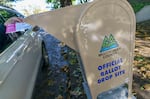
A voter drops a ballot outside of the Multnomah County Elections Division in Portland, Ore., Nov. 8, 2022. Oregon voters can currently vote by mail-in ballot, drop ballots at secure sites, or vote in-person
Kristyna Wentz-Graff / OPB
President Trump signed an executive order Tuesday that instructs the U.S. Postal Service to only send mail-in ballots to people who have been deemed eligible by the administration. Oregon Secretary of State Tobias Read has vowed to challenge the order in court, along with other secretaries of state.
Meanwhile, the Supreme Court appears poised to overturn a Mississippi law that allows mail-in ballots that arrive late to be counted as long as they’re postmarked on or before Election Day. Oregon has had a similar law in place since 2022.
Read joins us to talk about what these changes could mean for Oregon’s vote-by-mail system.
Note: The following transcript was transcribed digitally and validated for accuracy, readability and formatting by an OPB volunteer.
Dave Miller: This is Think Out Loud on OPB. I’m Dave Miller. President Trump signed an executive order on Tuesday that instructs the U.S. Postal Service to only send mail-in ballots to people who’ve been deemed eligible by the administration. Oregon Secretary of State Tobias Read, along with some of his counterparts in other states, have vowed to challenge the order in court. Meanwhile, the U.S. Supreme Court appears poised to overturn a Mississippi law that allows mail-in ballots that are postmarked by election day to be counted, even if they arrive later. Oregon has had a similar law in place for the last four years. Tobias Read joins us now to talk about what all this could mean for Oregon. It’s good to have you back on the show.
Tobias Read: Glad to be here. Thanks, Dave.
Miller: So before we get to the problems you see with the president’s recent executive order, I just want to get some clarity on what it would do. The executive order instructs the Department of Homeland Security, working in conjunction with the Social Security Administration, to “compile and transmit to the chief election official of each state, a list of individuals confirmed to be United States citizens, who will be above the age of 18 at the time of an upcoming federal election and who maintain a residence in the subject state.” Do you have any clarity on how the administration would put together this list of eligible voters?
Read: It’s a great question to start with, Dave, because the answer is no, and it’s just another example of how unserious this whole thing is. It is not only impractical, it is unneeded, it is reckless, it is expensive. And fundamentally, it’s a giant overreach by a president who I think is desperately worried about his unpopularity and the fact that he has to face the accountability in an election. So yeah, we don’t know how this would work and I don’t trust this federal government with that kind of data. That’s one of the ways that we beat the president in court already. We did that twice, when he demanded access to our full voter data. The Constitution’s really clear. It’s states that run elections, not presidents, and that’s just one of the reasons that we are pushing back against an executive order that is just another example of him exceeding his authority.
Miller: I’m glad you brought up this point about trying to get access to every state’s voter rolls, a nearly year-long effort on the part of the administration. Where does that stand right now?
Read: So we went to court when the administration… It’s funny, they started with a sort of a, they said, we want to have a conversation about your voter systems, and we said no thanks. Then they demanded the voter file, which includes, so people are understanding what this means, this is full driver’s license numbers, full dates of birth, partial Social Security numbers, the kinds of things that not only do they not have the authority to do, not only have they demonstrated an inability to protect that kind of data, but I don’t trust them with it.
So we said no to that, and they sued us. We went to federal court, and what I understand is a pretty rare thing, the judge in that case threw the case out, ruled from the bench, which is unusual. The administration’s indicated they’re going to appeal that, but we’re confident in the arguments that we’re making, and we’ll continue to assert the privacy rights of Oregonians.
Miller: I want to get back to this new executive order because I just started with the first part of it. Let’s say that that were to happen and the Department of Homeland Security did create what the administration calls these state citizenship lists. What would you, as a chief election officer for Oregon, what would you and your counterparts around the country then be expected to do with these lists?
Read: Well, I guess they contend that that should be the voter list, the determination of who gets to vote. But the idea that the federal government gets to determine who gets to vote and who doesn’t is contrary to everything we know about how the Constitution works. This is a fundamental constitutionally guaranteed right, and it is states that determine that. Oregon’s system is safe. It is accurate. It is fair. It is based on a system that has people prove their citizenship at the start, and then a ballot goes out. It is individually tracked. There’s a barcode on it. When it comes back, the ballot has to be in an envelope that is signed, and that signature is forensically verified by all the county elections officials across the state. That’s why our system is the gold standard, and it’s another example of why this is unclear, unnecessary, expensive. There’s really nothing positive to say about this effort.
Miller: The context for all of the administration’s actions right now are his contentions that there is widespread voter fraud and that large numbers of non-citizens are voting. Those have both been debunked over and over. But it’s important to note, and we’ve talked about this in the past, that before you became Secretary of State, news broke that about 1,600 non-citizens in Oregon were erroneously added to Oregon voter rolls through a mistake in the sort of backend processes of the Oregon DMV and the motor voter thing. And then over the course of two years, 38 people did vote. So again, to be clear, this is not widespread fraud and this is not a large number of actual votes. But what effect do you think an incident like that has on public confidence?
Read: It’s not good, and that’s why we’ve made a lot of changes into the way that that program is administered. But I think it’s worth noting that the errors that happened there happened when ID was being checked. So this is not an issue that would be solved by the unconstitutional proposal or executive order the president has issued. That was an administration error, that was poor execution, and that’s why we’ve made those sorts of changes. Fundamentally, you’re right, it is a myth. Voter fraud is vanishingly rare. It does not affect the outcome of elections. In Oregon, we did a study of about 61 million ballots over 20 years cast, and found 38 cases of improper voting. That’s 38 too many to be sure, and we’re always looking to raise the floor so that that number gets to zero. but it is not an issue that affects the outcome of elections, and it is not something that justifies this kind of overreach on the part of the federal government.
Miller: All right, I want to turn back to this executive order. So far, what we’ve talked about would apply to every voter in the country, regardless of how they vote. This so-called state citizenship list that you’d have to use to create the registration rolls at the state level. The next parts of the executive order and parts that have gotten a lot of attention have to do with mail-in and absentee ballots. And we should say, obviously this has been the way that Oregonians vote for years now, for decades now, but increasingly it’s the way many Americans vote. I think in the 2024 election, something like a third of Americans voted somehow using mail-in or absentee ballots. So this is, if not the norm across the country, really, really common. If the executive order were to be put in place, what would you have to do in Oregon for us to continue to use mail-in ballots?
Read: It’s all unclear the way this plays out. Again, I think what we have to realize is that vote by mail works in Oregon because it allows people to vote inside their complicated and busy lives. And no, I can’t think of many, if any other places in the economy where we take something that people want to do and try to make it more difficult, less convenient. This is a system that has security in it, that allows the right people to vote in a way that makes sense for them, and that makes us a better state.
And I just do not accept that people are going to be able to impose on us the way we run elections in Oregon. I’m not a lawyer. I don’t think you are either, Dave, but Article 1, Section 4 of the Constitution’s really clear. The time, place, and manner of choosing representatives is determined by the legislatures of the states. It doesn’t say president there, and he can continue to say things like this, but it’s just not true, and we’ve beaten him in court twice on these questions. We will do it again.
Miller: The executive order includes these lines: “To enhance election integrity via United States mail, additional measures are necessary. Secure ballot envelope identifiers provide a reliable, auditable mechanism to enforce federal law without unduly burdening or infringing on the rights of eligible voters.” Do Oregon ballot envelopes already contain unique identifiers?
Read: They absolutely do. The ballot itself carries a barcode. This is important because if someone loses their ballot or they make a mistake and they want to change it, a second ballot can be issued which invalidates the first one based on that barcode. So absolutely that is the case. It’s another example of how this is a clumsy kind of casual sort of effort that’s unserious, entirely. Apparently he doesn’t know and doesn’t care how Oregon runs elections and that’s fine because it’s not his authority to tell us how to do it.
Miller: Although, as I understand it, this executive order does go further than what Oregon’s already doing and it would require that the U.S. Postal Service check the barcodes, if I understand this correctly, against the database of voters in each state, so that the U.S. Postal Service itself would have all the voter information and it would be a new check based on data that it does not currently have access to. Is that how you understand this order?
Read: I don’t fully understand it yet, honestly, Dave, but if the president wanted to help us with voter integrity and election security, he would not be gutting the agency that is in charge of protecting elections against foreign interference and cyber threats. That’s CISA, and it’s largely gone at this point. On top of that, the postal service is now subject to a number of cuts to service and changes in the way they run their operations, which means that if you live in Medford, for example, and you’re trying to send your ballot across Medford to the elections office in Jackson County, it goes all the way to Portland for processing. Maybe there are arguments around the efficiency of the whole system that I’m not qualified to make, but that is not helping when it comes to elections. That’s one of the reasons we continue to tell people, if you can find your way to a county dropbox, that is a better way because you’re not relying on the postal service.
Miller: Have you already filed suit to fight against the executive order?
Read: Our office is in touch with the Oregon Department of Justice. I’ve spoken with the attorney general. We’re going to use every tool we can. I don’t believe we have filed yet, but there are going to be a lot of people across the country who I think are going to file in one forum or another.
Miller: Just briefly, I want to turn to another voting issue that was in the news recently. At oral arguments, a conservative majority on the U.S. Supreme Court did seem ready to tell states that they cannot accept ballots after election day, regardless of when the postmark is. That’s something that Oregon started doing in 2022. Let’s say that the court decision on this comes in the middle of June. Would that be enough time to get the word out for the November election?
Read: Well, we’ll certainly do everything we can, and it’s worth reiterating, we follow the Constitution, we follow the law. I think it’s also worth talking about what this actually means. The ballots that we’re talking about here are ballots that were cast legally. They were cast by voters on time, and the only reason they’re late is because the postal service delivered them late. So I’m of the opinion that valid, eligible votes ought to be counted, and we should be doing everything we can to make that the norm in Oregon.
These are people who deserve to be heard in our elections and I think it will be lamentable if the Supreme Court goes that way. And it’s not an insignificant thing because in 2024, we had about 13,000 ballots across the state that were delivered after election day, but postmarked, so they were counted. With the cuts that we’ve already talked about from the Postal Service, I worry that that number could increase. So again, I hope they go another direction. I hope that people will choose to use ballot drop boxes rather than the post office so we can count as many as possible, but we’ll follow the law.
Miller: Tobias Read, thanks very much.
Read: Thank you.
Miller: Tobias Read is the Secretary of State of Oregon.
“Think Out Loud®” broadcasts live at noon every day and rebroadcasts at 8 p.m.
If you’d like to comment on any of the topics in this show or suggest a topic of your own, please get in touch with us on Facebook, send an email to thinkoutloud@opb.org, or you can leave a voicemail for us at 503-293-1983.