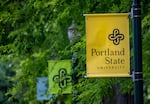
Some Portland State University faculty say they are in limbo as administrators work through a months-long cost-cutting process. The PSU campus in Portland, Ore., on June 29, 2024.
Anna Lueck / OPB
Deb Arthur loves her job as a professor within Portland State’s University Studies department, the unit that houses the institution’s required general education courses and its academic foundation for undergraduates.
“I love the interdisciplinarity of it,” said Arthur, who has worked at PSU for over two decades. “It’s really important for students to be able to think in a variety of different ways about issues.”
The department is also home to innovative programs, like the Higher Education in Prisons program, an initiative created by Arthur that offers degree pathways to people who are incarcerated.
Arthur says she built that program in service of PSU’s mission as an access institution. But now she thinks its value, as well as the value of the entire University Studies department, is being overlooked by administrators. Last month, PSU announced that this department, along with two others, could be eliminated under the university’s ongoing financial sustainability plan.
“We keep being told by administrators that no decisions have been made but the president has talked about University Studies in the past tense,” Arthur said, referring to a recent town hall the school held to answer questions about the restructuring process.
“I literally broke down crying hearing that,” she said.
Faculty with similar stories are expected to share their perspectives with Portland State’s board of trustees Friday.
The reductions of academic programs are a key part of Portland State’s efforts to close a projected $35 million budget deficit by 2028. Administrators say it’s one of the few levers it has to address the shortfall. But some faculty and students say they’re caught in the middle and have no meaningful say in proposed program closures and tuition increases.
Portland State’s financial picture has improved slightly, by about $5 million, since the board last met in January. That’s largely because the Oregon Legislature decided not to make cuts to higher education funding for the next fiscal year.
But even though state cuts aren’t coming, the university’s financial situation is still severe. Transformational change — even though it’s difficult — must happen now, said PSU Vice President of Finance and Administration Andria Johnson.
“It’s a really hard thing to have to look at my colleagues — not just on the academic side — and say, ‘We’re going to have to reduce’,” said Johnson, who is also an alumna of Portland State. “I sat in the classrooms of many of the faculty members that are still here today.”
PSU leaders have said the university’s deficit is structural, driven by years of declining student enrollment, increasing personnel costs and inadequate state support.
Administrators’ path to financial sustainability is largely built on reductions and has several moving parts. Those include an evaluation of PSU’s administrative and academic structures, as well as a process known as retrenchment, which allows the institution to lay off represented full-time faculty.
For some PSU faculty, that path is too narrow.
PSU American Association of University Professors President Bill Knight said the institution’s leaders and board should be focusing on a growing and flourishing university, not on cuts.
“We need to invest in recruitment, in marketing, in the transfer pipeline, in employment relations,” said Knight. “There are so many ways we could invest in growth that would put us on the financially sustainable path that our board wants us to be on.”
The faculty union recently proposed an alternative to the university’s plan. It argues for a temporary one-year pause in cuts, while using reserve funds and moderated administrative spending to close this year’s projected $12 million operating budget shortfall.
The AAUP plan emphasizes legislative advocacy, as well as boosting enrollment at PSU through increased investment in student recruitment and retention efforts. Enrollment has a direct impact on Portland State’s bottom line as tuition dollars account for 51% of the university’s revenues.
The proposal is also backed by national union leaders, including the president of the American Federation of Teachers Randi Weingarten.

Students use the common areas at the Karl Miller Center at Portland State University in Portland, Ore. on Feb. 4, 2026.
Saskia Hatvany / OPB
PSU administrators have enrollment growth targets and legislative priorities included in their plan. But Johnson believes PSU cannot grow itself out of its immediate financial situation without cuts.
The university has continually dipped into its reserves since 2022. She said the institution is already drawing another $12 million in reserves to close this year’s deficit. That’s about $4 million more than the AAUP plan suggested.
“That’s a huge use of reserves just for operating. We cannot continue this trajectory,” said Johnson, noting that this year’s drawdown will put PSU’s reserves below the $86 million minimum set by the board.
“It’s not fair to our students. It’s not fair to our employees. It’s not fair to our community,” Johnson said.
During Thursday’s finance and administration committee meetings, trustees wrestled with how workforce cuts could negatively impact the institution’s mission while also considering the future financial sustainability of the university. The committee also pushed through a 5% student tuition increase that will be considered by the full board Friday.
Esteban Salgado, vice president of the Associated Students of Portland State University, was on a separate committee that initially proposed a higher tuition rate increase of 8%. He said the university’s budget crisis and plan for cuts had a big impact on the proposal.
“The hope was that we could somehow prevent a few extra people from being laid off,” Salgado said, who noted that he personally preferred no tuition increase for next school year.
The tuition hike was reduced due to a board directive and after a campus-wide survey showed most students did not support an increase that high.
But even with the 5% bump, PSU will remain among the more affordable public university options for Oregonians. This school year, Portland State’s resident undergraduate sticker price, $12,315, was significantly less than the University of Oregon and Oregon State, where in-state tuition is $16,754 and $15,252 respectively. PSU tuition is higher than two of the state’s regional universities.
Salgado also said students who are aware of PSU’s financial situation care deeply about what could happen to both the institution and faculty in the next few years.
PSU’s English department could see impacts from cuts. And that’s not sitting well with Salgado.
“I hope to become an English professor one day,” he said. “So it’s a bit weird navigating this and trying to push forward, while also wondering if English departments will exist in eight years.”
PSU President Ann Cudd is set to update the full board on the university’s retrenchment process. A final plan outlining specific faculty and department cuts won’t be released until June.
“The uncertainty inherent in this process makes it very stressful for our campus community to endure,” Cudd said in committee meetings Thursday. “It’s important to me that faculty, staff, students and trustees understand that I’m working hard to create a longer term plan for how PSU will emerge from this difficult process.”