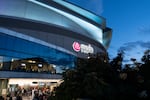
The Moda Center on Oct. 22, 2025 in Portland, Ore.
Saskia Hatvany / OPB
The Portland Clean Energy Fund was passed by voters in 2018. The 1% tax on retail sales of companies that make a billion dollars or more has generated a fund much bigger than expected.
Many non-climate projects have asked for some of this money. Now the mayor and other officials want to spend $75 million in PCEF funds to go toward Portland’s share of the $600 million in total taxpayer money for the Moda center remodel.
We talk with Portland City Councilor Steve Novick, who is opposed to this plan, about how he’d like to see the fund spent, and what he thinks of the city’s current approach to climate change.
Note: The following transcript was transcribed digitally and validated for accuracy, readability and formatting by an OPB volunteer.
Dave Miller: This is Think Out Loud on OPB. I’m Dave Miller. The Portland Clean Energy Fund was passed by voters in 2018. They created a 1% tax on the Portland sales of national retailers that make at least a billion dollars annually. The tax has generated more money than anticipated. And with a budget crunch, that’s led to a lot of interest for non-climate projects, things like homelessness response, police staffing and upgrades to the Moda Center.
Portland City Councilmember Steve Novick is opposed to what he sees as a departure from the program’s goals. He joins us now to talk about this. Welcome back to the show.
Steve Novick: Thank you, Dave.
Miller: So last week, the new Blazers owner Tom Dundon was asked multiple times in multiple interviews about the notion that he might move the team to another city if public money for a renovated stadium didn’t come through. His answers were all variations of, “I never said that,” and, “I’m only focused on the renovation and the lease.” But can you give us a sense for the lobbying effort that the team put forward over the last few months, including for members of city council like you?
Novick: Well, for whatever reason, I haven’t personally been lobbied on this, but it appears that everybody’s been acting on this apparently quite false assumption that there’s a danger the team’s going to pick up and leave at some point in the next six months. Dundon and his partners – particularly Sheel Tyle, who lives in Portland – based on what they said last week, that was never on the table. So people have been running scared for no reason at all.
Miller: Well, that’s one way to read this, that’s if you take all of those comments at face value. But after they’ve gotten much of what they’ve wanted, you’re saying that this was all for nothing? Or that now they’re saying that they have plausible deniability and, “We never specifically said this,” even if lobbyists did say that on their behalf – that that was the possibility.
Novick: I mean, it might be partly that, but I think that there was never a prospect that they were going to pick up and move if 90% or 100% of the costs of the renovation were gonna be borne by public bodies. If you look, they spent $4.2 billion buying the team. The prospect of moving somewhere else is rather dim because for one thing, the league’s about to expand, probably to Seattle and Las Vegas. So that cuts down on the number of places they can move it to, and it’s expensive to move the team. And the NBA certainly isn’t gonna want Portland to disappear when they’re adding Seattle, creating a natural rivalry.
Also if you look at what’s happened in other stadium deals around the country, in most cases there’s significant private investment in renovation projects, including in places where the arenas are publicly owned, like Indianapolis, Atlanta and Washington DC. So I don’t think that this was ever a serious threat. And yes, it’s easier for them to say now that it’s not a threat, now that they’ve gotten all this public money, but I think that people are running scared for not very good reason all along.
Miller: As a result of that lobbying, the state has committed hundreds of millions of public dollars in the form of debt they put out to the Moda Center remodel, but that money is contingent on a couple of things, including money from the city and the county. Where does the Portland part of that financing stand?
Novick: Well, nobody signed off on anything. There’s some money that the city has talked about committing from, for example, the business license tax revenue we will get from the sale of the team, which will be substantial. Also, there’s a proposal to spend some money out of our venues fund, so I think that that and a couple other things adds up to about $75 million.
I’m skeptical of that kind of financing, but not nearly as skeptical as I am of the PCEF financing. As I understand it, the contingency isn’t that the city has to come up with a specific amount, it’s that the city has to come up with a significant binding commitment. And $75 million has to be a significant binding commitment. So I don’t think that the deal all falls apart if we don’t allocate $75 million from the Portland Clean Energy Fund.
Miller: The mayor has argued that using $75 million from the Clean Energy Fund for a Moda Center renovation is a good fit for these funds because refurbishing the arena would have a much lower carbon footprint than building an entirely new one. What do you think of that reasoning?
Novick: I think that’s absurd. Nobody’s talking about building an entire new one. So I literally don’t know what he’s talking about. The argument I’ve heard is that if you refurbish the arena, it’ll be more energy efficient than it is now, which is true. But my understanding is that anybody who is refurbishing the arena would make it more energy efficient just for economic reasons. It’s not like there’s a proposal to build a less energy efficient facility and the PCEF money would make it more energy efficient.
But the primary reason I don’t think it’s a good fit is that the reason for the Clean Energy Fund’s existence is to help us fight climate change and help low-income people and people of color on issues related to climate change. And the position I’ve taken since the thing was on the ballot in 2018 is, the bulk of the money should go to transportation. Transportation is the biggest source of carbon emissions. It’s also a huge expense for low-income people and people of color. So I’ve thought all along that the bulk of the money should go to improving transit and making it easier for people to bike and walk; and in transit deficient areas, helping low-income people make the transition to electric cars.
That’s where the bulk of the money should go. Right now, a small fraction of the money goes to transportation, about 16%. I think that’s already too low and I’m going to oppose any effort to spend an extra $75 million on some non-transportation thing until I’ve fought to get as much for transportation as I can.
Miller: I want to turn soon to the bigger picture you’re getting to here, about your ideas for a better way to allocate this PCEF funding. But just to stick with the Moda Center piece for a second, a group of Blazers super fans have created a website called Rip City, Not Rip Off, where they list some of the potential ways they say the city could extract some concessions from the new ownership group in return for public money.
They include things like private investment in the larger Rose Quarter District; a share of money from naming rights; revenue sharing, perhaps from tickets; a longer lease, a longer promise for the Blazers to stay in Portland, among other things. What do you think about these various ideas?
Norvick: I think they’re all good ideas. I was actually talking to some of the Rip City, Not Rip Off people over the weekend. One thing I’m a little puzzled about is, why do we have to negotiate the naming rights? I mean, we own the facility. Can’t we sell the naming rights to whoever we want? And they didn’t have an answer to that.
But no, I think those are all good things. I have raised the question of whether we can increase the percentage we currently get from ticket sales, and the executive said that that should be on the table. I think all of those are good things. I’ve been focused more on the fight to prevent Clean Energy Fund money from being used on this and I’m just now looking closer at what the Rip City, Not Rip Off people are saying.
But all of those are good things and actually I’m indebted to the Rip City, Not Rip Off people, forgive me, the list of places where there’s been stadium renovations with significant private investment, including in places where the stadium is actually publicly owned.
Miller: So let’s turn to the current allocation of PCEF funds. Can you help us understand how this money has already been allocated for the next five years?
Novick: I talked to one of the past co-chairs of the PCEF Advisory Committee, like a year or two ago, and he said that PCEF has historically been kind of reactive. At first, it was set up as a grantmaking organization, so it was reacting to grant proposals from nonprofits. And then the city realized there’s a lot of money there and they started grabbing money for city bureaus. So it’s been a hodgepodge of things. Then the schools at one point came, and some of the schools said, “Hey, we need better HVAC systems.” So the city said, “OK, we’ll give you some money for that.”
So there is a climate investment plan where the bulk of the money goes to renovating the existing buildings or building more energy-efficient new buildings. And then there’s money for planting trees and money for taking away the responsibility of maintaining street trees from everybody in the city. Then there’s electrifying the city fleet, which does have something to do with climate change, but my question is, if we’re gonna buy electric cars, shouldn’t we buy electric cars for low-income people and thus hit both concerns of PCEF?
I don’t think that there’s ever been a real strategic look at, “OK, we’ve got $900 million, what’s the most effective way to spend that to help low-income people and to fight climate change?” And if we had that strategic approach we would wind up with a lot more than 16% of the money going to transportation.
I would argue that at a minimum we should decide, for the next climate investment plan, we’re gonna spend as large a percentage on transportation as transportation represents of our emissions – which is 40%. And I think that we should probably go above that. One thing to do is to improve transit and talk to TriMet about where we can improve transit in areas that particularly benefit low-income people and people of color who now have to drive. Another is to make it easier for people to bike and walk, and the Portland Climate Action Plan assumes that a huge percentage of trips will be taken by transit, biking and walking – we’ve made very little progress on that.
I mean, as far as electric cars are concerned, right now PCEF is spending a bunch of money, at $50,000 a pop, to refurbish single-family homes to make them more energy efficient. That’s useful and it saves some money for low-income people, but home energy is supposed to get increasingly less carbon emitting because the state has required the utilities to gradually switch over to 100% renewable. Also, transportation is a much bigger expense for low-income people than home energy. So one idea I floated is, hey, if we’re going to offer to spend $50,000 renovating people’s homes to make them more energy efficient, shouldn’t you ask them, “Well, the alternative is, can we just buy you an electric car at a charging station?” That’s the kind of discussion that I think that we should have.
Miller: I should note that we did reach out to the PCEF Committee, made up of Portland residents, and they declined to join us for today’s show or to provide a statement. Another important piece of this – just in the background – is that signature gathering is moving forward now for a potential November ballot measure that would put 25% of Portland’s Clean Energy tax revenue towards hiring police officers. I also mentioned the $75 million that’s being talked about from these funds to go to the Moda Center, $25 million now that could go towards homelessness response.
Given that a lot of this money that we’re talking about has already been allocated for the next five years, whether it’s the $75 million for the Moda Center or the $25 million for a homelessness response, where would that money come from or what would not be funded that has already been promised money?
Novick: That is a damn good question. I wrote a rather irritable email to the administration a few weeks ago. The administration sent out something to counselors saying, “If you have a proposed use for PCEF money, please tell us which of the existing allocations you want to cut.” And I thought that was reasonable, but I wrote back and said, “I assume the executive is following the same rules. What are you planning to cut to come up with the $75 million for the Moda Center?” And they said, “We’re working on that.”
I talked to the mayor the other day and I think that the idea of spending money on the homelessness response, either he was never really behind that or he’s backtracking on it. But yeah, that’s the question that should be asked, and nobody’s answered that on PCEF, yet.
I actually have to give the police union kudos because they’re not talking about just grabbing money from the existing fund to go to police, they’re talking about going to the voters to ask them to actually change the rules. And I’m going to oppose that, but that, I think, has more intellectual honesty than pretending that the Moda Center or homelessness response falls within the existing legal parameters of what PCEF is supposed to be spent on.
Miller: I’m curious about what you just said there earlier, that when in a recent conversation with the mayor, it seems like he maybe he’s backing away from the idea of using PCEF money for homelessness response. A city spokesperson, Cody Bowman, told the Oregonian on Friday that, “The city has identified that certain Portland solutions programs may align with the fund’s climate-related work.” He mentioned green infrastructure maintenance, active transportation, lighting upgrades and severe weather needs. What do you think of that?
Novick: Let’s see, I mean, looking back to the conversation with the mayor, I think that he might have said something about severe weather-related ideas, but I think that what was in the documentation that was produced seemed to go much farther than that. They were paying for a police behavioral health unit activity and just funding shelters themselves. So I think that the mayor is backing away from that sweeping use of the money.
Miller: In the end, allocations or reallocations of PCEF money have to be approved by the city council. You have been very outspoken about this, but where do you think your fellow councilors are?
Novick: Well, that’s hard to say. Because of public meetings law, there’s a limit to the extent that we’re allowed to talk to each other. You can’t talk to six other councilors about anything except in public, so I know where a couple of them are. I think that Councilor [Angelita] Murillo has been pretty strong saying she, at least initially, doesn’t like this idea. I think the same is true of Councilor [Tiffany] Koyama Lane, and beyond that, I actually have a hard time speculating.
I’m hoping that the statements made by the Blazers ownership group will help me in making the case that we should not be scared into spending this money out of the Clean Energy Fund. One thing that has kind of puzzled me is that the … not just the members of the PECF Advisory Committee, but the nonprofits that helped put PCEF on the ballot and have advocated for it haven’t been very noisy in opposing the grab for the Moda Center.
Miller: Why do you think that is?
Novick: I don’t know and I find it a bit frustrating. And I’m hoping that again, to the extent that they were, if they were scared that this is a juggernaut you don’t want to get in the way of, I’m hoping that the statements of the ownership group last week will get people to speak out more.
Miller: Finally, there was a reshuffling of city council committees this year, and the Climate Committee, which you were co-chair of, was eliminated. As I understand, it’s been folded into a different committee. How significant is that in terms of all the issues that we’re talking about?
Novick: Well, I would rather have a PCEF be a highlighted part of a committee that’s more dedicated to climate than any of the ones now. However, climate now falls under the jurisdiction of the City Life Committee, which is chaired by Elana Pirtle-Guiney, and I know that she agrees that we should take a more strategic look at how to spend PCEF funds as we look to the next climate investment plan.
I feel comfortable that we will have a lively discussion, and climate and PCEF won’t just fall off the radar. I actually initiated the discussion about how to spend a $15 million pot of money that had been freed up a couple of months ago and I was arguing that it be spent on transportation projects. The committee had recommended that it go to housing projects and they stressed to the council … stuck with housing.
But in that process, a number of my fellow councilors made it clear that they’re interested in the transportation discussion, they’re interested in the more strategic overall discussion. So I think that the council is going to have substantive conversations about the best strategic use of the Clean Energy Fund no matter what the committee structure is.
Miller: Councilor Novick, thanks very much.
Novick: Thank you.
Miller: Steve Novick is a member of the Portland City Council. He is one of the people who represents District 3.
“Think Out Loud®” broadcasts live at noon every day and rebroadcasts at 8 p.m.
If you’d like to comment on any of the topics in this show or suggest a topic of your own, please get in touch with us on Facebook, send an email to thinkoutloud@opb.org, or you can leave a voicemail for us at 503-293-1983.