Portland’s e-bike population will soon get a boost through a city rebate program aimed at helping people access these motorized electric bikes.
The Portland Clean Energy Fund on Monday is launching its E-Bike Rebate Program. The program aims to help low-income Portlanders purchase either a standard, cargo or adaptive e-bikes by offering rebates to qualified residents.
PCEF, a first-of-its-kind climate justice program, will invest $20 million for the program through June 2029.
The hope is to distribute 6,000 rebates during that timeframe to help people transition out of fossil fuel-powered vehicles, said Seetha Ream-Rao, PCEF’s transportation decarbonization program manager.
Some e-bikes offer up to 60 miles of range on a single battery charge, she said. That should help most people get to where they need to be, and faster than a traditional bike, she said.
“You’re able to have your own form of transportation, so you’re not reliant on a bus or someone else to pick you up, or the carpool,” she said. “You have the freedom to set your own schedule and get to where you need to go.”
Related: Portland looks to increase e-bike access for moderate- to low-income residents
The e-bike rebate program is launching at a time when many people are reeling from record-high gas prices due to the war against Iran. Higher-than-normal gas prices have already prompted some people to look for other options, like electric cars. E-bikes offer a lower cost for electric transportation options.
Portland also has a strong bike culture, Ream-Rao said, with the city’s roads and infrastructure making space for more bikes on the road. That helped PCEF prioritize developing a program that will help more people get into electric bikes but also reduce the city’s transportation sector’s greenhouse gas emissions — another high priority for the climate fund.
According to a 2023 Multnomah County report, the transportation sector accounts for 40% of the county’s greenhouse gas emissions.
If the e-bike rebate program is successful, Ream-Rao said it could help remove up to 17,000 metric tons of carbon dioxide. That’s the equivalent of removing the carbon emissions of nearly 4,000 vehicles driven for one year.
“The goal here is getting folks these bikes so that they can make the transition out of vehicles and get to where they need to be faster,” she said.
People interested in applying can find more information here. To qualify, applicants must live in Portland, be at least 18 years old, and have an income at or below 60% of the average medium income.
Related: Central Oregon makes it easier for e-bikes, even as vouchers uncertain from state
On April 20, the program will also begin accepting applications for adaptive e-bike rebates. These bikes are designed for people with disabilities, special needs or mobility issues. These rebates can go up to $8,500.
Accepted applicants will begin receiving rebates by April 27.
Standard, cargo and adaptive e-bikes
First, however, PCEF will begin accepting applications for standard and cargo e-bike rebates, beginning Monday.
E-bikes start at about $1,200, Ream-Rao said, and can cost thousands more depending on the style of the bike.
Class 1 e-bikes require pedaling to get an electric boost, and are capped at 20 miles per hour. The maximum rebate for these bikes is $1,600.
People can also apply for Class 2 standard and cargo e-bike rebates starting Monday. Cargo e-bikes are designed to carry more weight. The rebate cap for these bikes is $2,350.
The program is also offering up to $300 for accessories like helmets, locks and lights.
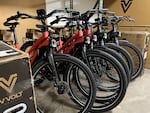
FILE - E-bikes sold by Portland-based Vvolt, as seen in May 2025.
Geoff Norcross / OPB
But before people can hop on and zoom around on a new e-bike, rebate recipients are required to take a safety course and submit the certificate completion, Ream-Rao said.
“Our training talks about how to maintain an e-bike, the battery, how to care for it, how to store it, best practices on how to lock it and safely use it, and as a bike rider, how to safely operate this when you’re biking in the streets when you come up on a pedestrian or a traditional bike, or when you’re e-biking near a car,” she said.
“We’ve got some great unique infrastructure features here in Portland, and so this educates the everyday person on those pieces.”
Qualified retailers
People who are approved for e-bike rebates must shop at qualified participating retailers.
That will ensure the quality of the bike and, if there is an issue with it, it can be brought back and repaired at the same shop, Ream Rao said.
There are 14 retailers throughout the city, and the list is expected to grow.
“The fact that we’re introducing new customers and hopefully helping these shops develop these long-term relationships with new bike riders is going to have a great outcome for the city,” she said.
“I think we’re going to see a lot more bike riders, which is definitely one of PCEF’s goals, and these small businesses are going to be supported.”