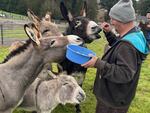
In this March 2025 photo provided Oregon Donkey Sanctuary founder Jim and Rhonda Urquhart, a volunteer feeds some of the donkeys at the sanctuary. The Oregon City nonprofit nurtures abused and donkeys with special needs, providing visitors a tranquil space to spend time with them, with the help of 160 volunteers.
Courtesy Oregon Donkey Sanctuary
When you think of a donkey, you might think of some stubborn, more dangerous version of a horse. But the couple that runs the Oregon Donkey Sanctuary says, if so, you’d be dead wrong. The myths and folklore about these animals is one reason they need special care in the first place. Jim and Rhonda Urquhart formally incorporated their nonprofit five years ago, but the sanctuary has been growing since they took in their first donkey in 2010. They now have 160 volunteers who facilitate visits from the public to spend peaceful time with the donkeys. The Urquharts say educating people about donkeys and creating the space for them to spend time with the animals has become an integral part of their mission. We’ll sit down with the couple to learn more about the Oregon Donkey Sanctuary — and how people respond to these donkeys, which they say are actually more like dogs than horses.
Editor’s note: This post has been updated to reflect that the Oregon Donkey Sanctuary is not the only one in the state. The Littlenuggets Donkey Sanctuary is located in the Columbia Gorge. OPB regrets the error.
Note: The following transcript was transcribed digitally and validated for accuracy, readability and formatting by an OPB volunteer.
Dave Miller: From the Gert Boyle Studio at OPB, this is Think Out Loud. I’m Dave Miller. Jim and Rhonda Urquhart operate Oregon’s one and only donkey sanctuary. It’s on their 40 acres near Oregon City. They took in their first donkey back in 2010. They have about two dozen now, along with a team of about 160 donkey-loving volunteers who facilitate visits so members of the public can spend peaceful time with these often misunderstood animals.
Rhonda and Jim join me now. It’s great to have you both on Think Out Loud.
Jim Urquhart: Thank you, Dave. Appreciate it.
Rhonda Urquhart: Thank you for having us.
Miller: Jim, first – when you both moved to Oregon from Arizona about 20 years ago, did you plan to open a donkey sanctuary?
J. Urquhart: This was not on our bingo card, no. We bought 40 acres in 2006. The property was in pretty bad disrepair. But while we were out working on the property, there used to be a donkey on the adjacent property that we could hear bray, and we thought, “Hey, it’d be a great idea. Let’s get a donkey for our farm.”
Miller: So you knew the sound of a donkey braying. You knew what was happening, what you’re listening to.
J. Urquhart: We did.
Miller: And it did sound like that donkey was in distress?
J. Urquhart: No, it didn’t. It was just, every time we would hear that sound, it was just almost joyful, and it was very unique. We thought, well, let’s look into donkeys and see what we can do. And that actually led us to Peaceful Valley Donkey Rescue. They’re the largest in the country.
They offered us the opportunity to become a foster facility for them – which we did. And that’s how we started in 2010, fostering donkeys for that organization and that’s how we started learning about the amazing donkey.
Miller: Rhonda, what do you remember about the first donkey that you were fostering?
R. Urquhart: Well, the first donkeys that came, I grew up with horses, so I just assumed, mistakenly, that they are much like a horse.
Miller: I would think so too. Sort of floppy-eared horses, but a little bit smaller.
R. Urquhart: Very different. They are small. They do resemble a horse, but emotionally, physically, just so many differences. And that was my mistake, that I just assumed that they were very similar to a horse. And after about 36 hours of being with our first donkeys, I said, “I need to buy a book, phone a friend or watch some videos, because I have no clue.” They’re very different emotionally, physically, the way they approach situations … completely different than a horse.
Miller: Where were these donkeys coming from, that they needed you as a foster family back then? This was what, 16 years ago now.
R. Urquhart: Correct. Our first ones came from Peaceful Valley Donkey Rescue, as Jim said, and they were either surrendered or rescued by that organization; and then they brought trailer loads of donkeys to us at that time. We would then rehabilitate and adopt them out. But as time wore on, we kept keeping the ones that had medical issues or were too emotionally damaged to adopt out, and that’s how eventually we came up with having a sanctuary.
Miller: Jim, how much did you learn about the pasts of these animals when they would get to you back then?
J. Urquhart: A lot of times we would get these donkeys in – a few have been abused or neglected – and a lot of times it takes us a while to learn what their trigger was that caused them to react to certain situations. Often we have these donkeys that, we don’t get a great history on them, and we do our best to … Donkeys can remember people, places and other donkeys for over 20 years, so they can remember bad experiences for a long time. So those are always things we’re looking at to see what we can do to put that donkey in a peaceful situation and start to gain their trust.
Miller: Rhonda, if they can remember bad things or people who mistreated them from the past, can they also remember people who are kind to them?
R. Urquhart: Oh, absolutely. Some that we have taken in, you would think with their past experiences that they would never trust a human again. I think that’s the one thing that’s remarkable is their capacity to forgive and then to move forward. They don’t ever forget because they forget nothing, but they do have an immense capacity to move forward, to forgive and to initiate relationships with new people.
Miller: Was there a point, Jim, when basically, you remember saying, “Alright, we’re gonna go all in on this?” You had been partnering with this other sanctuary as just a foster place to help these donkeys that had troubled pasts come up, get them new homes, but did this go from being a hobby or a pastime to a mission?
J. Urquhart: Well, as we expanded and started doing some social media for Peaceful Valley as a foster facility for them, we started getting contacted by people locally that had donkeys that maybe needed help or knew of a donkey that needed assistance. And it became clear to us that, well, there’s a lot of donkeys in this area that could probably use some help. Why should we continue to bring donkeys from Texas, which is actually an ideal climate for a donkey. Donkeys evolved in the desert, they’re desert animals. So, here it’s a little bit more difficult to maintain them the way they should be.
But, yeah, as it kept going on, we’d have people come out and visit. We’d see some special-needs people occasionally would come out and visit. We’d see these amazing interactions between the donkey and these folks, and it just became clear that, wow, we could really expand this and help not only donkeys but help people as well.
Miller: Rhonda, let’s take a step back. You mentioned that one of the things you learned is that donkeys are not just horse-like, that they’re their own creatures. What do you see as some of the bigger myths or common misconceptions about these animals?
R. Urquhart: I think that the most common misconception is that they’re stubborn, stupid and kicky. Quite to the contrary, they’re very intelligent, they have astonishing memories, as we’ve said. They’re very discerning. They’re very thoughtful. They consider everything in front of them.
A horse has a flight response, so if they’re frightened, they run away. A donkey will stop and assess whether they need to burn the energy, if it’s worth running or if they need to fight. So, horses tend to flight, donkeys tend to fight, and by fight, I mean stand and assess the situation.
You can put a halter on a horse and say, “let’s go,” and typically the horse will follow you. If you are dealing with a donkey that doesn’t know you and you haven’t built a mutual relationship with that donkey, you’re gonna put a halter on them and they’re gonna say, “Where are we going? Who’s gonna be there? Is there gonna be alcohol? Do we have a designated driver? What time are we gonna come home?” And you have to be patient to let them determine that this is safe.
They’re always thinking safety. A lot of times human nature is just not that patient. So that’s where they get their stubborn reputation, because you’ve been outwitted by a donkey, so you’re gonna label them as stubborn.
Miller: Jim, one of the things she mentioned is that they’re known as kicky, that they’ll kick you. How much truth to that is there?
J. Urquhart: Oh, absolutely, they’re very calm. I mean, certainly they can kick and they can certainly defend themselves if necessary. But with no reason to do that, they won’t expend that energy to kick. They’re very calm. Many people, when they come out to visit, they ask us, “Are your donkeys sedated?” I’m like, “No, this is just normal donkey behavior.” They’re very calm and relaxed in the situation. They meet you where you are, in your energy level.
As far as kicking, we’ve never had anybody kicked, never felt concerned about it. Now, if the donkey has their head in a trough and they’re eating, yes, we make a little noise behind them and let them know that it’s us and not another donkey; because if they felt there was another donkey coming in for their food, they might punch out a little bit then, but not at us.
Miller: You mentioned that people come to visit, and you’ve seen some really impressive scenes. So who is coming to spend time at the sanctuary?
J. Urquhart: We’ve had numerous groups. I think it’s just been amazing. We have a lot of retirement homes come out, some special needs groups come out, memory care facilities have brought their clients out. It’s intriguing because initially when these people come out to visit, they’re almost shocked that they get to actually go in with the donkeys. They assume that it’s going to be just viewing a donkey over a fence, and we’re like, “No, you’re gonna physically come in and get hands on a donkey.”
And it’s just amazing to see the smiles, the calmness that comes over these folks that come in there, and actually get to witness this large, 400- or 500-pound animal that’s willing to allow them to hug them and pet them. It really builds confidence in a lot of people.
Years ago, at one of our fundraisers, we had a family visit. And they had a young 7-year-old, nonverbal son that actually spoke his first words to one of our donkeys. It was shocking and amazing, and it changed their life. And that’s just the power of donkeys.
Miller: What did he say?
J. Urquhart: He said, “I love.”
Miller: And that was the first time he’d spoken?
J. Urquhart: According to his parents, yes. I won’t mention his name, but they said, “What do you think?” And he said, “I love,” and they were just blown away.
So yeah, we see a lot of people come out and no one has ever left without a big smile. It’s just something that I think is a tribute to the donkeys. A lot of times they’re considered the invisible equine and they really deserve a debt of gratitude.
Miller: What are they raised for? I mean, they’re coming to you and you’re taking care of them now, but what are people doing with them before they get to you?
R. Urquhart: Well, a lot of them come from the Bureau of Land Management. We’ve had several that have been wild donkeys that have been rounded up and have then been relocated to different satellite facilities.
Miller: In the same way that people might get mustangs from these roundups.
R. Urquhart: From exactly the same program, exactly the same Bureau of Land Management program, BLM. We have had several donkeys come from there, and those are donkeys that had originally … They’re ancestors of donkeys that have been released into the wild when the world became mechanized.
Then, as far as raising donkeys, there are some breeders that do breed donkeys, and sometimes they are overbred and end up in bad situations, so they have come to us. A lot of the donkeys come to us – I know this wasn’t the exact question – because they either outlive their owners. Donkeys are very long lived, they can easily live to be 35 or 40 years old. Our oldest one was 52 when she passed away.
So they come to us for those reasons, but as far as raising donkeys, that’s breeding specific as opposed to people having to surrender their donkeys because of life circumstances or being wild donkeys that were rounded up.
Miller: And at this point, because the word you used before was fostering them, at the beginning, is that over or are you still trying to find forever homes for these two dozen donkeys that are at your sanctuary?
J. Urquhart: No, the donkeys we have now on the sanctuary are there permanently. That’s going to be where they basically die eventually, at the sanctuary. We still network with Peaceful Valley Donkey Rescue, but we no longer foster for them. Like I said, we’ve found that there’s enough donkeys locally that need help, and rather than continue to work with bringing donkeys here, we’re just gonna help.
We network a lot now. A lot of times when people look to surrender a donkey, we also have people looking to adopt. And a lot of times we’ll work as a liaison to try and put those two together to make a good situation, rather than bring more donkeys into our sanctuary. We try and just rehome them outside that.
Miller: Rhonda, earlier Jim said that donkeys came initially from desert habitats, desert landscapes. You’re outside of Oregon City on the west side of the Cascades – not at all a desert, although we got less water this winter than we needed and should have gotten. But nevertheless, it’s not a desert in the Willamette Valley. What does that mean in terms of taking care of these animals?
R. Urquhart: It’s considerably more management because you look at a green pasture and you assume that would be a heaven for a donkey. And it is not because we have to really regulate and monitor their pasture time during the spring and the fall when the grass is high in sugar.
Although we have 40 acres, we also have very large dry lots that are sand that mimic the desert environment, because donkeys have to have a place where they have dry shelter, and you have to keep their hoofs dry or at least they have to dry their hoofs out at least once a day.
So it is a lot more management when you live in a green area with a lot of rain and moisture because that just is not their natural environment. It’s definitely doable.
Miller: And you don’t want them to eat too much tasty green grass?
R. Urquhart: Absolutely not.
Miller: But they want to eat it?
R. Urquhart: Candyland.
Miller: Will they get diabetes or something?
R. Urquhart: They can get multiple health issues. They can get obese very quickly, which can cause a lot of health issues; and they get mainly hoof issues, the sugar and starch will go to their hoofs and create very severe hoof issues.
Miller: One of the things that was really striking, I mentioned there are about two dozen donkeys at your sanctuary now, and something like 160 volunteers who are volunteering their time to take care of these animals and to facilitate visits. Why are there so many people, and there’s even a waiting list for people to be volunteers? How do you explain that?
J. Urquhart: We really don’t. I think part of it is, first of all, there’s a lot of amazing equine and horse rescues in the area. But I think because we’re solely dedicated to donkeys, a lot of people are attracted to that. And a lot of these volunteers initially maybe came to one of our fundraisers and found out about us, and once they started to volunteer, they were just enamored with these creatures.
Miller: Anything they can do to spend more time with these creatures, they will.
J. Urquhart: Absolutely. We’re 100% volunteer operated and these folks come out every day, rain or shine. They clean the barns, they feed the donkeys. They really allow us to manage the rest of the 40 acres we have and also focus on fundraising and other things like that.
Miller: Jim and Rhonda, thanks very much.
R. Urquhart: Thank you.
J. Urquhart: Thank you, Dave.
Miller: Jim and Rhonda Urquhart are the co-founders and co-directors of the Oregon Donkey Sanctuary outside of Oregon City.
“Think Out Loud®” broadcasts live at noon every day and rebroadcasts at 8 p.m.
If you’d like to comment on any of the topics in this show or suggest a topic of your own, please get in touch with us on Facebook, send an email to thinkoutloud@opb.org, or you can leave a voicemail for us at 503-293-1983.