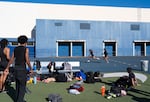
Students attend a track and field meet at Jefferson High School in Portland, Ore., on April 8, 2026. The renovation of the school has been delayed for years, but is set to break ground on May 29.
Saskia Hatvany / OPB
Keevin Collier Jr. almost didn’t go to Jefferson High School.
Despite growing up in a family full of Jefferson graduates, at one point, his grandma threatened to send him to a different high school.
“She said, ‘Keevin, if you don’t get your grades up, you’re going to Roosevelt!’” Collier recalls, laughing, at the thought of going to the North Portland rival. “I said ‘no, no!’”
He got his grades up and graduated from Jefferson in 2015.
Today, Collier works for Bora Architecture & Interiors, one of the design firms tasked with rebuilding Jefferson.
The 117-year-old high school in the heart of Portland’s historic Black neighborhood is next on Portland’s slate of high school modernization projects.
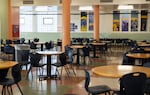
At a recent community information session at Jefferson, Collier and fellow Jefferson grad Naaman Yarbrough stood in the school cafeteria, showing off renderings of the new Jefferson High School.
“It was a safe place for me,” Collier said of his time at Jefferson. “It was also a very freeing place for me. When I came here, I could really be whoever I desired to be. I felt like there were no safeguards around that — people encouraged you to be yourself.”
Yarbrough grew up going to Jefferson basketball games with his dad and riding home with his cousins after his aunt finished teaching the Jefferson Dancers.
He calls going to Jeff his “birthright.”
“When you come into a place and … half of your teammates are the children of people that your parents went to high school with,” Yarbrough explained, “we all kind of feel this connection that we didn’t know that we had before we all ended up in this building. And in that, there’s a lot of support.”
After years of delays, plans are moving forward to modernize Jefferson. At the same time, the district aims to boost Jefferson’s enrollment so it’s similar in size to the city’s other high schools.
Policy changes will end the practice of offering students the option of attending other east-side high schools instead of Jefferson, likely leading to white students making up a higher percentage of the student body.
It’s a make-or-break moment for the city’s historically Black high school, and for Portland Public Schools.
The district is embarking on its most expensive and ambitious reinvention of Jefferson in a generation, and its leaders are feeling pressure and excitement to get this right: to maintain the school’s unique legacy, while building a strong foundation for its future with a larger, more diverse student body.

A student in the hallway at Jefferson High School on April 10, 2026. Jefferson is the seventh high school in line to receive renovations as part of the district's years-long plan to renovate its schools.
Saskia Hatvany / OPB
Collier and Yarbrough have been involved with the Jefferson modernization project for years now.
This semester, they’re sharing modernization plans with a leadership class.
“It’s a little sad that I’m not going to be here for it,” said Ella Henner, a senior and one of the leadership students. “I think a lot of students who are at the school now feel that way, but also it’s something that’s been needed for a long time.”
‘Not the shiny penny’
Rats. Old pipes. Falling ceiling tiles. Jefferson’s been due for an upgrade for years.
“It’s a very fragile school, and it’s one of those things where it’s like anything could break at any moment because of how old it is,” said Zemaj Mitchell-Johnson, a junior at Jefferson.
Modernizing high schools is not new to PPS.
Since 2012, Oregon’s largest school district has gone to voters for bond after multi-hundred-million-dollar bond to rebuild its aging schools. This is the seventh Portland high school getting rebuilt, with projects at Cleveland and Ida B. Wells high schools next on the list.
But the Jefferson project has been marred by delays and concerns about rising costs. Tensions flared among families and community members over plans to move students miles away during construction, forcing the project to slow down and go up in price.
The Jefferson project is also the first modernization under a new superintendent and a new process, following the district’s decision to outsource management of its bond projects to Procedeo, a Texas-based company under a $61.5 million contract.

A rendering of the new Jefferson High School project.
Courtesy of Portland Public Schools / OPB

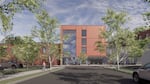


At the December meeting where the school board approved the Procedeo contract, company representatives said five Procedeo staff would “work alongside” the district’s Office of School Modernization.
“Procedeo will be held accountable for schedule, cost, scope, and quality,” Superintendent Kimberlee Armstrong said at the December meeting. “Tonight is not about blame, it’s about responsibility. It’s about restoring trust, and it’s about delivering results.”
But the recent moves have met criticism with headlines questioning changes to the proposed construction timeline and Procedeo’s decision to hire the superintendent’s daughter.
Those critiques exacerbated years of trust issues some people in the community, especially Portland’s Black community, have had with PPS.
Montral Brazile works at Jefferson, graduated from Jefferson, and sent his kids to Jefferson.
He said he’ll believe the project will break ground when he sees it.
“It just needs to be done, no more ifs, ands, buts about it,” Brazile said.
He’s particularly concerned about the school’s technology needs.
“We’re so far behind in this high school, it doesn’t make any sense — and there’s a reason why people are not coming. Kids and parents like the new, shiny penny. Nobody wants the old, dull penny that’s sitting in the box. They’re going to pick the shiny penny. And as of right now, we’re not the shiny penny.”

Substitute Teacher Lawerence Abrams prepares a classroom at Jefferson High School.
Saskia Hatvany / OPB
PPS’s long, complicated history of serving Black students
Over 40 years ago, Ron Herndon stood on a table during a Portland school board meeting to fight against a busing system that pushed Black students to schools across the district in an attempt at desegregation that left the city’s Black students isolated.
Through his work with Black United Front, Herndon has long been an advocate and activist for students in Portland, especially Black students.
“That’s how I got involved over the years of these episodic cases of where the district wants to back away from commitments that they’ve made, and we get involved again and get community support to try to force them to keep the promises that they’ve made,” Herndon said.
Today, Herndon leads Albina Head Start. Like others, he’s heard for years that Jefferson was going to be updated. Over the years, he’s seen threats to close the school and efforts to keep the school from being an “all-Black” school.
“Always it’s on the precipice of closure or some other measure that’s meant to diminish the possibility of it ever being viewed as an excellent academic institution,” Herndon said.

Jordan Polk, head coach at Jefferson High School, directs students during a track and field meet at Jefferson High School on April 8, 2026.
Saskia Hatvany / OPB
A decade and a half ago, when PPS ultimately decided to close Marshall High School, Jefferson was at risk of closure because of its low enrollment.
Not today.
PPS has made efforts to show that Jefferson will not be left behind this time around. In a letter to the Jefferson community posted on Instagram last year, Armstrong said PPS is “committed to doing right by Jefferson.”
“It was not lost on me that trust has been fractured, and that disappointment runs deep. You have been asked to wait. You have been asked to believe in promises not yet delivered. But you continue to show up, speak up, and fight for what’s right for your children and your neighborhood school,” Armstrong said in the message.
Herndon is watching.
So is Bahia Cross, the executive director of Black Parent Initiative, a 20-year-old nonprofit focused on supporting Black parents and children in Portland. Cross considers herself a community advocate. She’s also the board president for the Center for Black Excellence.
“What’s unfair in this process is that when typically you see a modernization project… you have a lot of passionate and vocal parents,” Cross said. “But when those parents are white, they are seen as just being passionately concerned about the welfare of their students and their opportunities. And when you see Black parents equally as concerned or upset, the spin on it is always very negative — like ‘oh, they want everything and they’re just complaining.’"
“It’s important to understand the history of forced displacement in this city, and gentrification, and urban renewal,” Cross said.
Longtime leaders at Self Enhancement Inc., a nonprofit with a longstanding presence at Jefferson, are looking forward to being a part of it.
“I’m not looking for Jefferson to continue to be an African-American dominant school based on what I see, so I don’t really care who else comes,” said Tony Hopson Sr., founder and president of SEI.
“We just want an excellent, comprehensive high school.”
The community surrounding Jefferson doesn’t look like it did 20 or even 10 years ago. And when Jefferson becomes a neighborhood school again, bringing in students from the nearby elementary and middle schools, the student demographics are likely to reflect the gentrification of a historically Black neighborhood.

A student from another school runs in a track and field meet at Jefferson High School.
Saskia Hatvany / OPB
A new school welcoming new students
What sets Jefferson’s modernization apart from other Portland projects is the school’s history as a predominantly Black school in a largely white city.
Jefferson’s demographics have changed over the years, but its location in the Albina neighborhood has been central to Portland’s Black community.
“Jefferson is very much a part of the fabric of the Black community of Portland — almost as important as church,” read a quote from Herndon in a district presentation.
Not only has it been part of the cultural “fabric,” as Herndon put it, but Jefferson has proved successful when it comes to improving academic outcomes for Black students.
The graduation rate for Black students at Jefferson outpaces both the district and state rates. For the Class of 2025, nearly 82% of Black students at Jefferson graduated, compared to 72% of Black students in PPS and 76% of Black students statewide.
But in addition to a new building, Jefferson will also be bringing in a lot of new students.
The plan is to double Jefferson’s enrollment by designating it as a neighborhood school, instead of a campus that students can easily opt away from.
Currently, students who live in the school’s boundary area have a choice to go to Jefferson or another nearby high school: either Grant, McDaniel or Roosevelt, depending on their address.
Starting in 2027, families will no longer have that choice, and a student’s high school will mostly be determined by where they go to elementary or middle school.
Jefferson’s future student body will likely be bigger and ethnically whiter than its current student population. The math of school funding in Oregon suggests that more students should mean a broader array of educational opportunities.
Take psychology, for example, which several PPS high schools offer.
Teacher RaeAnn Thompson said Jefferson students have to go to Portland Community College across the street to take psychology classes as part of Jefferson’s Early College program.
“I am really looking forward to them not having to leave our campus in order to take interesting classes for them,” she said. “You’re going to draw kids here with options… you’re going to make kids happier with options.”

The yoga room at Jefferson High School on April 10, 2026 in Portland, Ore.
Saskia Hatvany / OPB
Among the future Jefferson Democrats, or Demos for short, are Kristin Olson-Huddle’s two third graders. Olson-Huddle is the president of the Boise-Eliot Humboldt PTA.
“Being involved at this school has been one of my greatest joys in this season of my life,” she said.
As her children grow up and move on to middle and high school, she doesn’t want to lose that community. She also doesn’t want to see a high school where racial disparities show up in academics.
“I would like to see, right now, in elementary school and middle school, the support in place for excellence for everyone,” Olson-Huddle said.
Last year, PPS shared data showing white and Asian students taking and passing advanced placement courses at significantly higher rates.
“If we want Jefferson to be a success, I don’t want my kids to go to a high school that looks segregated,” Olson-Huddle said.
This new school building has to do a lot: support an influx of new students while also preserving the school’s history and legacy.
Ella Henner, the Jefferson senior, wants student artwork to have a place in the new school. She doesn’t want the new school to feel like an island.
“Make it seem like it’s a school for the community,” she said. “It’s for the people in this neighborhood because the neighborhood has fought so long for this school, and it’s time they get what they deserve.”
Thompson, the Jefferson teacher, agrees.
She said the school’s look should still retain some of its culture.
“They look like office buildings,” Thompson said of new schools like Lincoln and Grant. “It’s wood and white and glass, and it’s pretty, but I don’t think that our students would feel at home in a place that looked like that.”

Parents watch their kids compete in the track and field meet at Jefferson High School. “The family history goes back so far for us. We bleed blue and gold,” said Shalee Goss (top left), who graduated from the school in 1998.
Saskia Hatvany / OPB
But even as the demographic makeup of the school changes, Bahia Cross, with Black Parent Initiative, said the culture of the school doesn’t have to.
“Erasure is the violence — that’s what everyone’s afraid of,” Cross said. “If they can build a beautiful space that recognizes the beautiful contributions and the people who have made the school what it was, regardless of who’s in the building, I think that should just be there.
“The Black children, even if they are in the minority, are going to be like, ‘this is our space.’ And that’s unusual in education, and I think it’s an opportunity to put your money where your mouth is — if you value this community, then show that in some of the things they create in terms of the structure.”
For their part, Jefferson grads Collier and Yarbrough see themselves as bridges between the community of the past and present, and architects planning the future.
“I don’t see Jeff losing its seasoning,” Yarbrough said. “There are so many generations of people who want to send their kids here.”
What’s next
This isn’t just about Jefferson’s transformation, said Aryn Frazier.
She’s the executive director for the Center for Black Excellence.
She said it’s the first step in rebuilding a community that’s been displaced.
“The context of the neighborhood that surrounds Jefferson is arguably one of the most exciting in the country,” Frazier said. “There is this deep commitment to building all kinds of housing in this neighborhood where Black people were displaced.”
PPS is trying to show its support for Black students across the district through efforts like the Grice-Adair Center for Educational Excellence.

Zamirah Chadwick hugs a peer during the track meet.
Saskia Hatvany / OPB
Last December, over glasses of celebratory apple juice, community members, past and present, gathered inside the future home of the Grice-Adair Center for Educational Excellence.
“The sale is final,” Supt. Armstrong said to cheers.
In the audience was Armstrong’s granddaughter, a student at nearby Martin Luther King Jr. Elementary School.
“She’s in a classroom at King where she is just building her destiny,” Armstrong said before inviting her granddaughter to stand next to her at the podium. “She is from this community that will build her.”
And, Armstrong said she’ll be “from” the new center as well.
Funding for the Grice-Adair Center comes from the 2020 bond.
Like Jefferson, the project’s progress has been delayed, but supporters say it demonstrates the district’s commitment to supporting Black students across the district, not just in one building.
Harriet Adair, a longtime Black educator in Portland and one of the building’s namesakes, began to cry as she walked up to the podium.
The building’s other namesake, Michael “Chappie” Grice, passed away last year.
“I’m the one that should be sitting up there looking at all of you that have made my dream come to life,” she said. “This is where my church was, this is where my heart was, is, and always will be,” she said.
As she sat with other elders of Portland’s Black community, she wished her mother and her husband could be there.
Later in the ceremony, Michelle DePass, the board’s longest-serving member of color, took the microphone.
“For 170 years, PPS’s failing pattern of response to struggles of communities of color, especially Black and Native Americans, stems from institutional and cultural racism that continues to exacerbate the inequities that we see in our society today,” she said.

The entrance of Jefferson High School.
Saskia Hatvany / OPB
Current and former school board members, Portland Association of Teachers leaders, and other community members celebrated the step forward.
But tensions around race are affecting the new efforts in North Portland.
In February, the U.S. Department of Education opened an investigation into the Grice-Adair Center under its previous name, the Center for Black Student Excellence.
And just a few weeks before that joyful celebration at the center, racial tensions shook a Portland school board meeting.
One of the board members told an audience that included many people of color, including some of the same community members who’d been at the Grice-Adair center opening, that they were “not the public”.
Afterwards, the Oregonian reported that the board offered a public apology.
Cross was at that meeting. She said the comment reflected the dismissive “vibe” of the district.
“Black people have to feel valued,” Cross said.
It’s more than a shiny new school, Cross said.
It’s more than offering more classes on the strength of adding mostly white students to the building.
She says the district needs to improve support for Black students through policies, through the teachers the district brings in, and by challenging Black students with rigorous classes.