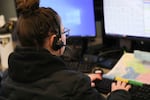
In this undated photo provided by Portland's Bureau of Emergency Communication, a 9-1-1 call dispatcher is pictured at work.
Courtesy City of Portland
Portland’s Bureau of Emergency Communications has drastically improved its 911 call times and medical response.
Just a few years ago, the agency was short staffed and response times were far below national standards. But the efforts the Bureau has made have yielded dramatic results: it recently earned accreditation by the International Academy of Emergency Dispatch, which put it in the top 10% of dispatch agencies in the world.
We talk with Steve Mawdsley, the interim director of the Bureau of Emergency Communications, and call dispatcher Hannah Kimbell to hear about the improvements they’ve made, and what it’s like to be the first call in an emergency.
Note: The following transcript was transcribed digitally and validated for accuracy, readability and formatting by an OPB volunteer.
Dave Miller: This is Think Out Loud on OPB. I’m Dave Miller. In July of 2022, it took an average of 1 minute and 17 seconds for a 911 call to be answered. It’s an unbearably long time for someone who’s in the middle of a life-threatening emergency. But according to the most recent report from Portland’s Bureau of Emergency Communications, wait times have improved dramatically. The average was 15 seconds in February. What’s more, the agency recently earned an elite accreditation that puts it in the top 10% of medical dispatch agencies in the world.
Steve Mawdsley is the interim director of the Bureau. Hannah Kimbell is a 911 dispatcher. They both join us now. It’s great to have you both on the show.
Steve Mawdsley: Thanks for having us. What a great opportunity.
Miller: Steve, first – so, call wait times peaked in the Portland area in July of 2022, as I mentioned, [at] 1 minute and 17 seconds. What were the reasons for that? What was going on in Portland and in the Bureau in July of 2022?
Mawdsley: Yeah, thank you. So that was a really trying time for us. Since then, it’s really been our story of progress. At that time, we faced a sudden increase in 911 call volume. It was our highest 911 call volume ever. At the same time, burnout from that first wave of COVID really impacted our employees. Employees were starting to burn out. We faced record low certified staffing as well. So a really challenging time for all.
Miller: So a ton of demand, in terms of the calls coming in, and a drop in the people who are answering them. What changes did you make since then?
Mawdsley: A great question, thanks for that. It’s been, like I said, our story of progress. Since then, we’ve really embarked on an aggressive campaign of recruiting, hiring, training and certifications to make sure we have a constant stream of folks in our training pipeline. We are able to host academies several times a year to bring new faces, new folks in the door to stay ahead of anticipated attrition.
Miller: Hannah, you’ve been a 911 dispatcher for about five years. You started in 2021?
Hannah Kimbell: Yes.
Miller: Why did you want to do this?
Kimbell: It kind of just came across. I had never thought about it. I was in the service industry, and I saw an ad on Twitter, and I was like, OK, I’m ready for a pivot and fast-paced work helping the community. I’m glad I did it.
Miller: So you’re one of the people who basically answered the call. Steve and others were saying, “We’re in a crisis here. We need people to step up.” And it doesn’t sound like you did this on a lark, but it was a real career shift. You said, “Let me try this.” I’m not sure that anything is quite like being a 911 dispatcher, but had you done anything that prepared you for the training and the job?
Kimbell: No, it was completely different. I guess there’s the multitasking with being a server. But then coming onto this, we start out in a two- to three-month academy. So it’s very classroom-based right away. We’re learning call types, our medical protocol that we just got accredited on, and a lot of geography of the city, which is important for our job. It was definitely a change.
Miller: What do you remember about those really challenging years and that really long call time? You were already on the job by that point, in July of 2022. What was that like?
Kimbell: It was stressful. I mean, we have six screens in front of us, and we can see the call times, like the hold times. So our community’s feeling it. They’re feeling how long it’s taking us to answer the phone. And we’re feeling it too. We see how long these people are waiting and there are real emergencies happening.
Miller: Do you remember the first real call that you took, when it was just you, when you were done with your training, done with a mentor sitting over your shoulder, and it was just you and a call?
Kimbell: To be 100% honest, I don’t remember it. A lot of call taking. We kind of go from one call to the next. So I don’t remember every call I take.
Miller: It’s just relentless. One call after another. How many might you do in the course of a day, let alone a week?
Kimbell: Oh gosh, just call takers … I’m a dispatcher as well, so my day is broken up between dispatching and call taking.
Miller: What’s the difference?
Kimbell: Call taking is just answering the phone, setting calls up. That could be to police, fire, medical calls. And then when you dispatch, you’re either going to be in the fire and medical area or you’re going to be on the police side dispatching, sending officers on calls, making sure that everyone’s accounted for.
Miller: Steve, you mentioned that one of the big reasons that the wait times were so long four years ago, was just that so many calls were coming in. How much control do you have on the response side of the number of calls that are coming in?
Mawdsley: We don’t control when people need 911. Obviously, emergencies aren’t scheduled. So part of our goal [is] to up-staff and ensure that we never go back to where we were in 2021, 2022 with that record low staffing. As call volume changes, we want to make sure that we adjust to the needs, to the demand, of the community. We want to be there when people need 911 and we don’t want them to hesitate to call.
Miller: One of the issues that we’ve talked about in the past was that a lot of calls that were coming to 911, they shouldn’t have been 911 calls to begin with. They were not real emergency calls. To what extent is that still an issue?
Mawdsley: What we’ve seen is, with improved call answer times, with our staff and the heat in the community turned down, with public safety, where people know when they call 911, their call is going to be answered … We’re making improvements in the last couple of years. One of the challenges is when we have those higher call times because of higher hold times for answering on 911, with the increased volume coming in the door, people who are not wanting to wait or think that if they hang up and dial back, they’re going to be moved further in the queue.
So some of those calls on 911 were either repeat 911 calls, and sometimes people with non-emergencies have extended wait times, because we answer 911 calls first. Those are always the priority. But the same call takers and dispatchers also answer non-emergency calls when there are no 911 calls holding.
Miller: But have you seen a decrease in people who are not in emergency situations using 911? I mean, in recent years, has the message gotten out that there are other ways to get help if you’re not in an emergency?
Mawdsley: I think we have. It’s hard to know and really make the most of the data when we look at what changes with the number of calls we receive, either on 911 or the non-emergency line. Because when people don’t call us, it’s hard to know why they’re not calling us. But with the improvements we’ve made in staffing and call answer times over the years, in addition to partnering within the city and county on the 311 program … 311 has been able to be a really big resource for us and takes some of that incoming non-emergency call volume, which really frees up our emergency call takers and dispatchers, to get to those holding 911 calls.
Miller: So Steve, I mentioned that the agency was recently designated as an accredited center of excellence in emergency medical dispatch. What does that mean?
Mawdsley: Boy, this is such a proud moment. I appreciate you mentioning that, Dave. It really means, for us, that it’s the highest standard of emergency dispatching. It’s that highest level of care, from the time someone calls 911 to the time emergency responders arrive on scene for a medical emergency. I’ll tell you, of the 4,000 agencies worldwide that are accredited through the International Academies of Emergency Dispatch [IAED], we’re in the top 10% that reached this accreditation level of performance.
Miller: What did it take to get that level of accreditation? What did you have to prove to this international body that you do regularly?
Mawdsley: Great question. Accreditation can look like many forms for different accreditation companies. For us, the IAED has a numerous checkpoint list. It’s actually 20 points of accreditation that we had to work through. Intense case reviews where call takers would receive one-on-one feedback from our quality assurance professionals that we have in-house. We also contract with the company to provide that level of feedback and really be able to provide them with that knowledge to help improve over time. It’s been a good road. It’s been a long road the last five years, but so proud of our staff for what they’ve achieved.
Miller: Hannah, as Steve was saying, one of the reasons for the long wait times four or five years ago was burnout, significantly tied to COVID. How do you think about burnout now? This is, I think, an inherently stressful job. You’re hearing people who I imagine are often asking for help on what is maybe the worst day of their lives. How do you handle that?
Kimbell: Well, we have each other. We have over 100 people working for us as call takers and dispatchers. So there’s a lot of camaraderie on the floor. If we have a bad call, we all have room awareness. So we’re aware if somebody took something that might be tough on them. It’s just kind of waiting till they’re off the call, checking in with them. But we also have peer support that’ll check in with people as well. We are able to leave if we take a really bad call, after we check in with supervisors. And there’s plenty of services throughout the bureau for us to talk to somebody if we need.
Miller: And does it feel sustainable, emotionally sustainable?
Kimbell: I think so. There’s always the option to take some time off, take vacation, if we need. But you’re used to the work after a while. So you can kind of prepare yourself and there’s outlets if you need it.
Miller: Steve, just yesterday, the mayor released his proposed budget for how to deal with a $172 million shortfall. It’s up to the city council to approve a budget. But the mayor’s plan would get rid of a fire engine, cut the cost, replace other aging fire trucks and reduce some medical response programs. What do you have control over, at the bureau level, in the context of potential cuts? We don’t know what the cuts will be. We don’t know what the administrator will put forward, what the city council itself will approve. But whatever happens, what do you have control over?
Mawdsley: I can’t talk specifics about the proposed reductions. As you mentioned, the mayor sent the communication out yesterday and presented it to the city council today. Really, any reductions to BOEC’s 911 capacity will impact the way that we provide services. So I know city leadership is committed to finding ways for us to continue forward. Whether we take reductions in the end or not, remains to be seen.
Miller: I’m just curious, what’s next for the Bureau? What do you want to see the Bureau get better at as you continue?
Mawdsley: The award a couple of weeks ago of medical dispatch accreditation was a fantastic achievement, five years in the making. Right now, our focus is maintaining that accreditation-level performance. That really adds to the public trust and guarantees transparency in the way that we process calls. So what’s next would be fire call taking and dispatching accreditation, through the same company. Protocol-based guarantees that the third party, who’s looking at the way we do business, can help validate what we know to be true: That our staff really provides that highest level of service for our community.
Miller: Steve and Hannah, thanks very much.
Mawdsley: Thanks for having us.
Miller: Steve Mawdsley is the interim director of the Portland Bureau of Emergency Communications. Hannah Kimbell is a call dispatcher.
“Think Out Loud®” broadcasts live at noon every day and rebroadcasts at 8 p.m.
If you’d like to comment on any of the topics in this show or suggest a topic of your own, please get in touch with us on Facebook, send an email to thinkoutloud@opb.org, or you can leave a voicemail for us at 503-293-1983.