In a win for the Trump administration, a federal appeals court ruled Monday that officers can continue to use crowd control weapons outside the Immigration and Customs Enforcement facility in Portland without restrictions — at least for now.
The decisions mark a setback for protesters, independent journalists and tenants of a nearby apartment complex who sued in separate lawsuits, arguing the use of tear gas and other chemical munitions by Department of Homeland Security officers violated their constitutional rights.
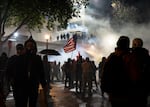
FILE - Hundreds of nonviolent protesters demonstrate as federal immigration officers deploy tear gas, flash-bangs and pepper balls outside the U.S. Immigrations and Customs building in Portland, Ore., Oct. 18, 2025. About 500 people gathered outside the facility to continue protesting following the “No Kings 2.0” rally.
Eli Imadali / OPB
Two federal judges in Oregon overseeing the two cases issued separate, preliminary orders that each limited use of those weapons to instances with specific and imminent threats of physical harm.
The Justice Department appealed both injunctions, arguing the lower courts exceeded their authority and created a dangerous situation that cut off federal officers from crowd control tools they rely on.
The pair of rulings issued Monday by the U.S. Court of Appeals for the 9th Circuit blocks both lower court injunctions, saying those judges “erred in handcuffing the government’s ability to counter” unlawful behavior. They wrote there was a “months-long siege of the ICE facility” and that vandalizing federal property and blocking the entrance to the Portland ICE building “are not protected by the First Amendment.”
Related: Appeals court pauses rulings that limit federal force outside Portland ICE building
In the case brought by tenants of Gray’s Landing apartment complex, which sits across the street from the ICE facility, the judges appear to have tossed out the case altogether. In a 2-1 ruling, Appeals Court Judge Eric Tung found there’s no such right to be free from exposure to tear gas.
“No such right exists in the Constitution,” Tung wrote. “Nothing in our constitutional text or structure evinces such a right.”
A coalition of attorneys representing the apartment building can appeal the decision to toss-out their case but didn’t expressly state as much in a statement Monday evening. Attorneys said they were “disappointed” by the ruling.
In a case brought by protesters and independent journalists, the same three-judge panel also ruled 2-1 that they had not shown federal agents were retaliating or there was an unwritten policy targeting demonstrators.

Federal officers outside the Immigration and Customs Enforcement facility in Portland, Ore., where hundreds of protesters gathered shortly after the conclusion of the third "No Kings" rally, on March 28, 2026.
Mathieu Lewis-Rolland for OPB
The ACLU of Oregon, which led the litigation in the protesters’ case, didn’t immediately return a request for comment.
“Much of the evidence shows the government trying to clear the entrance to the ICE facility in the face of unrest and an unruly crowd,” Appeals Court Judge Kenneth Lee wrote for the majority. “While some individual incidents might indicate an arguably disproportionate use of force, they alone do not amount to an unwritten policy of retaliation.”
In separate dissents, Appeals Court Judge Ana de Alba largely defended the conclusions of both federal judges in Oregon.
Both Tung and Lee were appointed to the 9th Circuit by President Donald Trump, de Alba was appointed by President Joe Biden.
The protesters’ case
In the case brought by five protesters and independent journalists, U.S. District Court Judge Michael Simon found Homeland Security had what amounted to an “unwritten policy” to use excessive force on protesters. In his March 9 order, Simon wrote the officer’s actions chilled the “exercise of constitutional rights to free speech and free press.” While Simon curbed officers’ use of crowd control weapons, his injunction still allowed them when faced with specific and imminent threats of physical harm.
In its ruling Monday, the appeals court found Simon “incorrectly concluded” the protesters were targeted. Appeals Court Judge Lee wrote that Simon didn’t find any direct evidence that Homeland Security officers sought to target protesters’ constitutional rights.
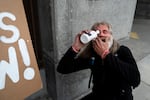
Steve Walker, a retired combat medic, rinses his eyes out after being tear gassed by federal agents outside the U.S. Immigrations and Customs building in South Portland, where about 500 people gathered to continue protesting following the “No Kings” rally in Portland, Ore., Oct. 18, 2025.
Eli Imadali / OPB
“To the contrary, DHS policies expressly prohibit its officers from ‘profil[ing], target[ing], or discriminat[ing] against any individual for exercising his or her First Amendment rights,’” Lee wrote. “Any officer who retaliates against protesters would violate these policies.”
A three-day hearing before Simon in March included a number of sworn video depositions from Homeland Security officers, primarily with the Federal Protective Service. At least eight officers expressed confusion about the actions protected by the First Amendment, proper crowd control tactics and their agency’s own use of force policies.
Judge de Alba noted in her dissent that the same policy Lee referenced only allows DHS officers to use force “‘when no reasonably effective, safe, and feasible alternative appears to exist.’”
In the majority opinion, Lee challenged the underlying analysis behind Simon’s findings, saying they were in part based on an “erroneous legal assumption that law enforcement cannot use non-lethal munitions against protesters unless they pose imminent physical harm to the officers.” He cited a 2017 case out of Arizona where law enforcement’s use of “non-lethal munitions” directed at protesters following a Trump rally were deemed lawful. Lee applied a similar finding to federal officers in Portland.
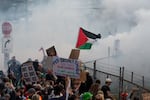
Thick clouds of tear gas, deployed by federal immigration officers, fill the air hundreds of protesters, including children and elderly people, try to escape outside of the ICE building in Portland, Jan. 31, 2026.
Eli Imadali / OPB
“When viewed under this proper legal lens, the use of such non-lethal force to disperse crowds engaging in unlawful behavior does not amount to an unwritten policy of retaliation but rather reflects law enforcement,” Lee stated.
The Appeals Court blamed Oregon’s sanctuary laws that limit local resources, including local police, from being used to support federal immigration enforcement from assisting federal officers with clearing the ICE’s building’s driveway.
The Appeals Court also found Simon improperly granted class certification to protesters, making his initial order applicable to greater numbers of people. In the majority opinion, Lee wrote “there is little in common between an Antifa provocateur who destroys the security camera at the ICE facility and a peaceful protester who holds a sign several hundred feet away on the public sidewalk.”
In her dissent, Judge de Alba said the federal government had undercut its own argument that it would face “irreparable harm” if it was curbed from using crowd control weapons in Portland. Federal officers complied with a 28 day temporary restraining order “‘without any indication of problem or prejudice,’” she wrote.

The U.S. Immigration and Customs Enforcement facility is reflected in the windows of Gray’s Landing, an affordable housing apartment building, which sits directly across the street from in Portland, Ore., on March 16, 2026.
Eli Imadali / OPB
Gray’s Landing tenants
A coalition of attorneys representing Gray’s Landing tenants and the operator, REACH Community Development, said Monday evening they were disappointed by the ruling.
In a group statement, they underscored that U.S. District Court Judge Amy Baggio’s initial, March 6 ruling found that federal officers knew the toxic clouds harmed tenants’ health but deployed them anyway.
“We are deeply disappointed by the court’s decision to eliminate critical protections for the residents of Gray’s Landing,” the attorneys wrote.
Judge Tung, however, hinged much of his 17-page ruling that the neighbors’ “bodily integrity” had no basis in the Constitution. He called the claim a “NIMBY” cause better suited for a tort claim.
“Our founding document does not address neighborhood grievances concerning unwanted smells and gas – no matter how unpleasant those may be,” Tung wrote.
The legal argument posed by the apartments’ residents and owner had repeatedly been called “novel” by Justice Department attorneys. Tung wrote that comparing the tear gas to toxic lead in drinking water was inadequate.
Tung cited federal officers’ incident reports as he agreed they faced repeated threats from protesters, including potential assaults, trespasses and danger to federal property. He also agreed with Justice Department attorneys that Baggio’s initial order was “unworkable” because it prohibited chemicals “likely to reach” the apartment building.
“All this is guesswork, and where a gas cloud travels will depend much on the weather,” Tung said.
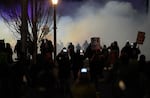
Tear gas is deployed as hundreds of people protest outside of the ICE building in Portland, Jan. 31, 2026.
Eli Imadali / OPB
Plaintiffs had submitted as evidence in District Court multiple occasions where federal officers had lobbed tear gas canisters over the crowd and toward the apartment. One such instance - which was omitted from the incident reports that day - was an Oct. 4 response where federal officers deployed tear gas across multiple city blocks with no clear justification.
In dissent, appellate judge de Alba noted that federal officers successfully protected the ICE facility without tear gas while they were under the injunctions. De Alba also wrote that the tear gas use was often “disconnected from any law enforcement purposes.”
Tung was not convinced by de Alba’s statement. He said federal officers were “tolerating a short-lived” inability to use tear gas and nonetheless were at-risk of violence.
Attorneys representing the apartment’s residents and operator made no mention of the appellate court’s decision to toss out the case entirely.
While they are empowered to appeal that decision for a broader panel review under the appeals court, or to the U.S. Supreme Court, they declined to respond to OPB’s questions.
This story may be updated.