Deep cuts to schools, central office services and specialized programs were among the features of Portland Public Schools’ $2.77 billion budget for the 2026-27 school year, presented by Superintendent Kimberlee Armstrong at a board meeting Tuesday.
“This is a fragile budget, we have limited reserves, we have little flexibility. Every dollar matters, every decision matters, and we are taking steps to reset our system,” Armstrong said.
Since the 2023-2024 school year, the district has cut about $115.5 million dollars from its budget. That includes a mid-year gap for the current school year. In order to fix that, the district implemented furlough days and cut 31 positions across the district, including in the central office.

Portland Public School Superintendent Dr. Kimberlee Armstrong participates in a school board meeting in which she presented the district’s 2026-2027 budget at Dr. Matthew Prophet Education Center in Portland, Ore., on April 28, 2026.
Eli Imadali / OPB
“These decisions are part of the district’s ongoing efforts to address a structural budget deficit and better align resources for long-term sustainability,” PPS chief of human resources Angela Freeman said.
Portland is not unique in facing steep budget cuts. Oregon school districts from Salem to the southern Oregon Coast have been forced to make cuts, while parents, teachers and other school supporters have pushed for funding increases at the Legislature. Funding shortfalls have also hit districts in Southwest Washington.
Consecutive years of cuts in districts such as Portland are a result of rising operating costs and declining enrollment. Enrollment matters because funding is based on the number of students in a school district, with additional weight given to certain student groups who may need more support. PPS is also seeing diminished revenue because fewer dollars in property taxes are coming in through the district’s local option levy. Rising costs include an increase to the district’s contribution to the state’s public employee retirement system, Armstrong said.
“PERS costs continue to rise — a PERS employer rate that has moved from just over 4% to just over 20%,” Armstrong said. “Compensation and benefits continue to grow, operating costs are increasing, and at the same time, our enrollment is declining and our revenue is limited.”
Those pressures mean difficult financial decisions, Armstrong said.
“While enrollment is decreasing, the fixed costs of operating 81 schools and the rising costs of personnel, benefits, and utilities continue to grow, creating a structural deficit that requires decisive budget adjustments,” district officials outlined in the 2027 budget book.

A graph outlining declining enrollment is projected during a Portland Public Schools board meeting announcing the district’s 2026-2027 budget at Dr. Matthew Prophet Education Center in Portland, Ore., on April 28, 2026. This is the 3rd year of budget cuts to PPS in a row.
Eli Imadali / OPB
The district’s proposed $2.77 billion budget for next year is an increase from last year, mainly because of a large increase in the district’s capital projects fund, which pays for bond projects approved by voters. The district’s general fund, which is the main source of money to run schools and district services, is down $6.5 million in next year’s proposed budget compared to what was adopted for the current school year.
There are two major funding sources that pay for PPS operations and staffing: the State School Fund and property taxes. While the state school fund amount going to PPS is slightly up for the 2026-2027 school year, property tax revenue is down $6.5 million, according to the district.
Where are the proposed cuts?
A school district’s biggest costs are staff. So in order to balance the district’s budget, staff cuts are virtually unavoidable.
District officials say they want to keep cuts as far away from schools as possible. This year, it includes a decline of 74 full-time equivalent employees in the central office. In past years, PPS has proposed reducing central office staff who actually serve in schools.
But still, schools will face some losses. The proposed PPS budget cuts 112 full-time positions from schools, 101 from “specialized programs” and 48 transportation and facilities positions that serve schools across the district. Some of the “specialized programs” staffers can be paid through another form of funding, PPS officials said Tuesday.
Removing so many staff positions from a school district of over 43,000 students will require changes to how schools operate.
Some elementary students may now be in blended classrooms, where students at multiple grade levels are grouped together in one room. Student-to-teacher ratios in middle and high schools will change, requiring educators to instruct more students. And at other schools, it may mean a reduction in classes or electives offered. PPS’ budget documents include a school-by-school breakdown that includes changes to staffing. Creston Elementary in Southeast Portland will lose 3.75 full-time equivalent positions, for example. At Ida B. Wells High School in Southwest Portland staffing will shrink by 8.7 positions.
In its forecast for future years, PPS’ outlook remains grim. Leaders projected needing to reduce $65.2 million for the 2027-28 school year.
Options for finding cuts are diminishing. At times, Oregon school districts would reduce the length of the school year to rein in costs without cutting staff positions. Gov. Tina Kotek recently ordered that school districts can no longer use furlough days as a cost-saving measure, arguing the state’s school year is already too short. That means PPS and other school districts in Oregon may have to resort to more staff cuts to keep schools running.
Hope and cause for concern
One glimmer of hope? A change in how Oregon funds schools. In recent months, education officials have asked for changes to the school funding formula. The Oregon’s Secretary of State’s office also plans to audit school district funding allocations in the coming year.
Another change to school funding was on the agenda at the same PPS board meeting where Armstrong shared the district’s proposed budget: a discussion to “pause” the school board’s policy ending local school foundations.

Eight-year-old Reike Elementary School student Cora Hiller, center, watches the Portland Public Schools board meeting with her mom, Amie Hiller (left), and brother 11-year-old Max Hiller (right), while they hold signs in favor of “pausing” a district policy that ended local school foundation funding model at Dr. Matthew Prophet Education Center in Portland, Ore., on April 28, 2026. The local school foundation funding model has raised more money than the districtwide model, but some see it as less equitable.
Eli Imadali / OPB
Parents from several schools packed the seats at Tuesday’s board meeting, some with green “pause” signs. Parents advocating for a pause want to see PPS return to its model of local school foundations, which raise funds that can be invested directly in operations and staff at the school level. At least two parents who shared public comment said they are considering or have enrolled their children in private school because they do not trust the district’s financial decisions. When students leave the local public school, it reduces enrollment and can affect how much funding the district receives.
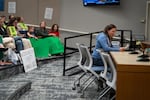
Kate Lefco, a Portland Public Schools parent and Peninsula K-5 social worker, speaks in support of a districtwide foundation model, which some say is more equitable than foundations based at individual schools. Lefco spoke during a PPS board meeting announcing the district’s 2026-2027 budget at Dr. Matthew Prophet Education Center in Portland, Ore., on April 28, 2026. This is the 3rd year of budget cuts to PPS in a row.
Eli Imadali / OPB
Other parents spoke in favor of the district’s current model, which prohibits local foundations and instead operates a districtwide Fund for Portland Public Schools.
After discussion, including comment from PPS’ newly-hired interim executive director Nick Brodnicki, the board did not take up a vote to pause the foundation policy.
Every Oregon school district is going through this budget process over the next two months, where they’ll hear from students, staff, and parents about what’s important in their schools. School districts are required to adopt a budget by the end of June.