Oregon is preparing for much hotter temperatures than usual this weekend, at a time when at least three cities in the state are among some of the fastest-warming in the U.S., according to a recent analysis.
On Sunday, temperatures across Oregon are expected to spike due to a heat wave that’s blanketed most of British Columbia. The heat is making its way down the Pacific Northwest and some areas are forecast to break records.
According to a National Weather Service Thursday forecast, Portland is expected to see temperatures reach as high as 79 degrees Fahrenheit on Saturday.
On Sunday, the city could see temperatures rise to as high as 92 degrees.
That’s 20 to 25 degrees warmer than the daily average for that day, which is around 66 to 67 degrees, according to NWS Portland meteorologist Hannah Chandler-Cooley.
“We are going to be pretty close to some record-breaking temperatures for the daily records,” Chandler-Cooley said.
The daily record for May 3 was set in 1992, when the city reached 89 degrees.
“So, really Sunday is the main day we’re looking at for potential records,” she said. “It’s not completely abnormal to get warm this time of year, but the 90s in early May is definitely more on the unusual side.”
Other parts of the state are also expected to see higher temperatures than usual for this time of year. Eugene is expected to hit the mid-80s, Chandler-Cooley said, which is at least 20 degrees higher than normal.

FILE: Jamie Test of Portland wipes the water from his face after cooling off in the fountain at Tom McCall Waterfront Park during a September 2024 heat wave in the city. Oregon is expected to see high temperatures again this coming weekend.
Alan Zhou / OPB
While some people may welcome the sun and hotter temperatures, Chandler-Cooley offered a word of caution.
“Having this heat so early in the season, most people’s bodies just aren’t used to this,” she said.
That means people are more likely to experience heat-related illnesses, especially if they spend the warm and sunny weekend outdoors, she said.
“We’re definitely urging people to make sure they stay hydrated, practice heat safety even though it doesn’t seem like you might need to.”
Temperatures are expected to decrease Monday and Portland should be down to a high of about 70 degrees by Tuesday, Chandler-Cooley said.
Fastest warming cities
Scientists have said for decades that the continued burning of fossil fuels like natural gas, oil and coal, is contributing to human-caused climate change. That long-term prediction is now coming true, as weather becomes more extreme around the globe and Oregon sees more hot days per year.
Research from Climate Central found that Portland, Eugene and Medford are among the fastest-warming cities in the U.S.
“We found, with this latest analysis, that 99% of the cities we looked at have warmed since the first Earth Day, which was in 1970,” Climate Central’s vice president for science Kristina Dahl said. “That pace of warming varies from place to place.”
Portland is 2.7 degrees Fahrenheit warmer than it was 50 years ago.
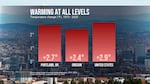
Portland, Ore., is among the fastest warming cities across the United States, according to environmental nonprofit Climate Central. Portland's average temperatures have increased by at least 2.7 degrees Fahrenheit.
Climate Central / Climate Central
Eugene has seen temperatures climb an average of 1.9 degrees over that time, and Medford is up 4 degrees, Dahl said. The national average change is about 2.9 degrees.
The fastest warming states are Alaska, New Jersey and New Mexico, she said. Alaska’s average temperature has climbed by 4 degrees in the past 50 years.
Some areas around the country are seeing even more extreme temperature increases. Cities like Reno and Las Vegas are up at least 6 degrees, according to the data. That’s due to several factors, Dahl said, including the local effects of climate change in each city, as well as land-use choices. Areas with more urban development can be hotter than less developed spaces, and agriculture also affects temperatures.
Hotter temperatures earlier in the year also impact the environment. They can lead to lower snowpack and affect locally grown crops that depend on specific weather throughout the year, Dahl said.
“What we’re capturing here with this analysis is all of the factors that are going into warming temperatures, and that will include the global climate signal, but it can also include some local factors too,” she said.
2.4 degrees hotter
Oregon’s 2.4 degree average temperature rise is a sign of something abnormal that goes beyond the normal fluctuations weather can bring, Dahl said.
“There are certainly year-to-year variations in weather patterns,” she said. “We will always have some summers that are warmer or cooler than others. But the consistency of this upward trend in temperatures and the pace of the upward trend is very clearly driven by human-caused climate change.”
By mid-century, Portland could experience about four days per year with temperatures reaching 100 degrees, if the trend continues, Dahl said. By 2100, that number could quadruple to 16 days per year.
Climate Central’s Climate Shift Index, a tool that shows how much of a factor climate change plays in any given day’s temperatures, says that this weekend’s Pacific Northwest heat wave was twice as likely because of the continued effects of fossil fuels.
For some people, 2.4 degrees of change might not seem like much, but Dahl said it could still have a huge impact.
“So, it sounds like just a little bit, right, 2 to 4 degrees of warming, but when you translate that into human health, human activity, ecosystem activity, it really can have a pretty profound impact,” she said.