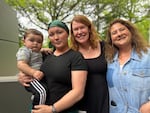
The Lullaby Project pairs parents who are incarcerated or homeless with professional singer-songwriters to write lullabies for their children. The Oregon Symphony then arranges, performs and records them. Ada McGraw wrote her lullaby with Bre Gregg, while serving time at the Coffee Creek Correctional Facility. Gregg, McGraw and her 10-month-old baby Legend, came to OPB on May 5, 2026 to be interviewed on "Think Out Loud." Jessica Katz (R), is the director of the Family Preservation Project, who facilitated the participation of the women at Coffee Creek, and was also interviewed.
Allison Frost / OPB
The Lullaby Project was created more than a decade ago by the Carnegie Hall’s Weill Music Institute. The program pairs singer-songwriters with parents who are incarcerated or experiencing homelessness, and together they create a lullaby. In Oregon, those songs are arranged for the Oregon Symphony and then publicly performed. This year’s performance is next Tuesday, May 12 at the Alberta Rose Theatre in Portland.
Ada McGraw was one of the first women to participate in this program after it expanded to the Coffee Creek Correctional Facility last year. While serving her sentence, McGraw was paired with singer-songwriter Bre Gregg. The lullaby they wrote was for her son Legend and included a poem from Legend’s father.
Jessica Katz is the director of The Family Preservation Project and facilitated their meeting. We talk with Katz, Gregg and McGraw to hear about this creative process and learn more about the larger impact of The Lullaby Project.
Note: The following transcript was transcribed digitally and validated for accuracy, readability and formatting by an OPB volunteer.
Dave Miller: From the Gert Boyle Studio at OPB, this is Think Out Loud. I’m Dave Miller. The Lullaby Project was created more than a decade ago by the Weill Music Institute at Carnegie Hall. The program pairs singer-songwriters with parents who are experiencing homelessness or are incarcerated. Together, they create a lullaby. In Oregon, the resulting songs are arranged for members of the Oregon Symphony and then performed publicly. This year’s performance is a week from today. It’s Tuesday, May 12, at the Alberta Rose Theater in Portland.
Ada McGraw was one of the first Oregon women to participate in this program after it expanded to the Coffee Creek Correctional Facility last year. She was paired with the singer-songwriter Bre Gregg. Together they wrote a lullaby for her son. Jessica Katz is the director of The Family Preservation Project. She brought the Lullaby Project to Coffee Creek.
All three women join me now, along with Ada’s 10-month-old son Legend, who you may have been hearing a little bit as I was just talking. It’s great to have all four of you in the studio.
Bre Gregg: Thank you.
Ada McGraw: Thanks, Dave.
Jessica Katz: Good to be here.
Miller: Bre, I want to start with you. You’ve been working on the Lullaby Project since 2019. What made you want to take part?
Gregg: They asked. It was that simple. It is an incredible program. I love music and the thing I love most about it is it sort of forces vulnerability. So this opportunity to go in and help people write stories about the people they love the most, seemed like an incredible opportunity. I can honestly say it’s the most soul-filling, inspirational thing I’ve ever been a part of.
Miller: What went through your mind when the Lullaby Project expanded to Coffee Creek? Because you’d been doing this for, I don’t know, six years or so before last year when Coffee Creek was added to the Lullaby Project. What went through your mind? [Baby cooing in background] And we’ll hear a lot more very soon from Legend.
Gregg: Yeah, little Legend. Well, [my] first thought was that it was an incredible idea to bring it to Coffee Creek. The reality was it made me so scared. Going into Coffee Creek made me realize how many preconceived silly ideas I had about that. So it was sort of a journey of realizing that I had no idea what I was in for. Then when I went in, immediately connecting with Ada and realized that most of my ideas were completely unfounded.
Miller: Ada, why did you want to take part in this?
McGraw: Because they asked and they said I would be trailblazing, and I always like a trailblazing thing. Also, Legend’s my first son, so just being able to have that experience, doing that for him and stepping outside of my comfort zone, those were all things that intrigued me about this. I’m not musically inclined at all, but I do love music. So I feel like this was a way I could try to get in that lane a little bit.
Miller: When did you realize you were pregnant?
McGraw: I found out I was pregnant actually on my way back to Coffee Creek.
Miller: You mean you were on your way to being incarcerated when you found out you were pregnant? Wow. And how long were you gonna be incarcerated for?
McGraw: At first, I was unsure because I had to take care of some things during that time, but I ended up doing about nine-and-a-half months.
Miller: So basically the entire pregnancy was behind bars. How did being pregnant in prison affect the way you thought about your future?
McGraw: Good question. I think while being there, I felt quite a bit of shame because there were a lot of people, sometimes COs, who would say things that were shaming for me being pregnant and incarcerated. I think my story was a little different because I had gotten my life together before I ended up, unfortunately, incarcerated.
So I had a different mindset than somebody who was just coming from crime and then going to prison pregnant. I will say that, being there, they also have this doula program. That really changed my thought process on that and helped me to be hopeful and not as scared of being a mom.
Miller: Jessica, I mentioned that you helped bring the Lullaby Project to Coffee Creek through what you run, The Family Preservation Project. It’s been a number of years since we talked about The Family Preservation Project. What’s the basic idea of it?
Katz: The basic idea is that when a mom is sentenced to do time in prison, so are their children and so are their families. The Family Preservation Project really exists to be able to keep families connected and to, without indictment, just wrap love, care and support around the whole family system: The mom who’s incarcerated, their children and whoever the unsung heroes are who are stepping in to provide care.
Miller: Why did you want to bring the Lullaby Project to Coffee Creek?
Katz: I suppose I should say they asked, to follow suit, which is in part true. But in August of this year, The Family Preservation Project (FPP) became a fiscally sponsored project of the Ostara Initiative, which is the umbrella organization over the Oregon Prison Birth Project, the doula program that FPP was very involved in helping to pass through the Oregon State Legislature. So this has given us a real increased opportunity to get involved with families as early as when they are newly postpartum.
I’ve been at Coffee Creek doing this work for almost a quarter of a decade. And in all of this time, one of the things I struggle to wrap my head around is, what it would be like to give birth and be immediately separated from your child. So this was an obvious yes for me. If we could be a part of anything that would make that more beautiful.
Miller: Ada, what do you remember about meeting Bre?
McGraw: I was nervous. Then as soon as we kind of started and got down to the nitty gritty, it was like butter. She was easy to work with. She didn’t make me feel any type of judgment at all. We actually worked very well bouncing ideas. She was very motivating. It made me feel like, oh, yeah, I can do this. So it was great.
Miller: Bre, you brought a keyboard with you. Can we hear the song? Can we hear “Legend’s Lullaby?”
Gregg: Absolutely. Do you want me to tell you a little bit about it before?
Miller: Please, yeah.
Gregg: Ada was so clear about exactly what she wanted to write about. We only had three hours to write this. [She] came in and immediately jumped in. She wanted to write the verses sort of about her perspective. Then she pulled out a little piece of paper, and it was a poem that Legend’s father had written and had sent over to her. He was also incarcerated in a different facility and sent over this piece of paper with this poem, and it was a fully actualized chorus. So we took his words and we wrote the chorus of this lullaby. So the verses are from Ada’s perspective and then the choruses are from Legend’s dad’s perspective, a little love letter to Legend.
Miller: We’re gonna hear the song, the lullaby for Legend, that Bre and Ada came up with.
Gregg [singing and playing piano]:
What color are your eyes?
Every day I’m gettin’ just to meet you.
The first time that you kicked, I felt complete.
You make mommy feel forever needed.
Daddy’s always by your side.
Don’t ya see the love in these eyes?
Have no worries little guy,
Daddy’s here to be your guide.
So let me see you smile so wide.
So wide.
You can do no wrong in our eyes.
Rest assured that we will never leave you.
We will keep you safe and protected.
Mmmmmm,
Oh, you’re perfect.
Daddy’s always by your side.
Don’t ya see the love in these eyes?
Have no worries little guy.
Daddy’s here to be your guide.
So let me see you smile so wide.
Oh, your family’s by your side.
Don’t ya see the love in these eyes?
Have no worries little guy.
We’re all here to be your guide.
So let me see you smile so wide.
So wide.
Mmmmmmm.
[Song ends]
Miller: That is “Legend’s Lullaby,” sung by Bre Gregg and written largely by Ada McGraw, for her son Legend, along with some lyrics by Legend’s father. Ada, what’s it like to hear that lullaby now?
McGraw: It’s emotional. From the first time I heard it, every time I hear it, it makes me emotional.
Miller: Jessica has described the goal of The Family Preservation Project as trying to break a cycle; to work alongside women to help them become deeply rooted in their identities as mothers, and to provide for their children the things that no one was able to provide for them. How much does that describe your situation? Do you feel like you’re trying to break a cycle right now?
McGraw: Yeah, absolutely. You hit the nail on the head with that. I didn’t necessarily have the best guidance as a child. But I did learn what I don’t want and how I’m going to try to use that to give my son everything that I would have wanted. Yes, trying to break that cycle for sure.
Miller: I want to hear part of another song from the Lullaby Project. It’s a song called “Connected” and it was sung by Stephanie Schneiderman, who worked with an adult in custody at Coffee Creek named Lacy. My understanding, Ada, is that you actually were there, not that far away, when Stephanie Schneiderman and Lacy were working on their song. What do you remember from their partnership?
McGraw: Lacy and I were also really good friends through this whole time as well, and I know that they worked together great. Lacy wanted to sing her song, which I thought was so brave, and she did it beautifully. Hers was totally different from mine and authentic, and still just as vulnerable. I know Lacy did walk away from that feeling good about it. And we both were on cloud nine when we were done.
Miller: Let’s have a listen. This is Stephanie Scheiderman, as well as musicians from the Oregon Symphony.
[Recording on “Connected” playing, by Lacy and Stephanie Scheiderman, with the Oregon Symphony]
Your breath is my breath.
Your smile is my smile.
Every tear we cried together,
Will always be left here.
We’re always fine.
No matter where you are,
I just pray you learned what love is.
Wherever and how far,
I just pray you know where home is.
Mom and Daddy will love you,
Til the end of time...
[Song fades out]
Miller: Jessica, what have you heard from the women in custody that you work with about what working on this program has meant to them?
Katz: It’s kind of incredible. I don’t know what the phenomenon is, but complete strangers come together in this very non-distinct classroom, in the middle of the prison, and make absolute magic. I have studied this a couple of times where I’ve facilitated the process and I couldn’t tell you exactly what goes into it. But there is a level of joy, vulnerability, honesty and risk-taking that continues to really stun me.
What I have been able to say to the moms that we’ve worked with is, in spite of this really terrible situation, your babies, forever, will have lullabies that their moms wrote to them that were performed by the Oregon Symphony with these incredible songwriters. Who can say that? It’s been a stunning experience. I’m honored to be a part of it.
Miller: I want to hear a little bit of another song. This is one Bre that you worked on, not with Coffee Creek, but with a man named Hunter. The song is called “Mr. Pogi.” We’re gonna hear a little bit of it. What should we know briefly before we hear some of the song?
Gregg: So Hunter is a single dad raising a three-year-old son. The word “pogi” means “handsome,” in Tagalog. His son’s mom is from the Philippines, and so they call him Mr. Handsome. So they call him Mr. Pogi. So this was written basically, a very different experience actually than Ada, who came in with really clear ideas, and we just immediately jumped in. He didn’t really know how to begin. So what we did was he wrote a letter to his son about his hopes and dreams for him. And I wrote a letter to my children with my hopes and dreams. And then I read him my letter and he read him his.
Because again, it’s super vulnerable. So, just making them do the vulnerable thing doesn’t make a lot of sense for connection. So we both did this. And then I took almost every word from the letter that he wrote, because parents are so poetic when they talk about their kids. It does not matter where you are living or your background. You want the best for your kids. It is universal and it is a beautiful thing. So the words that come out tend to be very poetic and song-like. This was written from that letter.
Miller: This is “Mr. Pogi.”
[Recording of “Mr. Pogi” playing, by Hunter and Bre Gregg, with the Oregon Symphony
Looking up at you, you gave me a poke.
And when things start to fall apart,
Your smile is like a path I know by heart
My sweet Pogi
Daddy’s here always.
You strike like lightning…
[Song fades out]
Miller: Ada, what are your hopes for Legend? I think it’s the first time we’ve had a 10-month-old in the studio ever. And it’s been fantastic to have a big baby here. What are your hopes for his future?
McGraw: [Legend cooing] My hopes for my son is that he grows up in a home that doesn’t traumatize him and that he knows he’s always loved. That he knows that he is always forgiven, that he is always accepted, and has unconditional love and family around him.
Miller: Ada, Bre and Jessica, thanks very much. Legend, the show is almost over. Ada McGraw, who was formerly incarcerated at Coffee Creek Correctional Facility; Bre Gregg is a singer-songwriter who partnered with her as part of the Lullaby Project; and Jessica Katz is the director of The Family Preservation Project. The Lullaby Project performance is one week from today. It’s Tuesday, May 12 at the Alberta Rose Theater in Portland.
We’re going to go out on one more song from the Lullaby Project. It’s called “Para Mi Niña.” The singer-songwriter is Anna Tivel. She worked with a mom named Maria.
[Recording of “Para Mi Niña” playing, by Maria and Anna Tivel]
“Think Out Loud®” broadcasts live at noon every day and rebroadcasts at 8 p.m.
If you’d like to comment on any of the topics in this show or suggest a topic of your own, please get in touch with us on Facebook, send an email to thinkoutloud@opb.org, or you can leave a voicemail for us at 503-293-1983.