Data centers and other large industrial power users in Oregon will soon pay more to access electricity through Portland General Electric.
This comes after state utility regulators issued an order last week under Oregon’s POWER Act, which creates a new rate class for these large energy users requiring them to pay for their share of electricity usage.
Before that law passed, PGE’s data center customers paid about 8 cents per kilowatt hour of electricity, while residential customers paid more than twice as much — closer to 20 cents per kWh, according to a state utility watchdog group.
PGE has until June 3 to determine how these changes will affect its customers.
“What we can say now is that we know data centers will be paying a little bit more for the costs associated with growth, and residential and small business customers should see some relief in their bills,” Ben Morris, PGE spokesperson, said.
According to Morris, 16 data centers will be impacted by this order.
Staff at the Oregon Public Utility Commission, which regulates utilities and approves rate changes, said the new rate structure protects PGE’s residential and commercial customers’ rates from rising as more data centers are built across the state.
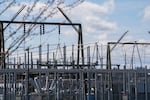
FILE: A Portland General Electric substation in Sherwood, Ore., on March 17, 2026. PGE will soon start charging data centers more to reflect the costs they are imposing on the electrical grid.
Saskia Hatvany / OPB
“Oregonians should not bear the costs of explosive data center growth, and data centers should be focused on limiting their overall impact,” Oregon PUC Chair Letha Tawney said in a statement. “This decision ensures the largest energy users in PGE’s service area pay their fair share, have clarity and predictability as they make business decisions and support the programs that keep our grid reliable and our communities strong.”
Environmental, climate and utility watchdog groups applaud the utility commission and say its order adds guardrails that protect Oregonians’ bills from increasing due to the surge of data centers coming into the state.
But the Data Center Coalition, a national membership association for the industry, said the upcoming changes are too stringent and could create barriers for data centers to come into the state.
Implementing the POWER Act
Oregon has more than 120 data centers, and is among a handful of states that are creating laws to protect ratepayers from higher electric bills as more come online.
Data centers take up a lot of energy, with specifics varying depending on the type of service they provide — from cloud service to powering AI technology.
But the region’s power grid is reaching capacity, and utilities are investing in more electricity generation and transmission lines to meet that demand. Those investments drive up costs for all ratepayers.
Until the law known as “Protecting Oregonians With Energy Responsibility” or POWER Act was passed, the Oregon Public Utility Commission split those costs across six customer categories. That included residential, commercial and industrial. Data centers were considered under the industrial customer category.
But the growth of data centers in the state has left many people and businesses subsidizing data center costs.
The POWER Act created a new classification, requiring utilities to charge data centers, cryptocurrency and other large industrial energy users more for the increased demand they place on the grid. It kicks in for projects that use more than 20 megawatts, or 20 million watts of power. That’s the equivalent of what a large industrial user, like a paper mill, uses in energy.
Portland General Electric is the state’s first electric utility to increase rates for these data centers and other big electricity users.
“We now have more tools to ensure that the customers who are driving growth are the ones paying for it, while still supporting economic development in the region,” PGE’s Morris said.
An analysis by the nonprofit watchdog Oregon Citizens’ Utility Board found data centers have been a driver of rising PGE bills, which are up nearly 50% in the last five years. PGE spent $210 million last year due to data center growth in Hillsboro, Oregon, CUB calculated.
“We are confident that by this summer, we will see data centers paying higher rates that more accurately reflect the costs they are putting on our energy grid.” Oregon CUB executive director Bob Jenks said in a statement.
In addition to shifting more costs to data centers and other large industrial power users, last week’s utility commission order also imposes renewable energy requirements on data centers before coming online, and requires them to pay “exit fees” if they decide to stop work before completing a project. And it adds a surcharge to the bills of extremely large customers, to fund energy efficiency upgrades for low-income households.
Barriers for data centers
Data Center Coalition vice president of energy Aaron Tinjum criticized Oregon’s new approach, saying it’s “out of step” with what other states are imposing.
The coalition represents 42 data center owners and operators from large companies to smaller companies that build and lease to larger ones. He said his members fully support customer protections and are committed to paying the full costs of building more transmission lines and adding renewable energy to the grid.
But he said the utility commission’s order presents some of the “most extreme versions of protective mechanisms” he’s seen.
“We really want those to be evidence-based and balanced in the sense that if a company wants to invest in Oregon, that they still have a pathway for doing that and that that’s competitive compared to other markets, especially regionally.”
He said data centers bring jobs and economic benefits that could be undermined by last week’s decision.
“It’s through jobs, it’s through tax revenue, and it’s through those industries that are poised to drive growth in our economy moving forward,” he said. “Data centers are at the center of modern economic growth.”
But Cole Souder, staff attorney at the Green Energy Institute at Lewis and Clark Law School, said the utility commission’s order, as well as the POWER Act, helps hold data centers accountable.
“Data centers will recognize that Oregon is a place where, if they want to connect there, they actually have to uphold their own statements, their commitments to taking on the cost that they impose, their commitments to being good neighbors, and in a broader sense, their commitments to not polluting and to use renewable energy,” Souder said.