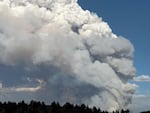
FILE - The ShoeFly Fire burns north east of Mitchell, Ore., on Sep. 2, 2024. Oregon lawmakers had to call an emergency session in December 2024 after the state’s most expensive wildfire season left the Oregon Department of Forestry with nearly $100 million in unpaid bills.
Kathryn Styer Martínez / OPB
As wildfires grow larger and more destructive across the West, state governments are having a hard time paying for response and prevention. Oregon lawmakers were called into an emergency session in December 2024 after the state’s most expensive fire season left the Oregon Department of Forestry with nearly $100 million in unpaid bills. They also created a new tax in the 2025 session on nicotine pouches, such as Zyn, to fund wildfire prevention.
Kyle Williams is the deputy director of fire operations for ODF. He joins us with more details about the state’s wildfire funding ahead of what could be a historic fire season.
Note: The following transcript was transcribed digitally and validated for accuracy, readability and formatting by an OPB volunteer.
Dave Miller: From the Gert Boyle Studio at OPB, this is Think Out Loud. I’m Dave Miller. Wildfires are not just getting bigger and more destructive, they’re also getting more expensive. Oregon lawmakers were called into an emergency session in late 2024 after a record fire season left the state’s Department of Forestry with nearly $100 million in unpaid bills. Last year, lawmakers instituted a new tax on nicotine pouches to fund wildfire prevention. But how are fire managers preparing for what could be another destructive year? And what does all this money actually pay for? Kyle Williams joins us to answer these questions. He is deputy director of fire operations for the Oregon Department of Forestry. It’s great to have you on Think Out Loud.
Kyle Williams: Appreciate it, Dave. You hear me OK?
Miller: I sure can. I wanna start with that last piece. When we think about the cost of wildfire response, what’s that money going toward? What do you have to pay for?
Williams: That’s the right first question. So, when folks think about the expensive fire seasons and where is that going, it’s going right to the people fighting those fires. Depending on the size, scale, let’s just start with a large fire, that’s what most Oregonians probably would be thinking about. When you’ve got a fire that requires multiple days of engagement and suppression action, essentially you have to create a mini town out in frontier, Oregon somewhere.
So you start with the general camp support: Feeding them, keeping them clean, all of that kind of stuff, and then you go out on the line and who actually is putting the boots on the ground to do that digging, and those are the wildland firefighters, both agency personnel, and we benefit in Oregon from a robust contract firefighting force. And in terms of numbers, primarily those contractors are who’s doing that firefighting, at least for the Department of Forestry, all out through Oregon.
And then you scale up from there. You’ve got aviation, you’ve got the helicopters, the tankers that are coming in, you’ve got heavy equipment, we fight fire with dozers and excavators, and then you need a grader to make sure that the road is capable of getting there. And by the time you’re done with it, you’ve essentially created an ecosystem around that fire that requires a lot of people. So that’s the people and equipment is where that money’s going.
Miller: We spent a couple of years ago now, a memorable, to me at least, 24 hours at a fire camp in Southern Oregon, which really opened my eyes to just the scale of the back end effort. As you said, it was an instant city set up in this sprawling area, where everything that was needed for people to live and eat and excrete and everything was all set up in a kind of “just add water” way.
And one of the phrases I remember people saying is, if the question was who pays, the answer was, “the fire pays.” But of course, the fire doesn’t actually pay, it’s taxpayers. But who is on the hook for these costs? I mean, how are they split up between a city or a county or the state or federal partners?
Williams: That’s also a really good question. It could be a very complicated answer. I’ll try and simplify it as best as possible. We think of fire in a concentric circle type way. And you start with that initial attack. When a fire is small, this is a funny way to say it, but your best investment is to catch a fire when it’s small. So if it’s 10 acres, we’ve got our district staff that are spread out across the state protecting our 16 million acres, and the local landowners within a given district will pay fees to the Department of Forestry to provide that basic – think of it as your local fire department service level. So if we can go out and catch a fire at the 10 acres, those folks are paid for by the landowners that are right there and adjacent. That’s the same way with a city fire department, and then same way with a federal agency, if they can take care of that fire when it’s small.
But then let’s say it goes to 1,000 acres and it’s crossed a couple of jurisdictional lines. So now it’s maybe, it’s a Department of Forestry fire, and it’s got some acres that are on the Forest Service. Well, at the end of that event, we will get together with our Forest Service counterparts and we do what’s called a cost share process, and we’ll send them the bills for the effort that was on their land. And likewise, if they took care of a fire that got onto us, they’ll send us bills for that.
And then if that fire continues to get bigger, say it now is threatening a community and burning down into that, whatever neighborhood or whatever town, there is an instance where the state of Oregon, through the federal system, a fire management assistance grant through FEMA – if the fire is large enough and is threatening that community, we can apply for assistance from FEMA to help pay some of the costs for that fire.
And so you’ve got that concentric circle. It may be a locally paid for event, it may then be, if it’s that bigger, state paid event, and then, in the worst case scenario, the federal government may assist in some of that. But for the most part, you would think of large fire expenses on ODF jurisdictional property as being paid for by the state.
Miller: When you just look in the big picture over the last decade or so, what does the cost trend look like?
Williams: Vertical.
Miller: Not even a hockey stick, just straight up basically?
Williams: Well, essentially, and that’s a bit of hyperbole. It’s certainly a significant increase decade over decade, and it’s commensurate, frankly, with the scale of fire we’ve seen. So, what we have consistently seen for the last 10 going on 15 years, bigger fires, more long-duration events threatening communities. And what that all adds up to is a lot more intensive firefighting for longer durations.
And as more fire, more complicated, you would expect to see those costs increase at the same time the folks providing those services. Again, I mentioned our contractor workforce and our agency firefighters, we know that the agency costs have gone up just through inflation and general factors, and that same thing’s happening on the contract side. If you look at our aviation fleet, the demand – because it’s not just an Oregon-centric issue, I want to be really clear as we’re having this entire conversation, it is a west-wide growing to nationally fire challenge that continues to outpace anyone’s ability to keep up with it.
If you are a vendor of any sort, whether, to your point, the blue rooms – the blue rooms are very important as well, and there’s a lot more demand for those services. So if you’re an aviation contractor and you are getting asked to go multiple different directions and you don’t have enough stuff to be able to provide, those costs would go up.
You look at just the general cost of parts and labor. To be a firefighter, generally, it requires a lot of training. It’s a very dangerous environment. And if you think about any other profession that requires a lot of training and is very dangerous on a daily basis, you would expect to get paid commensurate with that risk. And that is happening – more demand, more training, having to pay folks in order to go do really hard work, and in addition, fires that continue to get bigger, longer duration, and in more complicated places. You’ve got a perfect storm of that… you mentioned the hockey stick. It’s thankfully not quite that, but it certainly is increasing significantly over past decades.
Miller: Can you remind us what happened in 2024, when nearly two million acres burned?
Williams: That was a tough summer, and it started early. We had conditions mid-July that supported some early fires getting started, mostly human caused, unfortunately, and it was followed by several weekends in a row of widespread lightning. And the way our system’s built, it’s called the “Complete and Coordinated System.” So no one agency, as I mentioned earlier, is going to be by themselves capable of handling every single fire that might happen in their jurisdiction. We rely on our neighboring resources. That might be your local rural fire protection district, the federal agencies, the landowners have some firefighting capacity. We all work together to try to get on top of a fire early and keep it from getting big.
Well, in ‘24, in July, we had several human-caused starts that had already grabbed a lot of the resources that were available, and then we threw a bunch of lightning out across the landscape, and it simply overwhelmed what everyone together in the wildland fire universe could possibly handle. Those fires got big, the weather that followed was hot, dry, windy. Those are bad factors when we’re talking about trying to keep a fire small. And a lot of flashy fuel out in the east side of Oregon, it simply got overwhelming to the system.
We have an ability to scale up. We brought in over 570 firefighters from other states to support us. The entire national system came in to support. We had well north of 12,000 firefighters on the ground here in Oregon at one point, and it simply wasn’t enough people to keep up with the fires as fast as they were growing. And what you saw was a historic summer in terms of the number of acres burned, compared to at least recorded history, and really speaks to just that suppression approach alone is not going to get us out of this. There’s no way anyone could be expected to, (A), pay for every fire that’s out there, and, (B), have enough people ready to go fight it. It’s got to be a combination of, I mentioned that human-caused fire starts, it’s got to be a combination of prevention and preparing the landscape to have those fires and make it so that we’ve got a chance to go get them. Because if the fuel conditions are such that there’s just too much of it out there for us to have a hope in the suppression effort, we are not going to be successful.
Miller: With historic low snowpack and parched landscape already, how are you feeling? And fire season has begun. I was gonna say going into it but we’re here, now, in the early weeks of it. How are you feeling right now?
Williams: Well, that’s a good question. Yes, you’re right. Our Southwest Oregon district, the Medford area, has already declared fire season. Central Oregon has already declared fire season. You know, there are markers out there that say – and again, we’ve already started – it’s going to be an early fire season and it could be a tough one. No snowpack. I saw Timberline last week had its earliest melt-off in history. We know about the Crater Lake scenario, and that all adds up incrementally.
I think where we’re at is, we are as prepared as we’re going to be. We’ve got our firefighters starting to get hired. Many of them are already on. We’ve had folks already out in the southeast part of the United States helping those folks with their fire season. They tend to be more spring-centric, so they’ve been knocking the rust off and getting ready, and they’re already back in the saddle and prepared for Oregon. So we are going to be as ready as we can be.
You mentioned ‘24, and I mentioned the 15 years prior to that. Oregon has had a string of really difficult fire seasons. And the upside of that is that that’s a heck of a lot of practice at our craft, and we’ve gotten pretty good at it over the last few years. And that’s not just ODF getting pretty good at it. We’ve gotten really good working together with our partners, the local fire protection folks, the federal agencies. We have honed this Complete and Coordinated System to as sharp a point as we possibly can.
And, frankly, one thing that is a constant every summer is that there will be fires of some kind. The 45th parallel lends itself to that. And so we’re taking it from a mindset perspective, if we can’t control the weather, we can’t control where the next fire starts going to be, but we can control how ready we are. We can control our efforts in prevention, and I would say that all of that is as on point as it could possibly be going into this fire season.
Miller: A number of years ago, I remember at the federal level, conversations from the U.S. Forest Service and other folks – watchers, supporters – saying that there’s an imbalance here. We’re spending so much of potential money on wildfire response that there’s not enough money for prevention or landscape treatments that would lead to less severe fires. Is that same thing true at the state level?
Williams: Well, here’s what I would say. Historically, the approach to dealing with wildfire in Oregon, and frankly, westwide and nationally, was, I will just deal with it in the three months, three and a half months of the summer, and we’ll suppress our way out of this problem. And for a long time, I think everyone was augured into that.
Then in the mid-2000s, nationally there was this transition to a three-pronged approach called the National Cohesive [Wildland Fire Management] Strategy, which recognizes that nobody can suppress their way out of it. I’ve mentioned that a couple of times, that it really has to be…
You’ve got suppression, that’s a well and adequately prepared suppression component. You’ve got that mitigation, you just said it, creating a resilient landscape, and what we mean when we say that is that the wildland environment has been modified to a point where, when a fire does happen out there, you don’t have to spend as much money on suppression. It’s not going to be on the landscape for as long and it’s not going to threaten the community the way it had before.
And that third and final is the community itself. Is that urban environment prepared to defend itself, to receive and defend itself from an inevitable wildfire? And for a long time the investment focus was on that suppression. And I think what you saw, especially in House Bill 3940 that was passed last year, was a recognition and a purposeful investment in those second and third legs, that resilient landscape, and the prepared community.
You mentioned the oral nicotine tax earlier. There’s also a portion of the interest proceeds from the Rainy Day Fund that are now dedicated, for the first time in Oregon, proceeds from both of those elements are dedicated to creating resilient landscapes and preparing communities to receive wildfire.
At the same time, we’re going to fight tooth and nail on that suppression front. And Dave, I wouldn’t say that we’ve overinvested in suppression to this point at the cost of the others, because frankly, the others haven’t gotten enough momentum. It’s taken us 100 years to get to this point, from a fuel perspective. We’ve seen more growth in the urban environment, so you had to invest in suppression.
Now we are being more tactical in bringing along those other two legs of the stool, and it’s not going to happen tomorrow; but as we continue this momentum, we hope that eventually we will save money on suppression because we’ve invested in these other things, and that will be a multi-decade march.
Miller: Kyle Williams, thanks very much.
Williams: You bet.
Miller: Kyle Williams is deputy director of fire operations for the Oregon Department of Forestry.
“Think Out Loud®” broadcasts live at noon every day and rebroadcasts at 8 p.m.
If you’d like to comment on any of the topics in this show or suggest a topic of your own, please get in touch with us on Facebook, send an email to thinkoutloud@opb.org, or you can leave a voicemail for us at 503-293-1983.