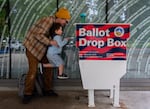
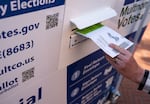
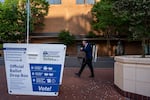
Matt lifts up his three-year-old son, Theo, to cast his ballot into the Hillsboro Public Library-Shute Park ballot drop box on Election Day in Hillsboro, Ore., on May 19, 2026. The two preferred to be identified by first name only.
Eli Imadali / OPB
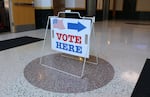
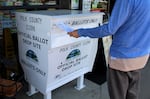
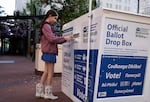
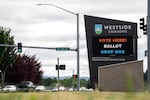
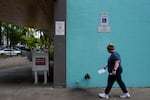
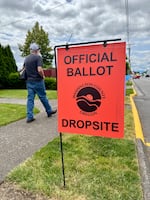



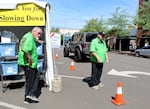
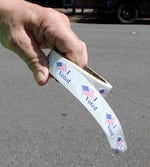
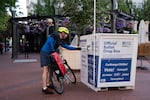
Tuesday is Election Day, and Oregonians are primed to vote on everything from school bonds to fire districts to the state’s new labor boss. OPB will be talking with voters throughout the day and providing updates here.
4:35 p.m.
As Oregonians cast last-minute ballots on Tuesday — for or against taxes, for Republicans, for Democrats, or as independents — voters interviewed by OPB seemed to share one common view: A mostly optimistic outlook on Oregon.
“Oregon’s generally in the right direction,” Walt Knodle, 81, a politically unaffiliated Bend voter, said.
Knodle said he does not think highly of politicians, but he appreciates a focus on the well-being of people in the state.
“I’m not saying they are successful, but they do recognize the homeless problem and there are strategies to ameliorate that.”
Another Bend-area voter, 79-year-old Sister Barbara Julian, said she was feeling upbeat on Tuesday.
“When we get the results of voting today, I think we may be going in the right direction,” the registered Republican nun told OPB.
She’s hopeful that local candidates in her community will be elected into roles where they can prioritize support for people with disabilities, she said — adding that she cast her votes based on each person’s strengths, not their political party.
That optimism was not universal, however.
Portlander Alice Graham had a mixed take.
“I think in some ways we’re headed in the right direction. People are paying more attention to some of the big issues,” she said. But she worries about the way Oregon pays for public education, and she’d like to see a broader tax base to support those programs.
Anne Livingston of Pendleton also worries about state spending and finances, but has a different political take.
“I believe it’s not going in the right direction. We need big changes,” Livingston said, adding that she worries taxes and government regulation are driving big companies away from the state.
12:00 p.m.
Many people who cast ballots Tuesday said they’re concerned about issues that underlie Oregon’s transportation tax measure.
That measure would raise the state’s gas tax by six cents, double registration and titling fees and temporarily hike a payroll tax. If it fails, which most observers expect, Oregon could see massive cuts to state road and public transportation funding.
Lucas Novak of Bend said a recent spike in fuel prices was one factor in his decision to vote against the gas tax. But that’s just part of the story.
“I voted no because it seems like a quicker fix, and we need larger tax reform,” Novak said.
With the cost to fill up his vehicle climbing from $60 a few months ago to $100 this week, financial concerns were also a factor, he said. “People are spread thin.”
In Portland, psychologist Alice Graham shared most of Novak’s concerns, but still voted “yes” for the tax.
“I don’t think that the burden of taxation should fall on people who are already having trouble affording things,” she said. “And I did vote for it because I want to send the message that Oregonians will vote for taxes.”
Finding a sustainable way to pay for public services is one of the biggest challenges Oregon faces, Graham said. “My main concern is we fix our revenue system. I think our taxation system is broken.”
10:50 a.m.
About a quarter of voters had cast ballots as of Tuesday morning, according to the Oregon Secretary of State.
By mid-morning, a steady flow of last-minute voters was depositing their ballots in drop boxes set up across the state.
Outside the Multnomah County Elections Division, Thomas Lundy, who will be entering the Willamette University School of Law in the fall, said he voted against the measure to fund the Oregon Department of Transportation by raising gas taxes and other fees.
“It’s difficult for me to ask struggling families to pay more for transportation, when it’s going to be such a difficult thing to finance in the coming months,” he said. “I think that Oregon is in a good place, but I am worried about the direction we’re headed in.”
In Central Oregon, Bend resident Steve Johnson said he also voted against the gas tax. “I can remember getting gas when it was 19 cents a gallon. It’s hard to deal with, especially when you’re dealing with a fixed income.”
Johnson, who is not affiliated with any political party, said he believes Oregon is headed in the right direction, although he worries about the integrity and independence of politicians in the state.
What to know about the primary:
Oregon has closed primaries. That means voters will nominate their major party candidates for the November election, like those vying this year for U.S. representative and governor. All voters will receive ballots for nonpartisan races and ballot measures.
Related: OPB Ballot Guide: Learn more about the key races and measures in Tuesday's primary
Among the measures is a controversial proposal to fund road and bridge maintenance statewide, Measure 120. But with gas prices soaring due to the war in Iran, Oregonians are already feeling the pinch.
“As someone who has to drive every day for work, it’s almost suffocating,” John Jozic, of West Linn, said Sunday while filling up his tank at the Space Age gas station on 17th Avenue in Portland. He was unsure how he’d vote on the measure, which includes new taxes, but said he sometimes paid more than $60 to fill up the tank for his commute, an hour in each direction.
“If you drive as much as I do, you see a lot of things wrong with the roads still, so you want to give them more funding,” he said. “But at the same time, there are a lot of things that don’t seem to get fixed that quickly.”
Here’s what you need to know about this year’s primary election:
When do I need to turn in my ballot?
Voters have until 8 p.m. to submit their ballot at local dropboxes or county election offices. Mailed ballots must be postmarked by Tuesday and received by May 26 to be counted.
Who’s running for governor?
The Republican gubernatorial primary is the top race this week.
Sen. Christine Drazan, one of Oregon’s most influential Republican lawmakers, is back in the race after losing to Gov. Tina Kotek in 2022. So is Chris Dudley, the former Portland Trail Blazer who, in 2010, came closer than any Republican in decades to earning the job as the state’s top executive.
The crowded field also includes Ed Diehl, a two-term Republican state representative from Scio, who is campaigning on his efforts to gather signatures to stop the gas tax. Danielle Bethell, a county commissioner in Marion County, is also running.
Whoever wins will take on Kotek, a Democrat who is not facing a serious challenger, in the November election. With Democrats expected to turn out en masse for the midterm, they’ll face headwinds in Oregon, which has not had a Republican governor since the 1980s.
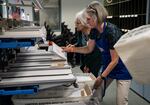
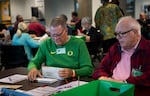
Volunteers Karen Arabas, left, and Diane Roth collect ballots after they go through a processing machine at the Marion County Clerk's office in Salem, Ore., on May 18, 2026.
Saskia Hatvany / OPB
What’s Measure 120?
Oregon lawmakers have been trying for nearly two years to find solutions to the state’s road funding woes. Transportation leaders say they need more money to maintain the state’s aging infrastructure.
State Democrats passed a bill in a special session last fall with a slate of new taxes and fees to fund the system. Then, Republicans gathered enough signatures to refer that law to voters, who they expect will reject it due to the high cost of living.
Measure 120 seeks to raise the state’s gas tax by six cents, double registration and titling fees and temporarily hike a payroll tax to pay for public transit. The proposal is widely expected to fail. No prominent Oregon leaders are campaigning to save it.
Who’s running for labor commissioner?
Two people are vying to be the nonpartisan boss of the Bureau of Labor and Industries, or BOLI, which helps uphold Oregon’s labor laws. Incumbent Labor Commissioner Christina Stephenson, who was elected in 2022, is facing Chris Lynch, who previously worked at BOLI and the Oregon Occupational Health and Safety Administration.
What local races are on deck?
A slew of candidates are jockeying for jobs serving their local communities. Homelessness, affordability and immigration are top issues underscoring races all the way from Bend to Salem to Pendleton.
County commission seats are up for grabs in Washington and Clackamas counties, two of Oregon’s most heavily populated areas. So are four positions on the Metro board, including president. The agency oversees a variety of issues — transportation, homelessness, land use — in the tri-county region that encompasses Portland and its surrounding suburbs.
Meanwhile, four of the eight Salem city council positions are up for grabs, but the most high-profile contest is the race for mayor. Incumbent Julie Hoy, a restaurant owner who won in 2024, is facing a challenge from Vanessa Nordyke, a city councilor and lawyer.
Correction: This story has been updated to fix incorrectly transcribed wording in a quote by Bend voter Steve Johnson.