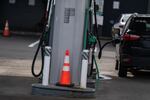
Gasoline is pumped at a Chevron gas station with prices starting at $5.39 per gallon for regular grade unleaded gas in downtown Portland, Ore., on March 16, 2026.
Eli Imadali / OPB
Oregonians overwhelmingly voted against Measure 120, a proposal meant to address funding shortfalls for the Oregon Department of Transportation.
Known as the gas tax, the measure would have increased the state’s gas tax by 6 cents per gallon, temporarily hiked the payroll tax, and doubled fees for registrations and titles. Without the tax, the agency only has funding to support core services until the end of 2027. Daniel Porter is ODOT’s Finance and Budget Division Administrator. He joins us to discuss the agency’s financial future.
Note: The following transcript was transcribed digitally and validated for accuracy, readability and formatting by an OPB volunteer.
Dave Miller: From the Gert Boyle Studio at OPB, this is Think Out Loud. I’m Dave Miller. Oregonians overwhelmingly voted against Measure 120 this week. Known as the gas tax, the measure would have increased the state’s gas tax by 6 cents a gallon, temporarily hiked the payroll tax, and doubled fees for registrations and titles. It was referred to voters after Democratic lawmakers passed a bill meant to address funding shortfalls for the Oregon Department of Transportation [ODOT]. But without this new revenue, the agency only has funding to support core services through 2027.
Daniel Porter is ODOT’s Finance and Budget Division Administrator. He joins us now to talk about the path forward. It’s great to have you on Think Out Loud.
Daniel Porter: Great, thank you, Dave. Appreciate the opportunity to be here.
Miller: I gave the short version of this, but how would Measure 120 have raised revenue?
Porter: That’s right. And your short version is very accurate. We would have had essentially a 6-cents increase in the fuels tax, which is currently 40 cents per gallon. [It] would have increased to 46 cents per gallon and then increases in light vehicle registration fees and title fees, as well as sort of a doubling of the payroll tax for transit that was sunsetted right to the end of 2027. So those are the kind of the core elements of 3991 that were referred to the voters. It would have probably raised, overall, maybe $300 million a year in additional revenue that would then split between ODOT, and cities and counties.
Miller: What would that money have then been spent on?
Porter: That’s a great question, and the idea behind this, for ODOT, was to provide funding for core sort of maintenance and operations functions. ODOT has a very complicated set of revenue streams. Most of the new revenue from prior transportation packages, starting in 2001 all the way through 2017, have been really dedicated to projects, not into sort of the maintenance and operations functions. That hasn’t really seen an increase since like 1993, which is also, interestingly enough, the last time the federal gas tax was increased.
So without those increases, costs have been rising over time, we haven’t had a lot of new revenue. This money was gonna really support those core functions so that we’re able to sort of maintain service levels that we have today.
Miller: What would Measure 120 have meant for public transit?
Porter: It would have been a huge influx of revenue for public transit. It’s basically doubling of the payroll tax, so what that would have meant was … Again, almost think of it as doubling the amount of revenue that would be available for public transit. Although it was short term, it would be interesting to have seen how the transit agencies, transit districts would have had to kind of deal with that, knowing that there’s a sunset on it. But it would have been a really large influx of revenue and help to the transit districts.
Miller: How do you explain the fact that more than 8 out of 10 Oregon voters said no to this measure? It’s just an electoral bloodbath.
Porter: Right, and I think that’s actually probably really similar to the fuel tax that was referred to the voters, I think 2001 or 2000, right around there, where the last time the gas tax was referred to the voters. And timing is terrible with the fuel prices being so high. It’s also something that, as an agency, we were building in the expectation that that revenue wasn’t going to show up. So as an agency, [we] have to build our budgets based on what we call current law, which is basically like taking what we know to be true. And at the time, those are taxes and fees that are on hold until the voters would approve them. They aren’t true and they aren’t in law, so we were kind of building our next budget cycle based on the fact that they weren’t gonna happen. So the agency is already building our expectations around that it wasn’t gonna happen, the increases weren’t going to take effect.
Miller: For the current biennium that we’re now almost halfway through, that goes through the end of June 2027 … is my calendar math right?
Porter: Yes, that’s right.
Miller: OK, so I want to turn soon to the questions of the path forward, but I’m just still curious about your read on this vote. You mentioned the gas prices now, the war in Iran, for example, jacking up gas prices. So one read is that Oregonians just said no, we don’t want to pay more at the pump. Another read that I’ve heard is that Oregonians are wary of entrusting your agency with more money. What do you say to Oregonians who don’t trust the agency right now to be good stewards of public money?
Porter: Yeah, appreciate that, Dave. I think those were pieces of 3991 that weren’t referred to the voters. The bill was a lot broader than just these tax increases. And I think that during the ‘25 legislative session, there was a lot of conversation about ODOT accountability and transparency. They had developed some measures and some ways in which to bring that out, whether it’s through more audits or just being more transparent in our information that we’re providing – those elements stayed and are in place today.
So I think the agencies are really committed to being as transparent as possible, to providing information that is needed to help make decisions for the legislature, for the governor’s office, for the public. And we wanna be providing services that are desired and that are needed, and [we] are committed to do so. So, we’re happy and look forward to what these changes can be and what more things could come along during maybe ‘27 session to help ensure that the public is feeling confident that this is an agency they can trust.
Miller: You had been facing a $300 million shortfall for the current budget cycle. What did lawmakers do in the most recent session to address that?
Porter: Yeah, that’s a great question, because I think a lot of it is that ODOT couldn’t do things themselves, right? We needed a legislature to act in order to be able to maybe move money around or something. And so what they did during ‘26 session, or a short session we just ended, was they took some one-time reductions within the agency. But then they did what they call revenue redirection, which is like moving money from certain funds to other funds in order to basically shift revenue around into our maintenance operations functions, to close our budget gap for our current budget period that we’re in now, like you said, which ends June of 2027.
Miller: As you said, when you were making your plans for this current biennium, the assumption was that these revenue raising pieces – the gas tax, registration fees, title fees – would not be approved by voters. So does this vote have any effect on your programs or your budget for the next 14 months?
Porter: The vote on Tuesday is not going to impact the current biennium. I think when the legislature made the decisions they made during the short session to provide funding for the agency, the expectation behind that was that we would be providing services to Oregonians at the level that support those fundings. So we’ve been hiring and filling positions that are vacant, especially with critical positions, in order to continue to provide service levels. And we will continue to do that throughout the remainder of the biennium, as what we were directed by the legislature and the governor’s office to do.
Miller: The governor has convened a new bipartisan working group made up of lawmakers, experts, stakeholders, some business folks, advocates – various folks that met at the beginning of this month, already. But the underlying fundamentals of the fiscal challenges the agency is facing, those haven’t changed. There are only so many ways to raise revenue for transportation. What can this new work group possibly come up with that has not already been put forward in recent years?
Porter: That’s a great question. I think the hope is that there will be something interesting coming out of that work group. It’s a different work group than what we had a couple of years ago. It’s set up differently. It involves a lot of different parties, and like you said, they just had a kickoff meeting earlier this month, and the subgroups that they’ve set up to look at the specific topic areas haven’t even started to meet yet.
But I think that what they’re trying to do is just look at all the different needs, understand that there’s only so much potential funding to even go around. So, think about [things] like, what are the priorities, what do we want to look at potentially funding? What are the different options that are available? And then package all that and present it to the governor and the legislature as a way to help kickstart a ‘27 conversation.
Miller: You’re not a political analyst. I recognize that, but I’m going to ask you this anyway. Do you see this more as a way to build political capital and to get people who have been wary of giving ODOT more money on board, or a way to come up with something completely new that has not already been discussed?
Porter: Yeah, like you said, I’m not a political analyst. But I think from our perspective – and I’ve been around a long time, I’ve been doing this a long time – it would be the latter of what you said. What I think we’re looking for is … Transportation is a system, right? And it’s something that impacts every Oregonian all across the state, whether you’re a direct user of it … everybody’s a beneficiary of it. So, how do we bring people together, develop some sort of common understanding that this system is a system of layers. ODOT is just one layer of it. Local governments are equally as stressed as ODOT is in terms of funding. How do you pull all that together and then sort of solve for something that everybody can get behind? I think that’s the big question and that’s what we’re trying to solve. And it’s a challenge, but we need to do it, otherwise we’ll be continually back here having this conversation again.
Miller: Is there any way to solve for that without saying somehow, “Oregonians, you’re going to have to pay more?”
Porter: Well, you saw in the ‘26 session what the legislature did. They did some reductions, and then they did some revenue redirection. So I think there’s an element there that could be a combination of things. But the underlying problem doesn’t change, which is [that] our revenue streams are not growing as fast as our costs are growing. And our costs have been rising a lot faster. Until [we] sort of solve for something long term like that, we’re gonna have consistent issues with our budget because what we have right now isn’t sustainable in the long run.
Miller: Daniel Porter, thanks very much.
Porter: OK. Thank you, Dave.
Miller: Daniel Porter is a Finance and Budget Division administrator for the Oregon Department of Transportation.
“Think Out Loud®” broadcasts live at noon every day and rebroadcasts at 8 p.m.
If you’d like to comment on any of the topics in this show or suggest a topic of your own, please get in touch with us on Facebook, send an email to thinkoutloud@opb.org, or you can leave a voicemail for us at 503-293-1983.