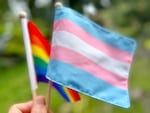
FILE - A rainbow LGBTQ+ pride flag, left, along with the transgender pride flag, right, pictured on June 2, 2022. The Oregon LGBTQ+ Aging Coalition is expanding its services to queer seniors through a new collaboration with the nonprofit AGE+.
Kristyna Wentz-Graff / OPB
The only statewide coalition that supports aging members of Oregon’s LGBTQ+ communities is expanding its reach.
Over the past decade, the Oregon LGBTQ+ Aging Coalition has conducted a survey on the needs of older LGBTQ+ adults and helped pass legislation that aims to protect queer seniors living in long-term care facilities. It’s currently a volunteer-run effort, but a new collaboration with the nonprofit AGE+ will allow the group to hire its first paid staff and eventually assume its own nonprofit status.
Brandy Penner is the executive director of the Coalition. She joins us to talk about the new partnership and the needs of this population.
Note: The following transcript was transcribed digitally and validated for accuracy, readability and formatting by an OPB volunteer.
Dave Miller: This is Think Out Loud on OPB. I’m Dave Miller. The only group that’s solely focused on supporting aging members of Oregon’s LGBTQ+ communities is expanding its reach. The Oregon LGBTQ+ Aging Coalition has been a volunteer-run effort. But a new collaboration with the nonprofit AGE+ has allowed the group to hire its first paid staff member and to eventually become its own nonprofit.
Brandy Penner is the executive director of the Coalition. She joins us to talk about the new partnership and the specific needs of the people they serve. It’s great to have you on the show.
Brandy Penner: Thank you, Dave. Thanks for letting me be here.
Miller: How big is Oregon’s older LGBTQ+ population, and what does older mean?
Penner: Yeah, great question. The state defines it as 65 and older. So we know that we have right around 900,000 folks 65 and older in the state of Oregon. For our coalition, we actually lower that to about 50. So once you add another 15 years onto that generation, we can estimate we have well over a million folks in that bracket that we’re serving. And we know that about 3.5% of our older adults are LGBTQ+ identifying. So that’s, in a conservative estimate, over 35,000 folks.
Miller: How much bigger is this population expected to get in the coming years?
Penner: We know Oregon is an aging state, right? So we, for the first time in history, have more folks over the age of 65 than under 18. And that is expected to continue to grow based on a variety of demographic realities like declining birth rates, for example, folks living longer, better health outcomes. And Oregon, we also know, per capita, has the highest rate of LGBTQ+ folks in the entire nation, and that is also expected to continue to grow. We are definitely seeing a lot of in-state migration specific to our trans and non-binary folks because we are seen as a culturally and legislatively supportive and accepting place.
Miller: How did the LGBTQ+ Aging Coalition first get started?
Penner: It got started well over a decade ago, and it was literally just older aging folks recognizing the need for visibility, for some sort of organizing effort around making sure that the needs and access to services were equitable for our aging queer folks. So it was just a group of volunteers who came together and said, gosh, we need some kind of organizing to happen.
Then I would say about five years ago, those volunteers started to get quite organized. There was a group of folks, including who I like to kind of think of as our founder, Liz James, who really made sure that there was a lot of energy put behind this in growing our coalitions. We currently have about 120 folks across the state, both folks serving LGBTQ+ older adults and also folks with lived experience.
Miller: So, how is becoming your own nonprofit, first partnering with an existing one as a fiscal sponsor but as a kind of pathway towards becoming your own nonprofit, gonna let you do things that you can’t do now?
Penner: In the nonprofit world, fiscal sponsorship is fairly common. It really allows a solid transitional support team, right? So we don’t have to, for example, file for a 501c3 through the IRS. We don’t have to handle our own payroll, some of these administrative, tax filing sort of issues. And it gives us an ability to have time to get mentorship from an established nonprofit, and AGE + has been doing amazing work across the state in aging for quite a few years now. So, really a chance to grow, be mentored, create best practices, get our governing board in place, for example, before we have to launch out on our own.
Miller: We got an email that basically asks, how is this different than Elder Pride Services at Friendly House? So what do you do that’s different than what some other institutions are doing?
Penner: I’m actually, full disclosure, former program manager of Elder Pride Services. It’s an amazing program, centering direct service and countering social isolation through social activities for queer older adults in the Portland metro area. So they’ve been around for quite a while. They tend to be a little bit more focused, like I said, on direct service and also the metro area. We are a statewide coalition. It’s focused on research, education, advocacy, so really that bigger picture, systems changing perspective.
Miller: This question, maybe it relies on broad generalizations which can be a mistake, but how much can you say about the population you’re serving, their specific needs and challenges, compared to the overall 50+ or 65+ population?
Penner: First, I always like to point out this is not a monolith of a group, right? We’re already talking in aging populations of three different generations. Like if we take 50 to, say, 100 +, that encompasses a whole lot of people with a lot of different experiences
Miller: And who grew up at times when society treated them very differently.
Penner: Yes, absolutely. I mean, if we’re talking to somebody who’s 85, they lived during a time of legal state-sanctioned violence, oppression. If we’re talking about somebody who’s just recently turning 50, that’s Gen X, right? They grew up in a time past Stonewall where there was already an expectation of visibility and civil rights. So that’s the first thing I kind of like to point out.
What we see specific to the aging population in general versus the LGBTQ+ aging population is, because of those eras that they have grown up in, oftentimes we see generalized demographic things like lower income earning over time. They’re not retiring in a place where they might have the financial needs of their peers. They tend to often not have as much biological family support. There could have been a history of estrangement, maybe they didn’t have their own biological children. So there can be higher levels of isolation.
There’s also a lot of potential psychological and internal homophobia that they’ve maybe dealt with. So we could have folks, well into their 70s or 80s who maybe aren’t even really out yet. So that process, coming out later in life, is also incredibly impactful. So, I always like to give an example of if you’re unable to tell your doctor your full life lived experience, that will deeply impact the quality of care that you receive. If you’re not able to be out and proud with your neighbors, right, if you’re constantly fearing for your physical safety, obviously it’s going to impact your ability to connect. You’re going to be more socially isolated.
Also, potentially unable to access services that might be available to you. So, in 2021, the state of Oregon conducted the first in the state older adult survey specific to LGBTQ+ older adults. And there were some findings that were really telling that we’ve been able to use to now influence legislation. But overall, the biggest one was that over half of participants reported unmet needs. And that could be in physical health, mental health, economic viability, housing stability. So really kind of trying to suss out, OK, what is the need and then how do we create those systems change.
Miller: And from that survey, the sense you got was that some of those unmet needs were directly tied to sexual orientation.
Penner: Yes, absolutely, and gender identity.
Miller: But my understanding is that that survey also showed some strengths. What were the positives that emerged from that survey?
Penner: Yeah, absolutely. I think the biggest strength is resilience. These are often folks who have had to navigate a lot of complex systems that were not built for them. They have a great ability to have a chosen family, chosen community. They reported that even though they may not have biological family, they still had higher levels of folks that they could call on in case of needs of support, like, maybe you just had a medical procedure. Who’s going to help buy you groceries or who’s going to come feed your animal if you can’t? That type of thing. So that informal networking is really, really strong.
Miller: The numbers there were striking: 80% of participants reported a good quality of life; 72% said that they bounced back quickly after hard times – that resilience that you were talking about; and more than 70% have three or more people that they can count on for social and emotional support.
I’m curious about the diversity within the populations that you’re serving based on region. I mean, how people’s experiences differ – and you got to this a little bit, but just to hear more – based on if they’re in urban, rural or suburban areas.
Penner: I think, as a Portlander myself, there’s a lot of generalization of, we live in this beautiful, progressive bubble where folks are free to be who they are, and I think in general that is true. But the issue with older adults specifically, again, is they grew up in a time where maybe that wasn’t true, right? So that transition is challenging. And I think also, in Portland, we tend to assume that we have the systems in place to support folks within the queer community, and that is not always true. So what we notice is there’s a cultural acceptance, but maybe not a systemic acceptance. So, for example, we don’t have a culturally-specific shelter in Portland for queer folks. So if you’re an older trans woman, for example, needing to seek out shelter space, it can be a very challenging, unsafe situation for you.
So I always like to preface it with that. That, even though we’re in Portland and we have an amazing culture here, there’s still sometimes lacking in support. But then you go outside of the urban cities more, including Eugene and the metro area. And not only is there a lack of culturally-specific services for queer older adults, there’s just a lack of services. So for example, I’ve been told Wasco County has three adult foster homes in the entire county. Now, if you’re a gay man living in Wasco County who needs that service, what are the chances that one of those three is going to be aware of your specific needs?
So really, it’s a constant effort of work of not only bringing visibility to the needs of this population, but making sure we have service providers throughout the entire state who have knowledge of it. We often hear from rural partners of, “well, we just don’t have any queer older adults here,” and I just put my hand up to my forehead and think, oh my gosh, you have to create a safe space for people to come out because there are queer folks in every corner throughout our entire state.
Miller: I’m curious about languages for a second because, in some ways, I think of the word queer as being very generationally-based. And for people – I’m not sure where the dividing line is exactly – maybe 50 or so and under, there’s been a real societal reclamation of a word that, for many people who are older, was – and still is – seen as a slur. How do you think about language inclusion when you’re spanning many generations?
Penner: I always like to encourage people to follow the lead of the folks that they’re speaking to. So if you’re presenting or in front of a group of older adults, LGBTQ+ is the sort of common phrase that’s generally accepted. If I’m speaking with somebody and they use a term that maybe I would think of as a slur, I always like to ask them, “I noticed you use this term. Is it OK that I use that?” Sometimes it’s yes, sometimes it’s no, right? So really coming out of language from a place of curious compassion and having an open conversation of, “Oh, I noticed you use this term,” just like you just did, Dave. Well done.
Miller: Many people, as they get older, move into some form of long-term care or communal living. What challenges do these facilities present for older adults who are queer?
Penner: There’s reportedly a lot of folks fearing that they need to go back into the closet when they move into a more communal setting. Because you don’t know who your neighbors are, you don’t know who your caregivers are. Is this a safe space? So there’s really a lot of sort of fear and uncertainty. One of the reasons that Senate Bill 99 was passed was to address this. It created a bill of rights in the state for not only LGBTQ + older adults, but also people experiencing HIV and AIDS. It creates culturally competent, mandatory training in these facilities, and it also created the governor’s subcommission so that we can help make sure that the highest level of decision makers are aware of the issues facing folks.
Miller: This was two or three years ago, right? I think 2023. Has it made a difference? I mean, it’s been enough years. Have you seen change on the ground?
Penner: Yeah, that’s a great question. We’re now in the area of trying to collect that data, to make sure first and foremost that people are taking the mandatory training. That residents know that they have these rights. I think that’s a huge issue we hear anecdotally, of folks going in and maybe taking a tour of a place, and meeting a resident who also happens to be LGBTQ+, coming out and saying, “I had no idea that I had this.” So maybe they joined the community prior to the Senate bill passing and weren’t presented with a bill of rights in their intake paperwork. Maybe they just don’t have the understanding that this exists. So we’re still very much in an education and outreach phase.
Miller: Speaking of education, you’re working right now on a queer end-of-life planning guide. What’s included in that?
Penner: Well, it’s robust. That’s kind of one of the issues right now we’re dealing with is making sure that it’s navigable for folks, but it’s going to be a digital publication. It’s free for everybody, and it’s going to cover everything from advanced directives, estate planning, making sure that you know: is there a queer-friendly death doula in your area or a funeral home so that folks, we can really encourage them to plan for these things. Because the worst case is that you get to that point and you don’t have any of this in effect.
So, we’re coming at it from an older adult perspective, but honestly, every age across the span, we are hoping we’ll engage with the end-of-life guide to make sure that it just becomes practice to get these things in place.
Miller: I understand you’re also working on potential legislation related to what are known as “respect after death policies.” What would that enshrine in law?
Penner: We’re modeling it after California and D.C. that have current legislation on the books in this regard. It would make sure that folks’ gender identity was respected after their death. So, either by a written proclamation that the person had in their estate planning or licensed government documentation, if they had [it], to ensure that folks have that human dignity after they pass, that folks can’t come in and misgender them…
Miller: On their death certificate?
Penner: Correct, yes, or a medical examiner or coroner making just visual assessments of somebody and deciding their gender for them. So it’s partially human dignity. The other part is actually that research and data collection. The medical examiners out of the metro area came out with a study a couple of years ago that studied this exact issue. And between 2011 and 2021, over half of gender non-binary and trans folks were misgendered on their death certificates. So we’re not getting correct data, which is a huge problem.
Miller: You just have about a minute left. But what drew you to this population, to working with people who are aging? We’re all aging, but people who are already older.
Penner: Best case, we get to be older, right? Yeah, our culture does such a disservice to aging when really, honestly, it’s a time to thrive for most folks. So that’s part of it. It’s a generalized human experience. And then working specifically with the LGBT+ community of really understanding there’s … Like we said, Elder Pride Service is the only local nonprofit working with this population, and we’re the only statewide agency, so we need more folks lending a hand to this.
Miller: Brandy, thanks very much.
Penner: Yeah, thank you.
Miller: Brandy Penner is the executive director of the Oregon LGBTQ+ Aging Coalition.
“Think Out Loud®” broadcasts live at noon every day and rebroadcasts at 8 p.m.
If you’d like to comment on any of the topics in this show or suggest a topic of your own, please get in touch with us on Facebook, send an email to thinkoutloud@opb.org, or you can leave a voicemail for us at 503-293-1983.