It’s just after the morning rush when Mike Christman walks into Black Bear Diner in Southeast Portland. He sits down at an empty table and starts flipping through the sizable menu.
He’s not ordering breakfast though — he’s planning his inspection.

Mike Christman loves being a health inspector and has done the job for almost three decades. He examines dates in a walk-in cooler at Black Bear Diner on May 13, 2026.
Lillian Karabaic / OPB
For this installment of “At Work With,” we followed Mike Christman, a registered environmental health specialist for Multnomah County, for a day of checking temperatures and inspecting dates to find out what it’s like to be a health inspector.
Christman has been a health inspector for almost 30 years. He got into the field by chance after a friend suggested he might be good at it. And he had the right educational background, with his biology degree from Portland State University.
He loves his job so much that he even moonlights as a health inspector on the weekend for other counties.
While he sometimes inspects spas, pools and daycares, he mainly focuses on restaurants.
What do you wish more people understood about your job?
“Historically, people always say, ‘You don’t look or act like a health inspector.’ I think people are under the misunderstanding that we’re kind of mean, forceful, aggressive,” Christman said.
“In my job, I try to be as nice as possible and kill people with kindness and get compliance.”
“We’re out trying to make a difference. We’re out to protect public health. We’re not all mean. We’re people too,” Christman said.
“We’re just trying to do our job, but we’re trying to do it correctly to protect the public health. That’s the bottom line for us.”
What’s the process like for an inspection?
Christman has a checklist he works through.
“It varies each inspection individually,” he said. “I usually will start with the flow. Sometimes I’ll start at the back door and walk through where the foot goes into the walk-in cooler, goes out into the kitchen itself.”
“Sometimes I will start on the grill line. If it’s near lunchtime and it’s not lunchtime, I will start on the front line. That way when lunchtime comes, I’m clear of the line and they can continue as they are. So it just varies facility to facility.”
“You want to verify the menu, processes, cooling, reheating, cooking, animal proteins. Then just follow the flow of the food within the kitchen through the walk-in cooler and staffing,” Christman said.
He writes up his reports, on a tablet, at the end of his walk-through and has the manager-on-duty sign it.
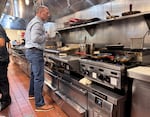
Mike Christman loves being a health inspector and has done the job for almost three decades. He conducts a routine inspection of Black Bear Diner on May 13, 2026.
Lillian Karabaic / OPB
If there is a priority item that the restaurant needs to remedy, he’ll come back to confirm that within 14 days.
If there’s a violation that requires an immediate shut down to preserve public safety — such as the fridge being out or finding a roach infestation — he will come back within 24 to 48 hours.
For a restaurant he’s not familiar with, it might take four or five hours to do a full inspection. For a restaurant that’s familiar, it might take less than an hour to re-inspect.
Can you tell when something is wrong right away?
“It’s when you pretty much you walk in, and you go in the walk-in cooler,” Christman said. “You do this long enough, you can figure out the ambient temperature just by walking into it and you kind of go, ‘This is not where it should be temperature wise.’”
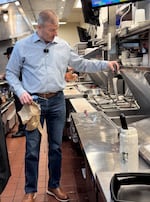
Mike Christman said every inspection looks for the same thing, but in a different order depending on the restaurant. “You want to verify the menu, processes, cooling, reheating, cooking, animal proteins. Then just follow the flow of the food within the kitchen through the walk-in cooler and staffing,” he said.
Lillian Karabaic / OPB
What makes someone good at this job?
“Communication is very key. Paramount to this position is you must be able to communicate what you are trying to get across to the operators, and that’s kind of the bottom line. If they’re a great communicator, I can train them,” Christman said.
What is the most important part of your job?
“I want to set people up for success and I want people not to fear us as health inspectors,” Christman said.
“We’re here to help you. We want to make sure you’re in line with the code, doing things that you should be. That way everything going forward is smooth. There’s no issues, no violations, no potential issues that may arise that possibly close a facility.”
What’s the hardest to train someone on?
Christman said there are hundreds of violations within the code.
“The hard part of the job is the inspector learning that,” he said. “It just takes time. It’s a lot in that to learn the code.”
Is there something small that most people would not notice but that you immediately pick up on when you walk into the back of a kitchen?
“Hand-washing,” Christman said. “Humans carry a lot of disease. Hand-washing helps prevent that. We don’t want that spread.”

Mike Christman washes his hands dozens of times a day when on-site inspecting restaurants. "We like to practice what we preach," he said.
Lillian Karabaic / OPB
What does a roach smell like?
“It’s a musty distinctive odor. It’s very similar to a rodent. It’s the same kind of thing,” said Christman.
But looking for pests also involves more than the nose.
“There’s other signs. Droppings — I’ll call them ‘brown rice’ — in the corners, that’s rodents. Roaches, they leave little specks similar to pepper, coffee grounds on the corners. You draw your attention to them when you see it.”
What’s your worst day on the job?
“Worst day on the job? Every day is a great day on the job,” Christman said.

Mike Christman tries to time his surprise inspection around the usual flow of traffic. “Sometimes I will start on the grill line. If it’s near lunchtime and it’s not lunchtime, I will start on the front line. That way when lunchtime comes, I’m clear of the line and they can continue as they are," he said.
Lillian Karabaic / OPB
What’s your least favorite part of the job?
Christman said he’s not a huge fan of paperwork in the office, or emails. “I consider myself a people person. I like talking to people. So phone calls, I don’t mind. But I prefer to talk to them in person. I want to make sure people get it right.”
What’s your favorite part of the job?
“I love the variety. I love the fact that every day is different. I’m not stuck in an office,” Christman said.
A change that resulted from the COVID-19 pandemic is that field inspectors don’t need to start their day in an office. They have county-issued vehicles and are able to plan their day without going into the office.
“We start in the field and we get more done,” he said.
Are there any health code rules that you think are silly?
“There’s a science behind every piece of that code,” Christman said.
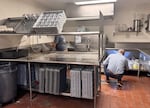
Checking the chemical levels of dish sanitizing machines is standard protocol for Mike Christman when inspecting restaurants.
Lillian Karabaic / OPB
Has a restaurant owner ever tried to bribe you?
He said that hasn’t happened, but sometimes owners do try to argue.
“Communication skills can help diffuse that issue,” he said.
And sometimes staff will try to offer food as a welcome.
“They’re just nice,” said Christman. “They offer food because that’s a cultural thing.”
But he doesn’t accept food from the places he’s inspecting when he’s on-duty.
How are the standards for certifying the health of food truck pods different than those for restaurants?
The food pods are licensed separately from the individual food carts.
“We do license a food pod. They must have proper potable water connections, sewer connection, unless the carts themselves are disposing of water themselves or have a gray-water hauler come. They must have refuge, recycling, garbage, et cetera. Overall, the pod must be maintained and cleaned,” Christman said.
“Food carts, they’re very similar to a restaurant. The same code applies ... It’s a small unit, so they can only make so much food. So cooling is a big factor in how they do things in there. But the same thing applies — personal hygiene, hand washing, hot holding, cold holding temperatures, same as a restaurant," he said.
What are the most common violations?
“You see the big three: cold and hot violations, as well as cooling violations,” said Christman.
What is the process to become a licensed inspector?
“It’s a very competitive,” Christman said. The position requires a bachelor’s degree in a science-related field.
“Once they’re on board, they have a two-year training process. They become a registered environmental trainee,” Christman said. During the training period, they learn on the job and work alongside a supervisor. “They do their inspections, they learn by the mistakes. Hopefully it’s not egregious mistakes, but they learn by mistakes.”

Mike Christman examines the menu at Black Bear Diner before starting his inspection, looking for different types of animal protein that have different handling rules in the health code.
Lillian Karabaic / OPB
“They use us staff as interpretation of things when they need help. And then once two years, they take a national exam through to become a registered environmental health specialist,” he said. Once they have passed their exam, they work independently.
Are there any red flags that diners can spot themselves?
“I always say if the restrooms are clean, the facility’s probably clean,” Christman said.
Open and visible kitchens make it easier to ascertain the cleanliness. “If it’s an open kitchen where public can see it, [the] public’s pretty in tune to what’s going on,” he said. “They can see if something goes awry in the kitchen.”
Have you seen ‘Ratatouille’?
Mike Christman hasn’t seen 'Ratatouille‘, a 2007 animated film where a rat is in charge of a restaurant kitchen. But he said that even if the rat wore gloves, it wouldn’t be up to code to have them cooking in a kitchen.
“Rats and cockroaches carry a lot of vector disease, a lot of disease in those animals,” he said. “We don’t want them in the food. We ask them to stay home.”
Should I report a restaurant if I suspect something is unsafe?
“We like to have communication. Some of our facilities that we do, we are only there twice a year, and it’s only a little small time that we’re there to do an inspection,” said Christman. Multnomah County environmental health department encourages the public to report any food safety concerns or cases of food poisoning.
“Sometimes our eyes and ears are the public,” Christman said. “They call and they say, ‘This place is doing this and this,’ and we do investigate those complaints to make sure they’re doing what they should be.”
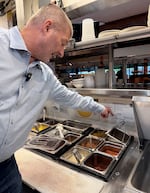
Mike Christman looks at the posted instructions for food prep temperatures Black Bear Diner while inspecting the restaurant.
Lillian Karabaic / OPB
After seeing so many restaurant kitchens, do you still enjoy eating out?
Yes. Christman even sometimes goes back to the restaurants he inspects off-the-clock as a diner if the food looks tasty. But, he cautions, “I know where not to eat.”