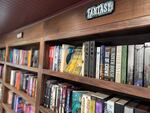
The inside of Lost & Bound Books, a mobile bookstore owned by Desirai Vuylsteke and Sidnee Andreychenko, on June 4, 2026, the day of the "Think Out Loud" interview about Portland Book Week. The mobile bookstore is one of more than 80 independent bookshops participating in the third annual event.
Allison Frost / OPB
For the third year in a row, the Cascade Booksellers Association has thrown a kind of huge book party for book lovers in the Portland metro area. The idea is to highlight the huge variety of book shops and get people out to visit as many of them as they can. More than 80 bookstores are participating in Portland Book Week this year, including the White Rabbit Book Cafe in Oregon City, Maggie Mae’s Bookshop in Gresham and Lost & Bound Books, a mobile bookshop based in Portland. We sit down with owners Danielle Walsh, Sho Roberts and Desirai Vuylsteke to hear more about what led them to start their independent shops, how they see their role in their communities and their fondest hopes for the week.
Note: The following transcript was transcribed digitally and validated for accuracy, readability and formatting by an OPB volunteer.
Dave Miller: From the Gert Boyle Studio at OPB, this is Think Out Loud. I’m Dave Miller. For the third year in a row, the Cascade Booksellers Association is throwing a kind of huge book party for book lovers in the Portland metro area. The idea is to highlight the wide variety of bookshops and encourage people to visit them. More than 80 bookstores are participating in Portland Book Week this year. I’m joined now by the owners of three of them. Sho Roberts owns Maggie Mae’s Bookshop in Gresham. Danielle Walsh is the owner of White Rabbit Book Cafe in Oregon City, and Desirai Vuylsteke is a co-owner of Lost & Bound Books. That’s a mobile bookshop based in Portland. It’s great to have all three of you on Think Out Loud.
Danielle Walsh: Thank you.
Sho Roberts: Thank you.
Desirai Vuylsteke: Thank you.
Miller: I want to start with a voicemail, because we asked folks about their favorite small or independent bookstores all across Oregon. This is Diane who called in from Sherwood.
Diane: I love the Sherwood Bookstore, an independent bookstore in Sherwood, Oregon. The young family that started it are digital people, but opened it to fill a void in the community and provide a welcoming, safe space to bring people together. They hold many book-related activities, including young authors’ workshops this summer. They care about the community and books in that order. At least that’s my impression.
Miller: Sho, what does it mean to you to care about community in the context of running a bookstore?
Roberts: I think she got that right with, I feel like booksellers, we care about community and then books. Like for us, bookstores represent the community. We are part of that community, but it’s also a place where you can go and be seen and meet other people as well. We do a lot of community events in our bookshops, so it’s really important. I feel like that’s what makes bookstores a little bit different than maybe some other retail bookstores.
Miller: Danielle, so I’m curious about that. So how is a bookstore, maybe this is a silly question, but how is it different from a pet food store or a grocery store? There are all kinds of retail options. What’s different about selling books?
Walsh: I believe that booksellers are really interested in bringing people together. So White Rabbit hosts four free events every week, Thursday through Sunday nights, because we want people to come and talk to their neighbors and create a sense of community. So I think that that’s what we all do.
Miller: How do you create community through books?
Walsh: We create it through representation. We want people to see themselves on the shelves when they walk in. And then people come and talk about books. So the idea is, how did you relate to it? How did it affect you? What did you connect with? And even people who come in for bunco are sitting next to books and talking to booksellers that love books.
Miller: So it’s a kind of osmosis, even if they’re not opening them, they’re near them.
Walsh: It’s a step.
Miller: Desirai, with a mobile shop, a converted bus, are you a kind of event everywhere you go?
Vuylsteke: I would say so, yeah. I mean, we are partnering with other local businesses like breweries and coffee shops. So when you come, most people are coming in with beer or coffee and going for an experience. We try to curate to wherever we’re at and the community that we’re in, but generally yeah, it’s always an event. People are always excited to come see us.
Miller: This mobile bookshop is a side gig for you and your co-owner, but it seems like it’s a lot of work.
Vuylsteke: Oh, yeah.
Miller: Why do you do it?
Vuylsteke: Why not? We love it. We love books and we love being out with other people that love books as well. We found a need. There’s nothing like us out here besides Evie, which is through the county, I think it’s in Washington County through the library there. And we’ve heard in the past and since doing this whole experience with the mobile bookstore, a lot of people are like, oh, I remember this as a child growing up. The book bus coming out to us and picking out books, and it’s nostalgic. So having that experience again for people, it’s been special and it’s been great.
Miller: Sho, what about you? You were a full-time educator, I understand it. Why did you decide to open a bookstore?
Roberts: For me, it was always like something I did when I retired, and I think I got to where I was like, well, why am I waiting to do what I want until I retire? So that’s where it started, and I started off really small. I would go to all the street markets in Portland in the summer selling used kids’ books and then building up to make sure that I could be able, I was like, OK, this is something I can do. I can do this, and then going from there.
So I was like, I love books, especially, I started off with children’s books. They’re pieces of art and they’re so important for kids. But also I feel like grown-ups, when you read a kid’s story, you’ve experienced so much more, so you get something out of it as well. And I was like I wanted to keep that passion I have for it, but also meet people who have that passion. And I was in an area that was a book desert. Gresham was kind of a book desert a little bit, so I wanted to be able to be there too and have that for people.
Miller: Danielle, was this a kind of a culmination of a lifelong dream for you as well, or was it a more recent decision?
Walsh: I’ve been in business almost 12 years and I was taking actually one year off from education as well. I was just gonna do this little teeny 400 square foot spot, only to find that the wonderful community in Oregon City wanted to talk books, wanted to have a bookstore, and so here we are.
Miller: We asked folks on Facebook about their favorite independent bookstores. We got a lot of responses and a lot of geographic diversity.
Jill Rogers wrote, “Oliver Books in Prineville. As a small community, it’s always been a struggle for independent businesses and especially so for a bookstore. The owner of Oliver Books has built a welcoming and creative space that has quickly become a part of the community.”
Katie Withey wrote, “Betty’s Books in Baker City. It’s so nice to have a bookstore on the eastern side of the state.”
Lisa Lawrence said, “Cloud and Leaf Bookstore in Manzanita. It’s a must for browsing, buying, and small town friendliness.”
And Nancy Novak wrote, “It’s a toss-up between Bob’s Beach Books in Lincoln City and Good Books/Bad Art in Hood River, both great community bookstores and good book buying and selling experiences.”
We also heard about Paulina Springs and Sisters Floodtown Books in Hepner, Wacoma Bookstore in Hood River, The Book Loft in Enterprise, Rebel Heart Books in Jacksonville, and on and on. And we got this voicemail from Tom:
Tom: My favorite by far is Roberts in Lincoln City. Those guys rock. Every time I go in there, it’s like a treasure hunt and just an amazing bookstore overall. They have everything in there. They have games. I mean, original artwork. It’s an amazing place. I just love it.
Miller: All of you are in either Portland, Desirai is based here, or in the Portland area, Gresham and Oregon City. So not, say, in Enterprise or far away from a major metropolitan center. But Danielle, in Oregon City, what do bookstores that are not directly in a really large city, what do you need to do in order to survive?
Walsh: I think community first, so trying to create safe places for people to come in and talk to each other and to interact with books. So we tell people, come in, talk books with us, take pictures, and then go to the library.
Miller: You say that?
Walsh: Yes, we want a literate society for a democracy. We want people to read. People can come to book groups without buying the books with us. There’s no cost. We want people to read.
Miller: That seems like, and you’re nodding here, it seems like lovely advice for a lovely society, but it doesn’t sound like necessarily an obvious recipe for sales. Sho, how much do sales matter?
Roberts: Sales matter because we need to stay alive, and keep in business, but it is about that, like, I just want you to read a book and I want to have a discussion and us being, you gain understanding where people are at. That shows so much more too, because you’re going to keep coming back because people see you for where you are and who you are at that moment. And we have the new East County Library just blocks away. So we’re like, oh yeah, go to the library. We love the library and support the library, like everyone should. So I feel all book lovers still go to your independent bookstores, go to your library, and that’s how we can still have that literate.
Miller: Joy Bruce, when asked on Facebook about their favorite library, she said, “No favorite. I love all bookstores that have a few comfy chairs, a store, cat or dog, and books everywhere on steps, stacks, on floors, on desks, and the store needs a book smell when you walk in. When I want a nice neat arrangement throughout, I go to the library.” What’s the value, Desirai, of ambience, the feel of the book shopping, book browsing experience?
Vuylsteke: Oh, it’s everything. Everybody wants to be cozy. I envision a bookstore being taken like you’re being transported to somewhere. So whether that’s being a fantasy or into, I don’t know, outer space or something, I don’t know. At our bookstore, we try to make this little cozy hobbit hole type situation, apothecary style, so when you come in, you’re getting that full experience. It’s warm, it’s cozy. Experiencing Sho’s bookstore, Maggie Mae’s, it’s whimsical in there. It’s vibrant, you’re just, I don’t know, something about having that experience in your bookstores is so important.
Miller: There’s a mention of the cat and dog there. We got other people talking about this. Jenna May wrote, “The Book Bin in Salem, excellent, inclusive environment, great selection, easy resale process, friendly staff, and Rose the cat is a lovely bonus.” And Dennisa Lockwood wrote, “Vintage Books in Vancouver. Spending rainy days perusing the stacks with Maisie and Oliver, the store cats, are some of my favorite days.” Do any of you have store cats or dogs?
Roberts: No, I’m named after our dog, but we do not have a dog.
Miller: Maggie Mae. OK, it’s not some old song.
Roberts: Nope, it was named after my bulldog, Maggie. And I just wanted her to, she was always gonna… [The] very best snuggle partner and reading companion, and I always wanted her to be around. And she lives in spirit though, so we have always welcomed dogs to come in.
Miller: But no, no resident dogs.
Roberts: Not yet.
Miller: This is Lawrence who called in from Portland.
Lawrence: I wanted to give a shout out to Lost Avenue Books on MLK Boulevard. It is a tiny little shop that has one of the most expertly curated collections, in my opinion. A lot of translated work, contemporary literary fiction, poetry. It’s run by a great guy and they have a great book club every month.
Miller: We had some other folks who brought up selection. Tom Richards said, “Mother Foucault’s in Portland is the best and most authentic. They have the best books – none of the popular crud — and I’m also a big fan of Word Virus books off Burnside and 9th. Super nice couple that owns a store. I can always find great modernist novels there.” And Kurt Kemmerer wrote, “Broadway Books, where the curated selection is wonderful. The staff are friendly, knowledgeable, and offer wonderful recommendations, add the regular evening readings to the mix, and it’s just about the perfect independent bookstore imaginable.”
So all these folks are talking about selection, and Desirai, first, because I’m curious, you have, I think, the smallest space to work in a converted mini bus. How do you decide what to carry?
Vuylsteke: Oh man, that’s a tough one. We do have a small selection, so our primary focus is horror, romance, and fantasy and a little bit of fiction. We try to curate to the most up-to-date, latest books that are out there, and also very special editions. So all the pretty books that you can find, sprayed edges, all of them.
Miller: Sho, what’s your balance between carrying, I don’t know, obscure titles for nerds, I say lovingly, people who say, “none of the popular crud,” and also popular titles for everybody else?
Roberts: We really just go to what the community wants and what they keep showing up to purchase and going kind of that way. So our selection more is curated by the community than us, and sometimes we’re like, “Oh, you’re going to love this because we loved it.” We’ll bring in books that the booksellers love and know that they can talk about, so that’s how we kind of do our more curated selection.
Miller: So if you’re sort of listening to your readers, your customers, your community, what are the big messages you’re hearing right now? What are people into?
Roberts: Right now for us, horror is really big. We have a horror book club, and then our customers were wanting a sci-fi or fantasy book club. So we have one of those now, and we’ve increased that selection as well. So we’ve kind of are hearing like, well, we want more of these books or this, so we do our research and we bring in more books or ask them for recommendations, and then they tell us and we bring in books that customers already love.
Miller: Danielle, what about you? How do you figure out what to carry?
Walsh: I was a school librarian, so I actually use more of a review process for our front list, but then each one of our staff is in charge of their own section or sections. And so they do a lot of buying and decisions for that, which is super fun for the community. So we call Terence our romance expert, and he does all romance and romantacy and will stand and talk to you for half an hour. Em does horror. Sterling does fiction. So everybody has their own areas that they’re curating and watching, taking care of, displaying.
Miller: And is there like a 3-by-5 card saying “Em’s picks for romantacy” or whatever this month?
Walsh: I mean, we have picks, we have 500 of those, so we do them, everybody does them in every section.
Miller: This reminds me, a lot of folks did talk about genre-specific stores. Joshua Gross said “Vivian Culinary Books in Portland, great owner and wonderful store full of vintage cookbooks.” Roy Kaufman wrote, “I love Parallel Worlds books on Alberta, all fantasy and sci-fi,” and Kathy Camper wrote, “Green Bean Books and A Children’s Place Bookstore, excellent support of kids and YA books.” I’m curious what you all see as the challenges or the benefits of really focusing in on a genre. None of you, it seems, focus wholly on one genre like these particular stores do, but how do you think about that kind of specialization? Desirai?
Vuylsteke: I think the benefit would be, you know so much about that specific genre. So if it’s romance, then you are curating everything that is in that genre. So you can have romantacy and dark romance, and it could just be a lot easier to navigate those books and know what you’re selling to people.
Miller: Danielle, what about you? How do you think about the idea to be a little bit more of a generalist as opposed to a specific focus store?
Walsh: I think that what people feel passionate about is going to be the thing that they are successful at. So our collection actually changes according to staff. So as people come in, the things that they feel passionate about, those sections will change, grow. So what people feel passionate about.
Miller: Sho, how do you think about online sellers like Amazon and in particular, I mean, how do you think about competition? It’s very easy for someone on their phone, on their computer to push a couple of buttons and then maybe the next day, a book will arrive at their doorstep, maybe even a used book, and probably it’s not gonna cost that much money. But that money is not going to you. How do you think about the overall marketplace of books right now and where you fit in?
Roberts: I think we fit in in a really great spot because we are able to remind people that if you shop online, you can still shop online through us. It’ll get there a little bit longer, but it’s gonna be more taken care of. There’s going to be more care into packing that, as well as like a little note, and we really appreciate that, we celebrate every sale. And it’s also keeping money into our community and we’re able to then give more events, do more things for our community. Where if you’re shopping elsewhere, like a big store like Amazon – boo – they’re not caring at all where you’re, about your money or what you’re doing and things like that. Where we all, I think all independent bookstores, we celebrate every sale and we really put the care into making sure that book gets to you in a great way as well.
Miller: Let’s listen to one more voicemail. This is Maggie from Milwaukie:
Maggie: My favorite bookstore in the Portland metro area is the Clackamas Bookshelf, located on the Kraxberger Middle School campus in Gladstone. The reason that this is such a special bookstore is that it’s a funding mechanism to help fund the Clackamas Bookshelf’s mission, which is giving free books to kids in Clackamas County. The bookstore is open one day per month, either a Saturday or Sunday. They have about 10,000 different donated books, but run the entire gamut from mysteries to romance to cooking, lots of fiction. All books are 50 cents each. Children’s books are 25 cents each. And again, all the proceeds go to buying new books for children in the county to help increase children’s literacy. The bookshelf partners with the different school districts in Clackamas County, as well as Head Start and some other community organizations to make sure that books are getting to the kids who really need them the most.
Miller: Danielle Walsh, Sho Roberts, and Desirai Vuylsteke, thanks so much for coming in.
Roberts: Thank you.
Walsh: Thank you.
Vuylsteke: Thank you for having us.
Miller: Desirai Vuylsteke is a co-owner of Lost & Bound Books. It’s a mobile bookshop that’s based in Portland. Sho Roberts owns Maggie Mae’s Bookshop in Gresham, and Danielle Walsh owns White Rabbit Book Cafe in Oregon City.
“Think Out Loud®” broadcasts live at noon every day and rebroadcasts at 8 p.m.
If you’d like to comment on any of the topics in this show or suggest a topic of your own, please get in touch with us on Facebook, send an email to thinkoutloud@opb.org, or you can leave a voicemail for us at 503-293-1983.