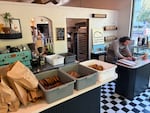
Josh Fairbanks prepares bread and bagel orders at his Fairbanks Bread pop-up in Portland, Ore. on June 1, 2026. He turned a 2021 pop-up into a thriving business, saying the pandemic gave him the audacity to try something new.
Crystal Ligori / OPB
Every Monday afternoon, Rebekah Lee and her young daughter Rosemary have a scheduled “date” to pick up bagels and bread at a pop-up in Northeast Portland.
“My husband and I moved from New York City, so I was on the hunt for some good bagels,” said Lee. “We made it our Monday afternoon ritual, a fun thing to build into our rhythm that we get to do at the end of my workday.”
Lee has been a devotee of the baked goods from Josh Fairbanks for more than a year, shortly after his bread and bagel pop-up moved into the Portland cafe Ollini on the one day a week the traditional bakery is closed.

Nearly three-year-old Rosemary enjoys a chopped chocolate bagel from Fairbanks Bread on June 1, 2026.
Crystal Ligori / OPB
“They always wanted to be closed at least one day a week and I’ve always wanted bakery equipment [without] a 10-year lease and $100,000 of debt,” he laughed.
Fairbanks grew up making bagels with his grandma in Maryland and like many East Coasters, when he moved out West couldn’t find a good bagel.
“There’s something about bagels that everyone has an opinion on,” he said. “I think we can embrace lots of different good breads, and we can’t really embrace lots of different mediocre bagels.”
In Fairbanks’ words, he was ‘saved’ by a road trip to San Francisco, specifically by the breads at the famed Tartine Bakery. After some persistent emailing and an eventual job interview, Fairbanks landed a job at Tartine working under lead bread baker Nick Beitcher. This was in 2018, at a time when East Coast-style bagels had just started making a name for themselves out West.
“While I was working at Tartine, they had a bagel pop-up starting called Midnight Bagel‚” he said. “And now there’s this whole kind of wave.”
Fairbanks made the move to Portland in 2020, at a time when much of the city’s restaurant workforce was still struggling to find work.
“[Businesses] had not hired back the people that they had laid off and I think a natural response for a lot of folks who couldn’t find work was ‘I’ll just do my own thing’,” he said.
His own thing ended up being Honey Bagel, a micro-bakery pop-up serving fresh bagels out of a local pizza joint before their nightly service.
“I think that the pandemic gave us audacity,” he laughed. “It gave us the ‘f**k around and find out’, ya know? Like, let’s have a pop-up and if I’m 200 bucks in the hole, then I’m 200 bucks in the hole.”
Fortunately for him, word of mouth and a write-up, by food critic Karen Brooks gave his bagels a cult following and now regulars schedule their Monday afternoons around their bagel pick-ups.
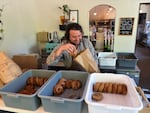
Josh Fairbanks packing up a bagel order at his Fairbanks Bread pop-up inside Ollini in Northeast Portland, Ore. on June 1, 2026.
Crystal Ligori / OPB
This may all seem extreme for anyone outside of this bagel revolution, but Sam Silverman, who is New York’s self-proclaimed bagel ambassador, explained that the simple formula of flour, water and yeast is much more than its ingredients.
“Even though the cost of the goods is relatively low, the amount of time and effort that goes into it is much higher than a lot of other foods,” he said.
Silverman, who is also president of Bagel Up, an organization dedicated to “promoting bagels and the people, culture, and community behind them”, said Jewish immigrants brought their bagels to the U.S. from Poland at the turn of the century. By the mid 1960s, bagels started to make their way into homes across the country, pre-packaged and frozen.
“Murray Lender and Lender’s Bagels successfully assimilated bagels into American breakfast culture,” said Silverman. “But since then, there have been these divergent paths.”
While grocery store bagels have been mainstream for decades, the rise of fresh, hand-rolled bagels beyond the East Coast is more recent, accelerated in part by the pandemic.
“The exodus of New Yorkers and Northeasterners who went to other places in the country and brought their standards for bagels with them was the perfect match for local entrepreneurs to fill that hole in the market,” said Silverman.
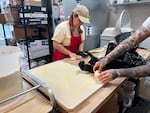
Pipsqueak Bagels owner Madilyn Gibbons hand-rolls bagels at her shop in Portland, Ore on May 13, 2026.
Crystal Ligori / OPB
And it’s entrepreneurs like Fairbanks and Madilyn Gibbons, owner of Pipsqueak Bagels in Portland, who are stepping up to fill that hole.
“I come from a long line of bakers,” explained Gibbons while slicing off long strips of dough, deftly twisting sections into perfectly round bagels. “I would always give baked goods away to my neighbors, like challah or cakes, and it wasn’t really until I started sharing bagels with people that they were like, ‘Those are really amazing, are you selling those?’”
After years of Gibbons doing farmers’ markets and bagel pop-ups, Pipsqueak went brick-and-mortar in April.
“We’re selling through everything, every day,” she said. “Ever since the day we opened, it’s been lines around the block. It’s been amazing.”
Gibbons says she sells around 1,500 bagels a day, each one hand-rolled, boiled and baked by a small staff.
“We get here at 4 a.m. and we have three people,” she said. “Someone who’s boiling, someone who’s on ovens, and somebody who’s doing dough production.”
At Pipsqueak, dough production happens six days a week because making bagels is a multi-day task.
“From start to finish it’s like a three-day process,” said Gibbons. “We do a 48-hour fermentation, so we’re always working two days ahead.”
On weekend mornings, the line at Pipsqueak is often snaking around the corner with people waiting 40 minutes or more for a bagel. Many of the customers are looking for a bite of nostalgia, while others are experiencing bagels like these for the very first time.
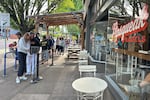
A line of waiting customers wraps around the corner in front of Pipsqueak Bagels in Portland, Ore. on May 10, 2026.
Crystal Ligori / OPB
Fairbanks thinks this bagel boom has room for everyone, bagel makers and bagel consumers alike.
“I want to wholeheartedly support traditional bagel making and at the same time, I want people to feel like they have their own expression within that,” he said.
Honey Bagel and Pipsqueak are just two of the many artisan bagel shops that have opened recently in Portland, but Seattle has also seen a similar trend with Hey Bagel opening last year and capturing the title of ‘Best Bagel’ at the first-ever West Coast BagelFest. With artisan bagel shops also opening in McMinnville, Eugene and Grants Pass, this bagel boom is showing no signs of slowing down.