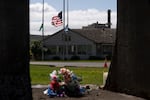
The Washington state, American, and Nippon Dynawave flags fly at half-staff while flowers mark a makeshift memorial on old mill equipment in front of Nippon Dynawave Packaging Co. for the victims of the May 26 chemical disaster, in Longview, Wash., on May 29, 2026.
Eli Imadali / OPB
The Association of Western Pulp and Paper Workers in Vancouver, Washington, is the union that represents the nearly 400 workers who were working at the Nippon Dynawave Packaging Co. when a chemical tank ruptured at the paper mill last month. Eleven employees died, all of whom were union members.
AWPPW has been coordinating relief efforts, including donations, to support and assess the needs of victims and their families. Last week, the union announced it had reached an agreement with Nippon Dynawave to secure full pay until at least Aug. 8 for workers who are unable to or were instructed not to work. Those who are scheduled to work will receive an additional three hours of pay for each shift they work.
A federal investigation into the cause of the rupture is currently underway and being led by the U.S. Chemical Safety Board. Josh Estes, a spokesperson and former local union president at AWPPW, says the union supports the demands for answers and accountability from victims and their families to ensure that a tragedy like this doesn’t happen again.
Estes joins us to share the union’s focus on supporting workers and their families and the importance of this industry to the local economy.
Note: The following transcript was transcribed digitally and validated for accuracy, readability and formatting by an OPB volunteer.
Dave Miller: This is Think Out Loud on OPB. I’m Dave Miller. It has been nearly two weeks since a chemical tank ruptured at the Nippon Dynawave Packaging Company’s paper mill in Longview. Eleven people were killed. They were all members of a union called the Association of Western Pulp and Paper Workers. The union has been coordinating relief efforts to support victims and their families. Last week, the union announced that it had reached an agreement with the company to secure full pay until at least August 8 for employees who cannot work. Josh Estes is a spokesperson and former local union president at AWPPW. He joins us now. It’s great to have you on Think Out Loud.
Josh Estes: Thanks.
Miller: I want to start with this question of returning to work. Around 400 people had been working at this particular facility, which is actually just part of Nippon’s overall footprint there. How many of them have been able to return to work?
Estes: You know, I don’t have a specific number. We’ve got some folks that returned as early as this morning to work on some parts of the mill that were unrelated or not in the same vicinity of the tank, in order to move some product along through the system and be able to get some product out that was already staged and waiting. We still have a very small number of individuals working and hoping to continue to bring some folks back as it’s safe to do so.
Miller: What’s that dependent on? What has to happen before workers can return?
Estes: Well, it’s a case by case basis, area by area. There’s a tremendous amount of analysis going on right now, both in conjunction with an investigation, multiple investigations that are going on at the same time. And then really assessing what parts of the facility are able to restart safely because they’re either not in the immediate vicinity or the zone of where that tank was, or they are a totally unrelated process to the liquor itself. Those are on a case by case basis and in real time being determined based on whether or not they’re safe to return to.
Miller: Right. So, there is a state investigation and then the federal, the U.S. Chemical Safety Board investigation. We heard a little bit about that last week from Democratic Representative Marie Gluesenkamp Perez. It seems that it’s unknown exactly how long that federal investigation is going to take, but I’ve seen estimates of six months to a year or perhaps even significantly longer than a year. Is it possible that some workers won’t be able to return until the investigation is fully completed?
Estes: Yeah, that’s hard to say. I think it’s definitely a possibility, depending on where their work is located and whether or not it’s impacted by that immediate vicinity. But we owe it to every worker and every family member to get this investigation right. The most important thing is that we just can’t speculate. Families deserve facts, not speculation. So, whatever duration that takes to get to those facts, that’s what we’re gonna be fully supporting and pushing for.
And if that means that some areas are unable to get back to full strength for a delayed process, we’re gonna navigate that together with all the entities and the employer to make sure that, number one, we can get our people back safely, cause that’s paramount. And two, that this investigation gets the full head of steam that it needs to get to the facts so this never happens again. And the third bucket for us is really the first one, which is making sure that the families have all the support that they need going forward. And those three are all in parallel at the same time. There’s not one that is taking paramount priority or the other. They’re all operating as number one priorities for us.
Miller: I imagine there’s some combination of trauma, fear, anger, questions about the future among workers and their families, and people who are really demanding answers about what happened and how. At the same time, this mill is enormously important to the livelihoods of hundreds of families. You’re emphasizing that there are three simultaneous priorities, nothing is more important than anything else, they’re all of vital importance. But I’m just curious how you think about the balance of accountability and economic necessity, the desire to get people back to work and have paychecks assured long term.
Estes: It’s a great question. You know, the Longview community understands how deeply connected this facility is to the regional economy, and really to generations of workers, and there’s absolutely grief right now, and anger, but there’s also tremendous resolve within this community and this workforce, and balancing… Balancing may not be the right word. It’s really operating one step at a time, and trying to understand that it’s OK and important to be able to process grief and demand answers, while at the same time recognizing that this is a vital engine for the entire community.
Not just for the 550+ employees directly at Nippon, but also the 500 at the facility next door and the other family wage jobs that are dependent on materials and support from that facility.
It really is a regional impact that folks’ livelihoods depend on, and the loss of these jobs and the ability to be able to, at some point, get this facility back to a place where it’s able to sustain and support that recovery.
And when I use the term “recovery,” I mean recovery of allowing people to process and to move forward, and recognizing that this community will be different and it might take years and even, in some cases, generations to deal with the impacts of this incredible tragedy. So we recognize that, and our goal is really to make sure we’re compassionate but also responsible and transparent, because sustainable for the long-term needs of families is also a reality. We’re doing our best to try to balance that, recognizing the sensitivity both of our members, our families of those affected, and the general community are going through right now.
Miller: Can you tell us about the agreement that you reached with the company last week about pay for workers who are unable to return to work?
Estes: I want to say that that was some positive news in the moment. I know a tragedy like this hits in a lot of different areas and for folks that are home and having a tremendous amount of uncertainty in what the next steps forward might look like, bills are due at the end of the month or the beginning of the month and if paychecks aren’t coming in or there’s no certainty, it creates a secondary tragedy for the community.
So we approached this like we do as a union and as a team, and made sure that we express the importance of getting to a point where our members have some certainty in the steps forward. And Nippon and their team worked very closely with us to make sure that we could get some certainty out. I think in the first iteration there was a lot of confusion as to whether or not there was an early hard stop date, and that got out and a lot of people took that as that there was a hard stop of the 7th. This extension is at least through the period of August 8, which tells us that this situation will continue to evolve and we’ll continue to assess as we move forward. But at least for the next two months, we have some clarity as to what that might look like so people can plan ahead.
Miller: Do you have any sense for what happens after Aug. 8?
Estes: No, it’s too early to tell that. Like I said, for us, speculation is not accountability, facts are accountability, and right now, the facts that we have are based on the process of the cleanup and the coordinated effort to assess the situation ongoing, and the investigation. All of those parts combined will allow us to continue to establish whether or not the next steps beyond August 8 are in a similar fashion as this announcement was.
Miller: How has the union been supporting and coordinating assistance to impacted workers and their families over the last two weeks?
Estes: Right now our focus is making sure families and affected workers have that immediate support, while also building a responsible long-term structure to assess those evolving needs over time. It’s difficult because you have to be able to establish strong communication and make sure that relevant and the right information is getting out so that we can get families and understand their needs, and as we understand those needs, we’re in a position to service them. So it really looks like a lot of coordinating, a lot of reaching out to other partners.
You know, this Longview community is absolutely incredible. They’re a mill town, a community in every sense of the word, and they’ve come together and established a tremendous amount of support. A number is not even a comparable term. They’ve unimaginable, organized efforts to support these families, and now it’s figuring out how to make sure that we are able to establish a structure that’s both responsible and addresses the needs to where they are most. That is where we’re at right now, working through those logistics and working through making sure that we can address those immediate needs while we’re working for the long term, whatever that might look like.
Miller: What do you think the public may not understand right now about what your members and their families are going through?
Estes: That’s a tough one to answer. Our members are the union, their families are the union. When you work in these environments, you become family. You spend holidays together, you work overtime together, you do shutdowns together, extremely difficult shifts together. There are people grieving right now who worked side by side with these individuals for decades. It’s unimaginable, and to qualify or quantify the grief or what the families are going through, I don’t think anyone can do that. I think that only the families understand what they’re going through.
All we can do is be supportive of those needs and stand with them to demand answers to get to the bottom of why this happened, to make sure that they get the closure and clarity that they deserve and that we can ensure this never happens again.
Miller: One of the stories of the Northwest over the last 50 years or so is the closure of scores of mills that had been the lifeblood of their communities. How concerned are you about the possibility of this mill closing as a result of this deadly disaster?
Estes: I’ve said it before, that these facilities support generations of family wage jobs in entire communities. And that’s not just in Southwest Washington, that’s still in other parts of the Pacific Northwest. You’re right, we’ve lost a lot of mills. We lost a lot of mills for a lot of different reasons. Some communities recover, some don’t. So it’s always a concern.
When you have an economic engine like Southwest Washington, and really, I don’t think a lot of people understand, outside of the area and some of the major metropolitan areas in Washington and Oregon, that Southwest Washington in the Longview area is really a crown jewel of the Pacific Northwest. And to lose a facility or the possibility of losing a facility that is central to that economic engine would be devastating. That’s why we want to do everything we can to ensure that doesn’t happen. And it’s a delicate, delicate balance because the messaging is sensitive. You have to make sure that folks understand that losing a mill like this would devastate thousands of families in the region, in addition to the devastation that we have already seen in this tragedy, and that can’t be lost on the community.
I think when you’ve got a community that stands up to support, like they do in this case, and have for, again, the term generations, we owe it to this community to make sure we get those answers and figure out what that path forward is so we can keep jobs here in the region and allow people to move to a point where they can begin to heal, and that healing is going to take a long, long time.
Miller: Josh, thanks very much.
Estes: My pleasure.
Miller: Josh Estes is a spokesperson and former local union president for the Association of Western Pulp and Paper Workers. That’s the union that represents workers at the Nippon Dynawave Packaging Co.
“Think Out Loud®” broadcasts live at noon every day and rebroadcasts at 8 p.m.
If you’d like to comment on any of the topics in this show or suggest a topic of your own, please get in touch with us on Facebook, send an email to thinkoutloud@opb.org, or you can leave a voicemail for us at 503-293-1983.