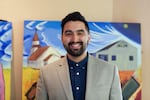
FILE: Juan Carlos González is the new president of Metro, Portland's regional government. He made history in 2018, becoming the youngest member and first Latino to serve on the Metro council.
Anna Griffin / OPB
Juan Carlos González was elected president of Metro in May and then appointed to serve out the remainder of the previous president’s term. He made history in 2018, becoming the youngest member and first Latino to be elected to the Metro council.
His priorities for the council are creating more affordable housing and jobs in the region. Metro has begun what it calls Future 50, a planning process designed to shape the metro area through 2077.
We sit down with González to hear more about his priorities and vision for the next 50 years.
Editor’s note: This post has been updated to clarify that González was the first Latino elected to the council. Latina Betty Dominguez was appointed to the council and served in 2018.
Note: The following transcript was transcribed digitally and validated for accuracy, readability and formatting by an OPB volunteer.
Dave Miller: This is Think Out Loud on OPB. I’m Dave Miller. Juan Carlos González was elected president of the Metro Regional Government in May. It is a four-year term that is supposed to start in January, but Gonzalez is getting a six month head start. He was recently appointed to serve out the remainder of the previous president’s term. González has already made history at Metro. In 2018, when he was 25, he became the youngest member and first ever Latino to serve on the council. He joins us now. It’s great to have you on the show.
Juan Carlos González: Hey, Dave. ¿Cómo estás? Buenas tardes, good afternoon. Great to be here.
Miller: Thanks very much. Can you remind us first what Metro does?
González: Absolutely. Well, Metro is our regional government here in the Portland metro area. And I think it’s best to start with covering the actual geography of what the region is. So, it’s 24 cities, three counties from Forest Grove to Troutdale, down to Oregon City and Wilsonville, to where I live in Beaverton. And, Metro, I think the best way to put it is, a government that works on things that cities and counties can’t do alone. We are a seven-member council. We have six councilors that are elected by district, and then one council president that is elected at large. And our primary responsibilities include major regional issues. So think about regional venues like the Oregon Zoo, Oregon Convention Center, the Portland Expo Center.
We do land use planning and transportation planning. We have regional housing work that we do, garbage and recycling at a regional scale. And we also manage close to 20,000 acres of parks and natural areas with the goal of protecting clean air and clean water, wildlife for the region. And I’ve seen us do some remarkable work, and I’m excited to be here.
Miller: Willamette Week recently called Metro a turducken, meaning various seemingly random things stuffed into one. And maybe you answered this a little bit by saying that you do things that the constituent cities or counties can’t do alone. But how do you see these various pieces, everything from the zoo to recycling and trash, to acquiring and creating parkland, to more recently, managing tons and tons of taxpayer dollars for homeless services or affordable housing … how do you see them fitting together?
González: Yeah, I love this question. I see our North Star at Metro, and my North Star as the Metro Council president, is to create the best quality of life for people that call this place home, and that work that we take on is the work that the voters ask us to take on as issues of metropolitan concern. In 2018, for example, one of the new areas that Metro stepped into was affordable housing. We passed the Regional Affordable Housing Bond program, which has built over 5,000 units of affordable housing. Like I was talking about earlier, we have been able to develop some beautiful parks and protect nature that, I think, defines some of the most special things that we love as Oregonians in our natural area and our environment. And the work that Metro does in that area is something we do with a lot of care, a lot of diligence, and again, with the goal of protecting quality of life.
Miller: I want to turn to one of the biggest issues that Metro now has a hand in managing. I don’t think this was true 20 years ago, even 10 years ago. It’s the Supportive Housing Services tax on high earners that basically funds homelessness services and housing assistance. What has that accomplished?
González: The Supportive Housing Services measure is one of the most important tools that Greater Portland has to tackle and address homelessness. I see it as an essential tool. When I see the federal government disinvesting from housing, from homelessness, from behavioral health programs, when I see our state legislature really struggling to meet all of the needs that we’re facing across the state, a local revenue source that funds the three counties – Clackamas, Washington and Multnomah County – and our homelessness approach is important. And I also recognize there is a lot of work to do to continue to show voters that we are making as much impact as possible.
But I want to talk to you about the success that we have seen, because since 2020, we’ve housed over 18,000 people with our local supportive housing services program, and we’ve also helped 5,000 people exit chronic homelessness. I do think it’s important for me to hit a reset button, especially now as the Metro Council president, because we are working on some very important reforms across the region. We’re making sure that our data, our programs are truly making the highest impact possible. I also have a real focus on integrating our housing services programs with health care and behavioral health, which is one of the most significant gaps that I see in the system right now. And if listeners today walk away with one thing, what I want them to walk away with is recognizing that our supportive housing program alone cannot solve for what I think is a broken economy.
Here in Greater Portland, we have 1,000 evictions a month, and people are being evicted from their housing, one, because housing is too expensive, and two, because jobs aren’t paying the kind of wages that Oregonians need to thrive. And when you put all of those things together, there’s no single public resource that can address this broken economy problem. But I do think what we can do, again, is deliver the most essential services, reduce the amount of time people have experiencing homelessness and place them into housing, make sure that they don’t become homeless again.
Miller: I think a lot of people in the Portland metro area hear about the huge public investments in housing and homelessness in recent years, and then walk around and see tents or see people sleeping on sidewalks, see visible homelessness and wonder, what are we doing? What have we actually accomplished? What do you say to them?
González: That is a great thing that I hear from folks. I heard a lot about it on the campaign trail. I even hear from my parents who live in Cornelius and feel just as frustrated. What I want folks to know is that two things can be true, that our homeless approach needs a lot of work, but also that the local providers are working so hard to meet people where they are. And at the same time, we have a broken economy, where the rich are getting richer and the poor are getting poorer, and as we see housing affordability continue to be a challenge for working Oregonians, it’s going to be a problem that we see for a very long time.
I think that stems from actually a cultural issue that I want to approach for Metro. One of my most important priorities is to reorient the work that the agency does. For a generation Metro’s most important charge was to manage growth. And right now, we’re in a position where we actually have very little growth to manage.
Miller: Is that true regionwide, or is it mainly true in Portland and Multnomah County?
González: The data that I’ve seen and that we work with shows that it is a tri-county problem specifically. And I see a huge challenge with our housing production, the lack of housing that we’ve been building for the last 20 years. So a lot of the problems that we see today are chickens coming home to roost of decades of inaction, of decades of not lining up our policy with our values. And that is one of the most important things that I need to work on and that the Metro council will work on is making sure that we build the housing that people need so their families can afford to live here and thrive here, and also work on bringing jobs that pay living wages and help people have strong and prosperous lives.
Miller: Well, what are the levers that you’re saying you want to use at Metro to do that? I mean, if you’re not talking about, say, affordable housing creation, which would be funded by the taxpayer approved bond from 2018 … If you’re talking more about economic development more broadly or market rate housing, why is that a Metro job?
González: It’s a Metro job because it’s in our charter to think about the long-range planning, the long-range vision of how this region grows and meets the needs of working people and families here, and I take that responsibility very seriously. The state has charged Metro with a whole range of housing analysis, production analysis, tasks. And we know that over the next 20 years, we need to build close to 200,000 units of housing. Some of that is market rate, but actually the overwhelming majority of the housing that we need to build is what we call deeply affordable housing, that’s zero to 30% AMI. Think about the housing that someone working a full-time minimum wage job needs to actually be able to afford to live here.
The data that we see is that, for those people that are in deep extreme poverty, over 60% of those people are paying 50% of their take-home income in housing costs. So we see an extremely strained housing market. And again, Metro’s responsibility is to make sure that we plan for the market-rate housing, the workforce housing. And the Metro Affordable Housing bond, which built over 5,000 units of affordable housing over the last eight years, to me, is an excellent example of how our local government can play a role in housing production for housing that will serve the lowest income Oregonians.
Miller: But my understanding is that that money has largely been spent. When it winds down, the region’s affordable housing production is expected to slow down greatly, especially the exact kind of housing you say is most needed: the deeply affordable housing or family-sized, deeply affordable housing. But I have to say it’s hard to imagine the current electorate asked today, “Hey, do you want to re-up this affordable housing bond? Do you want to keep giving Metro this money to do this?” It’s very hard for me to imagine a majority of tri-county residents saying yes, the way they did say yes eight years ago.
First of all, do you agree? If you ask voters in November, “do you want to re-up the housing bond,” what do you think would happen?
González: I agree with you. I do think that we’re living in a moment where everyday voters are feeling like their disposable income is less and less, and it doesn’t go as far as they need for their basic expenses. So thinking about asking them to help us take on another problem, to take on a new tax is a big challenge.
Miller: This is separate from, although related to, the Supportive Housing Services tax, which is on high-income individuals. But grouping those together, what is your plan for how to build enough goodwill among metro area voters that they would renew this bond and this tax that you say are crucial?
González: I love this question. I fundamentally believe and want to remind people that, as Oregonians, we’re capable of taking on big and complex problems. And the way that I am going to approach that work at Metro is by setting a culture of excellence for public services, for public stewardship of resources. I think that people expect from us to make the most of every tax dollar, to show them the value that they’re getting for that work. And I acknowledge that a lot of our local governments right now have such a low level of trust with people. I see my primary responsibility as going out there and showing people every single day: these are the small things that we can do, and these are the big things that we can do, these are the medium things that we can do. And I think that good governance is actually a lot of small, good decisions over time. We need to earn the right for voters to do it again.
But I do think, back to your point, with this affordable housing bond program that has been incredibly successful, building some of the housing that working families need here in the Portland metro area, there’s no question to me that we will need more investment. This is not something that the private sector can fix by itself. We do have an underproduction housing issue across all income brackets. I’m someone that believes in a yes/and approach. And we need to show people that we can build things. I think that this region is at its strongest, at its most effective, at its most inspirational when we build things, and that is one of my mantras.
Miller: Do you think a bigger challenge, in terms of these potential votes in the future, is a lack of trust in Metro or the county’s spending of these taxpayer dollars, or taxpayers saying, “I don’t have the money to give you?” It’s not either/or, but I’m curious for your political read on what you see is the bigger challenge you’re going to have to overcome.
González: I do see them as intertwined. And for decades, one of the Portland metro area’s most appealing advantages on the West Coast – looking at just major West Coast cities – was how affordable we were. People could come here, people could move here. We were a place where people could take risks. As our region has grown over the last 20, 30 years, we’ve really lost that edge of affordability. To me, that is a combination of, one, people do feel like their money does not go as far. Our economy is not growing. Our economy is not as strong for everyday Oregonians. Wages are not keeping up with expenses. I mean, these are basic things that I feel like most Oregonians would agree with me on.
At the same time, we do have a crisis of confidence in our local governments. I see myself as a new generation of political leadership that wants to remind people that we can do work, that we can do hard things, and that’s the attitude that I’m going to approach the work with.
Miller: How much faith do you have in your regional partners right now? And I’m thinking specifically about Multnomah County and the Supportive Housing Services measure, where they were dinged at Multnomah County by Metro folks a couple of years ago for not spending money fast enough. And then last year, your predecessor and the governor, plenty of people were very much taken aback when the county said, oh, actually, we’re missing $100 million for homelessness services and can you please help us out, regional partners, and the state.
How much faith do you have in Multnomah County right now as a partner?
González: I’m an optimist, and I have to have faith that we can figure it out. In our work with homelessness – which is, on the campaign trail, one of the most pressing issues that I heard in every single corner of the region people want to see us address – [we] recognize that our Supportive Housing Services measure is a 10-year program, and the expiration is on the horizon for us. Metro is going to need to ask for all of the counties to come up with a wind-down plan soon if we do not have a pathway to renew and extend the measure. That is creating incredible set of urgency for partners to come to the table, to set aside small differences, and then look at what are the highest impact investments that we can make to help people exit a humanitarian crisis to take care of the most pressing issues that they’re facing in their personal health, the barriers that they have. And then getting those people into safe and stable housing.
I do see a lot of opportunity for us to do that work, and I, as of right now, am the new chair of a new regional Homeless Services Committee. I’m working with that committee. We have partners from health care, from the criminal justice system, from the governor’s office, the three counties, cities. We are setting a table for all of the stakeholders to come together and actually fix the problem, solve the problem, and throw our entire weight at making the most of the money we have. Because I don’t think there’s more money out there for us, we have to do more with what we have.
That is what I’m hearing from voters. Before you ask me for more money, make more of what you have. I hear you. That’s what we’re going to do. And I have so much confidence that we’re going to see more visible improvements and also a much more efficient system, as a result of this approach.
Miller: I want to turn to a broader question about the future of the region. You chair the Future Vision Commission. What is the intended end product of this process?
González: The Future Vision Commission is one of the projects that gives me so much hope for the future, because what we are doing is looking out in a 50-year time horizon and saying, what are the region’s values and how do we want to approach the problems that we’re going to face for the next 50 years? The last time that the region looked at a future vision project was back in 1995. Think about how many things have changed since 1995. And as a Millennial that is elected, I’m a new dad, I’m thinking about the world that I’m living in, someone else designed for me, that a past generation designed for me. And now we have the opportunity to do that.
Miller: To what extent is the world that we’re living in based on what were the ideals or hopes from the mid-90s? I guess another way to put this is, what bearing on the future of the metro region will this plan, when it comes out next year, have?
González: I think it’s significant and it’s tremendous, the 1995 plan. It informed the 2040 growth concept, which truly, if you look at that plan and the neighborhoods across the region … Orenco Station in Hillsboro, you see the Albina neighborhood beginning to pop up in the central city, a corridor strategy for infill and transit-oriented development. I think actual resources that poured into that plan, I see an opportunity for this generation to set again, another set of expectations and ideals.
I do think that a great amount of the challenges that we face today are actually a result of a lack of alignment. I think a lot of people are asking themselves right now, what is it that we actually want for our future? Our counties, our cities, the state, everyone’s kind of saying different things about where should we be rowing the boat?
As a Metro councilor, as the Metro Council president, I do think that one of the most important things our local leaders can do is focus on alignment, on getting on the same page, on identifying the opportunities, and on putting our money behind important moonshots, behind a clear theory of change, a North Star for how this region is going to work for everyday people. And my priority is making sure that as a new dad, my daughter has a home that she can afford to live in, that she has clean air, clean water. And my biggest worry as a new dad is that when she grows up, she’ll say, Portland is just the city that my parents are from, because she’ll be somewhere else. So my job is to make sure that what she inherits, what the next generation inherits is something dynamic, something robust, where people can truly plant roots here.
Miller: Juan Carlos González, thanks very much.
González: Thanks.
Miller: Juan Carlos González is the Metro Council president.
“Think Out Loud®” broadcasts live at noon every day and rebroadcasts at 8 p.m.
If you’d like to comment on any of the topics in this show or suggest a topic of your own, please get in touch with us on Facebook, send an email to thinkoutloud@opb.org, or you can leave a voicemail for us at 503-293-1983.