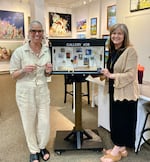
Camas-based artist Lara Blair and Kim Nickens, the co-owner of Gallery 408 in Camas, pose for a portrait on May 20, 2026 at Gallery 408 in this provided photo. Blair designed a miniature version of the art gallery featuring tiny painted canvases , sculptures and other objects she and 12 other local artists, including Nickens, contributed for the installation which was publicly unveiled in Camas on June 5, 2026.
Courtesy Lara Blair
During the pandemic, Lara Blair found herself with a lot of time on her hands. With her Camas photography studio sitting idle, Blair reminisced about her childhood and two things that brought her joy as a 10-year-old: donuts and dollhouses. Thanks to how-to videos she saw on YouTube, she soon began making sculptures of donuts from clay, adorned with sprinkles and surreal, whimsical elements such as tiny people with ropes climbing up their frosted, candy-colored sides.
Today, Blair works full time as a small-scale artist creating intricate dioramas, shadow boxes, commissioned pieces and other tiny, sculpted works she sells online or at Gallery 408 in Camas. The Columbian recently profiled Blair and a miniature version of the art gallery she designed and helped create with the gallery’s co-owners featuring tiny, painted canvases and sculptures Blair and other local artists, including Portland painter Bianca Youngers, contributed.
The mini gallery was inspired by a conversation Blair had with Rachael Harms Mahlandt, a Portlander who co-created the PDX Sidewalk Joy Map that has since expanded worldwide. Harms Mahlandt was one of the featured guests on Blair’s new podcast, “Tiny Worlds, Big Stories.” Blair and Youngers talk with us about making small-scale art that can spark delight and childlike wonder for its creators and audiences alike.
Note: The following transcript was transcribed digitally and validated for accuracy, readability and formatting by an OPB volunteer.
Geoff Norcross: This is Think Out Loud on OPB. I’m Geoff Norcross. During the pandemic, Lara Blair found herself with a lot of time on her hands, and she thought a lot about her art. While her photography studio in Camas, Washington was sitting idle, she got to reminiscing about her childhood and two things that brought her joy when she was a kid, donuts and dollhouses.
Thanks to how-to videos she saw on YouTube, Lara soon began making sculptures of donuts from clay adorned with whimsical elements like tiny people climbing up them with ropes. Lara Blair is now a full-time small-scale artist, and she also hosts the “Tiny Worlds, Big Stories” podcast. She joins us now along with Bianca Youngers. The two artists collaborated on a miniature version of an art gallery in Camas, and they both join us now. Welcome to both of you.
Lara Blair: Hi, thanks,
Bianca Youngers: Thanks for having us.
Norcross: It’s so great to have you. Lara, can you talk more about your inspiration behind your move to the tiny?
Blair: The move to the tiny. Yes, like you said, I just absolutely have always loved small things, and I think when the world is heavy, you look for things that are your inner 10-year-old, you know, the things that made you happy when you were a kid. And it has always been tiny things.
It’s difficult to work with them sometimes because they are so small. My eyesight isn’t real great, so a lot of magnifying glasses and the whole thing in my studio, and I was able to make pieces that, to me, had meaning. And then as I started making more and more art, it was like a metaphor, some of my work has a message; and that was the most fun thing for me, was creating pieces that actually said something with tiny people and also keeping the delight of it being small because people do kind of tend to like tiny things. It’s interesting.
Norcross: Artists want to make messages out of their work, no matter what they’re doing. Is there just something about the small that makes messages spark a little bit more effectively?
Blair: I think it’s the detail. You have to lean in to really see what’s going on sometimes. And you get quiet when you lean in and a little bit more introspective, I think when you look at small things. And I also think, like I said, the delight part of it, when you combine that with looking at the details and you go, “Oh, I see what she’s trying to say here.” I’ve had people say that to me before. “Oh, this is cute,” and then they look and they go, “Oh, I see what you’re trying to say.” So that’s been fantastic to have that come across.
Norcross: You actually brought something. Can you describe this for me, please?
Blair: This is a piece my friend Bianca, who’s going to talk here in a minute, bought from me a while back, and it is a ceramic heart with a big crack down the middle, and it has gold paint in it. And if you know what kintsugi is, I hope I’m saying that correctly, it’s where people fill in gold leaf to things that are broken, pottery that’s broken. And the whole metaphor is to heal yourself by putting gold in there and it makes it stronger.
So there’s a little tiny painter, and he’s on the ladder and he’s got his little paint on the bottom and he’s filling that crack with gold. And to me that just means, yes, we’ve all got cracks in our hearts, but the gold in it, it makes you stronger and more resilient.
Norcross: Why are you drawn to working in this scale?
Blair: I think it’s just, first of all, it’s fun. I really enjoy that part of it. It’s fun. And to me, I love details, and I like looking at small things as well that other people have made. I’ve been looking at people’s art that is small for years, and now I get to talk to them on my podcast. So I have been enjoying every minute of it because it’s people who live in this weird little world that I live in.
Norcross: Can you tell me more about mini-Gallery 408?
Blair: Bianca and I show our art at Gallery 408 in Camas. It’s an adorable downtown that we love, and Michelle Purvis and Kim Nickens own it. Amazing women, and they were very receptive to the little gallery idea. On my podcast, I interviewed a woman named Rachel, who’s from Portland, and it’s the Sidewalk Joy Project. It was so intriguing to me, these little galleries and little libraries and all the things that are around Portland. Not only that, they’re all around the world now. Rachel has made this map with her partner, and I wanted to do it.
I live kind of in the country, in the middle of nowhere in Vancouver, and I just didn’t think anyone would come to see my tiny gallery. I thought, no one’s driving out here to see it. And I actually got the idea talking to Rachel after the podcast was over. She’s like, “You know, you should approach your gallery.” And I was like, “Huh.” So I went to Michelle and Kim and I just said, “What do you guys think?” They took it and ran with it.
It was amazing. Michelle built it with her husband, with me kind of telling them what to do. They needed popsicle sticks, I brought them a giant box of popsicle sticks to make the floor, she showed it to me and I’m like, “You need crown molding, you need this.” They put skylights in. It’s gorgeous.
Norcross: It’s a tiny gallery.
Blair: It’s so cute, and it’s a version of their gallery, small. They took it and ran with it, and then I curated it, so I got to talk to artists in the gallery and said, “Will you make tiny art for this?” And at first, I kind of got a, “I don’t know if I can do it, it’s small,” and Bianca ended up doing a sculpture version of her beautiful paintings. We had a ceramicist do this tiny, tiny little, I couldn’t believe that she did it. We got all this beautiful art to put in there. It was on pedestals, we put it on the wall, and we had a big opening, and I had tiny scissors to cut a tiny ribbon, and the mayor was there, and it was just a dream come true.
Norcross: That’s adorable.
Blair: And really, these women kind of helped me have my dream come true by doing this. So it was wonderful.
Norcross: Bianca, tell me what you were thinking when you were first approached about being involved in this project.
Youngers: Well, I had just done another project for HappenStance Gallery, which was a version of a mini gallery, which is bizarre that it had happened. So I had a little show. It was the first time I’d taken my work to miniatures down to 3D or tiny little things. And then Lara would ask me to do it and I was like, oh my gosh, absolutely, I’m addicted. And it was just leaning into these little, tiny miniature things. It made me really happy.
Norcross: What did you actually make for the tiny gallery?
Youngers: I made a little underwater sea sculpture. It looks a little bit like coral, very colorful, and then a tiny little black and white version of my leaves and flowers.
Norcross: Was it hard?
Youngers: Surprisingly. I always stay away from tiny works. I paint really big, and maybe just going this tiny was easier, I don’t know, less constricted. There was something, like Lara said, getting into it just feels good to get tiny.
Norcross: How do you actually do it, though? I mean, do you have a tiny paintbrush?
Youngers: I was sitting at work. We all work down there and gallery-sit, and in the drawer, there was a little tiny bucket of black paint and a tiny little paintbrush, and you’d left me a tiny little canvas. I’m like, I’m just going to try it. So yeah, a tiny paintbrush.
Norcross: How do you think it changed your approach to your art? Are you going to go back to the big stuff?
Youngers: Absolutely. I love the big stuff, but I made this little shadow box. It’s brought me into making some tiny things. It’s brought me into this new world. I’m like, wait, this is distracting me. What’s happening?
Norcross: Lara, as we mentioned, you also host a podcast about this. It’s called “Tiny Worlds, Big Stories,” and I wanna play a few highlights here. You talk with an artist named Susan Canaday Henry, who makes intricate dollhouses as a hobby, and here she is talking about her first experience working on a dollhouse
Susan Canaday Henry: I think there’s a bit of fear when you first get a dollhouse and you’re not experienced with it because you don’t want to touch everything. Everything looks pristine and it’s kind of perfect, and you’re not confident of your own skill. By the time I was finished with that dollhouse, I had taken out a floor, knocked out a wall. You find yourself inspired by things that you didn’t think of looking at before, because now you’re looking for small scale things. It changes your eye when you’re working in miniature.
Blair: Totally agree. The best parts.
Canaday Henry: Oh my God, it is the best part. So seeing the world differently and then just having the creativity and the power to just create and control what you make, that to me was probably the most gratifying thing as an artist because it was a control that I’d never had before. From conception to execution, it was all my call. It was all in my timeline. It was all in my budget, and in that space, I just found immense joy and freedom and escape.
Norcross: Lara, that line, “It changes your eye,” jumps out at me. What does she mean by that?
Blair: Well, as an example, when I go to Home Depot now, I look at it through the eyes of a miniaturist. It’s my favorite art store, Home Depot. I go in and just look for tiny, tiny things that I can turn into something else. I can’t even describe it. Like every store I go into, if I’m looking for tiny things, what can I make that into? Or I’ll see a little scene… it does change the way you see the world. It’s the details. It’s the tiny things that you didn’t think about before, and it quiets you down a little bit, which I really like.
Norcross: Yeah, you know, and I was thinking about this when thinking about other art forms that I know of, and radio is a good example. You might think that working in a tiny space would be limiting, but it’s actually not, and I know this intrinsically, because we don’t have a lot of time to get our message out in a radio form. It’s kind of like the haiku of oral communication. And so, is that kind of the idea? That you may think you’re in a limiting frame, but actually there is a whole world that you can explore within it?
Blair: And you can make crazy things happen in those dioramas as well. I’ve done some fantasy fun things and dioramas that I just thought, oh it would be fun to make that. And also, in my own home, there are things I wouldn’t do in terms of design and things that I just go crazy with. I have a modern dollhouse. It’s a brownstone from New York. It’s great, and I want to do things in this house that I would never do on my own. It’s a freedom and a fun, creative outlet for a lot of people who work with miniatures.
Norcross: I was struck by something that you said on your website to describe your art. You say, “The worlds I build now reflect the questions we all carry. Where do I belong? What am I becoming? What beauty grows when I slow down?” What do you mean by that?
Blair: Slowing down, I think, is taking a moment to introspect, of course, to look inside. I don’t think we do that enough, especially now. Times are hard. It’s a difficult time to be alive, and it’s a lot of darkness. But when you think about what you really loved as a kid, first of all, it’s OK that you still love it as an adult, and I don’t feel like you have to take those things away just because you’re grown up. Indulge those things.
That’s what Susan was talking about. She realized that she could go into her space with all these dollhouses, and she has a very stressful job. She escapes. It’s the part of you that wants to go deep with the things that you love and not forget who you are. For me, I’m basically an overgrown 10-year-old person who is living an adult life, but I love these tiny things, and it’s OK to feel those things. It makes me happy. It brings me joy and delight, and man, has it changed my perspective on a lot of things.
Norcross: Bianca, does working in this small space require you to slow down and think about your work a little bit more?
Youngers: It does, absolutely. But I think the thing that most stands out about this is that everybody else that looks at it slows down, and it’s very community driven, especially this little Gallery 408, the HappenStance Gallery, it’s just very community-oriented and it’s bringing happiness and joy to the world. We need it.
Norcross: I want to play another clip. You spoke with Erica Meade, who is another miniaturist based in the San Francisco Bay Area, and here she is talking about the similarities and differences between miniature art and art that is made by artificial intelligence.
Erica Meade: I’m sure you have this happen, too. You scroll through Instagram and you’re like, wait, is that a full-scale room or is that a tiny room? What is this? And that feeling, that kind of delight, the word that comes to mind for me is bamboozled. I was tricked. There’s something kind of, like, delightful about it, and that feeling is in such stark contrast to, I think, when you see an AI-generated image and you’re tricked and led to believe that it’s reality, but it’s not.
Yeah, one creates this sense of awe and appreciation, and I hope makes you, as a viewer, think, how do I see the world and what are all the details around me that I don’t notice? ‘Cause miniatures are so much about details, where obviously AI is kind of the opposite.
Norcross: Lara, this is kind of the question of the moment, which is, what is art in the time of artificial intelligence? And I get what she’s saying. Both involve some sort of trickery. But it’s different. Can you talk more about that difference?
Blair: Well, someone made something with their hands, and to me that’s always amazing, especially when it’s tiny. And when it’s a room that I see, I love being tricked. And that’s kind of how it all started on Instagram for me. I was watching these amazing artists going wait a minute, that can’t be miniature. And it is, because of the skill and the craftsmanship it takes to build some of these things, and not just dollhouses and miniatures like that, but also dioramas.
There’s a whole world of diorama makers where they’ve learned how to weather, make things. I mean, there are people who build model airplanes, people who do scenes, like kind of dirty scenes, like in an alley with trash, and they really, really spend time making it look weathered and realistic. Some of those look so real, you wonder.
It’s the craftsmanship, it’s made by hand. And in a world where so many things, we don’t know. I hate that when I don’t know, like, wait a minute, is that real? Is that AI? With these tiny made things, it makes you appreciate the time that it takes, because a lot of it takes a lot of time, and the patience for working with tiny things, I just am amazed by that and it’s something that I don’t think will ever go away.
Like, stop motion amazes me as well. It’s in that world for me. And we have these great stop-motion studios in Portland. I mean, all these people who have made these films that take forever to make because it’s all by hand, I have a real respect for that in terms of the arts, and that it hasn’t gone away makes me hopeful that it won’t go away.
Norcross: Is it immune to AI?
Blair: I think in some respects people are always going to be drawn to something that was handmade. That’s the optimist in me, of course. I do think there’s going to be a swing to like, I’m tired of not knowing if things are real. I actually want to hold something, or I want to go somewhere and see something where people made it with their hands. I like to think that that is the magic of being human and that we will keep that throughout this transition.
Norcross: One more clip from the podcast. You spoke with Miriam Stone Wilson, who is a Seattle miniaturist who makes whimsical dioramas, and here she is making a strong case for being creative, especially now.
Miriam Stone Wilson: Creativity sustains us. I’ve seen people saying, you know, “How can you share art online, when all these things are happening in the world?” And I think it’s essential right now. I mean, it’s always essential, but right now it’s essential to be building the worlds that we want, that we want to live in.
Norcross: Lara, why is it essential, especially now, to build the worlds we want to live in, even if they are tiny?
Blair: People try to tell us where we’re supposed to be, I think, whether it’s advertising or the news or whatever it may be. And you have a choice. You have a choice where you want to find your joy. And if it happens to be looking at details in tiny worlds, then do it. Do it as much as you can. And it doesn’t have to just be miniatures. It’s whatever brings you joy and that’s real to you, that makes you feel alive. Those are the things we need to be gravitating to, because people who do that are better humans in the world, and that makes us all better in general.
Norcross: Bianca, you’re part of a community of small-scale sculptors and painters, and I’m wondering how this community is different compared to other artists’ communities that you’ve interacted with?
Youngers: Well, I think the whole art scene is joyful. I think that I’m walking into this world of miniatures and it’s like, childlike, maybe. And I think that’s exactly it. It just brings back the happiness of childhood. So I don’t know that it’s different. I just think it’s playful. Yeah, the artists are all playful.
Norcross: Do you have, though, more plans to create miniature works?
Youngers: I think I’m going to weave it through. I think it’s making me bring my paintings into a 3D world. So now I’m getting interested in sculpture, and yeah, it’s really changing the way that I’m looking at my art.
Norcross: Really?
Youngers: Thanks, Lara.
Norcross: So, Lara, are you exclusively a miniaturist now?
Blair: I guess. I mean, some of my pieces are big, but they have miniatures in them.
Norcross: What counts as big in your world?
Blair: It’s so funny, well, like a 20-by-30 inches, you know, a bigger piece, and I have some at the gallery that are bigger, but it cracks me up because every time I go in the studio and think, “I’m going to make this big piece,” it always ends up being like 5-by-5 inches tall, and I think that’s just where I live.
And I also like to make a piece when I have something to say that I can do in one day, and when it’s small like that, it’s so gratifying to do the floor in the dining room and have the little people paint them and do all the building of the terrain, and it’s done. Then I can have that at the end of the day as a piece that I made with a message to it, and that is very gratifying. So I think I will continue to do that.
I have a show at 408 in November, and I’m doing 30 5-by-5 shadow boxes. They’ll be all on one wall. So I guess when you put them all together, it makes one big piece.
Norcross: Can you describe one that you’re especially excited about?
Blair: Oh goodness. I have a woman with these giant flowers kind of overtaking her. She’s little, about this big, HO scale.
Norcross: You’re putting up your fingers about two inches apart.
Blair: Maybe even smaller, yeah, HO scale, and she’s got this giant bouquet in front of her. You can’t see her face, and she’s got her arms wrapped around it. And on the little table next to her is a giant bouquet, and it’s all about, you buy yourself flowers. You know, if you really want the flowers, you buy them and put them there. And that’s one of my subliminal messages to women, like, don’t wait for it, if it’s something you enjoy, take it.
Norcross: You actually sell your tiny creations. How’s the market for tiny art?
Blair: What’s nice about tiny art, at least mine anyway, is it’s very accessible. It’s not a huge price tag on it. They are going up a little bit with encouragement from my artist friends, but it’s like art for all.
Norcross: You can be democratic about it.
Blair: Yes, you can find a piece that speaks to you and it’s not going to break the bank, and you can put it on a shelf at home and it’ll make you happy. And then hopefully you come back and you buy another piece that also makes you happy. I have collectors that have bought at least five or six pieces, and those are my people. They get it, you know.
Norcross: Do you think that’s more true for tiny art than for traditional art that lives in a 20-by-30 scale?
Blair: Gosh, I don’t know. I’ve never been a big painter like Bianca. I mean, her pieces are so beautiful and huge and take up, they really hold a wall, and mine are like an addition to the wall. I think it just depends on the person. Once you find your collectors though, they will follow you with whatever you do. They’re your people, and I have definitely found my people, which is great.
Norcross: Bianca, what are you working on right now?
Youngers: Well, I just finished up a series for the Seattle Art Fair with Gallery 408. They’re taking me. But then I got distracted and I’m doing these little shadow boxes that I have no idea what I’m going to do with them…
Blair: You’re welcome, Bianca.
Youngers: I know, thanks – but I do feel like what you were saying, that it brings my art to a scale that could be affordable for somebody. I feel really bad about that sometimes, because I do paint big and it takes time. And that comes with a price.
Norcross: Well, this was delightful. Thank you both very much.
Youngers: Thank you so much.
Blair: We really appreciate it.
Norcross: Lara Blair is a small-scale artist and miniaturist and host of the “Tiny World’s, Big Stories” podcast, and Bianca Youngers is a Portland-based painter who participated in the miniature Gallery 408 project.
“Think Out Loud®” broadcasts live at noon every day and rebroadcasts at 8 p.m.
If you’d like to comment on any of the topics in this show or suggest a topic of your own, please get in touch with us on Facebook, send an email to thinkoutloud@opb.org, or you can leave a voicemail for us at 503-293-1983.