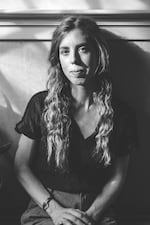
Portland writer Erica Berry won a 2026 James Beard Media Award for her personal essay, "Intuitive Eating: On poison, pleasure, and trust," published in Orion Magazine.
Andrea Lonas
Portland was well represented at this year’s James Beard Awards. Cocktail bar Scotch Lodge took home the award for Outstanding Bar, while Japanese restaurant Nodoguro’s Ryan Roadhouse won Best Chef: Northwest and Pacific.
Writer Erica Berry also won a Media Award for her personal essay published in Orion Magazine. In it, she explores the balance between risk and reward in both mushroom foraging and her personal relationships.
Berry joins us to share more about her work.
Note: The following transcript was transcribed digitally and validated for accuracy, readability and formatting by an OPB volunteer.
Jenn Chávez: From the Gert Boyle Studio at OPB, this is Think Out Loud. I’m Jenn Chávez. The James Beard Awards dropped this week, and among the Portlanders represented for culinary excellence is writer Erica Berry. She’s the author of “Wolfish: Wolf, Self and the Stories We Tell About Fear,” and a contributing editor at Orion Magazine. She’s won a James Beard Media Award for her personal essay called “Intuitive Eating” which is about trust, risk, and mushroom foraging. She writes, “Like many things I wanted in life, the pursuit scared me. This seemed like reason enough to do it.” She joins us now to talk more about her award-winning piece. Erica Berry, thank you so much for being with us today.
Erica Berry: Thank you for having me. It’s an honor to be here.
Chávez: Yeah, so first of all, woo, congratulations on winning a James Beard Award. That is major. How are you feeling after getting that news?
Berry: I mean, it’s so exciting because I feel like when a chef wins, it’s clear that the whole restaurant is behind them. And so I just want to say that even winning this award for me as a writer, it really feels like a triumph for this magazine, Orion, which publishes amazing literary work about nature and culture and has been for years. And my editor who’s also a Portlander, Tara Rae Miner, and I went and sat down in a coffee shop in Portland and had one of these mushroom- infused coffees. I don’t know if you know what I’m talking about.
Chávez: Yeah, I think so, yeah.
Berry: An early iteration of this article was that I was only going to be eating mushroom things for like two weeks, and see how it did. So anyway, just the point being, this piece, this essay transformed over months of conversation and editorially, and that’s such a pleasure whether you’re producing food or producing a piece of written work. There’s a whole slate of people whose labor and art is going into that.
Chávez: Well, my hearty congratulations to your whole team and Orion too. Thank you for shouting them out. So your winning essay was featured in Orion’s issue called “The Future Is Fungi” and is in large part about that, your experience learning to forage for mushrooms. But you also use it as a lens with which to examine other things. And one juxtaposition comes early in the piece where you mention these two Facebook groups you were in. One of them is about mushroom foraging, and another is for women trying to determine whether people they were seeing were safe to date. You wrote, “Both made you feel electric with the adrenaline of the near miss,” which I thought was really interesting. How are these two groups similar for you?
Berry: I think at first, they’re both on your feet and I’d joined them both because of things in my life where I felt like I was trying to… I was curious in how people evaluated risk, and I think whether we’re talking about feeding ourselves, like the appetite for food or the appetite for connection. There’s this intrinsic relationship I started thinking about between food and sort of love, which is just to say, we’re drawn to these things. We need to eat, we need to love, we need to connect. And there is a risk involved and nowhere is that more acutely clear than when you are feeding yourself food from the wild, which was foraging, or foraging in the modern marketplace as a dater.
Chávez: It is foraging.
Berry: Yeah, you’re kind of picking up these different profiles potentially on the apps and being like, do I want to sit with this for an evening or not? And so it sort of struck me on a metaphoric level that there was a similar muscle maybe at play in myself when I thought about both of these acts.
Chávez: So, I want to focus on foraging. So even though mushroom foraging was new to you at the time you’re writing this, you did grow up around other types of foraging. What did that teach you as a kid about your relationship with food?
Berry: I think I really understood the pride that my relatives who grew up in Montana, my grandmother out there has been known to eat roadkill, maybe only once, but like, she sort of tells it like a funny anecdote, but definitely we grew up with fish that she was catching or a bear sausage in the freezer that my uncle caught. And just like a sense of accomplishment and sort of this full circleness of food I really have always appreciated, both intellectually and kind of in practice.
And so, I think I just felt there was an honor to being able to procure your own food that connected you to the natural world. And I was drawn to that as someone who loves to eat and loves to be outside, and I just sort of wanted to experience that on a closer level, and at the same time I hadn’t grown up mushrooming. I grew up in Portland, but I hadn’t grown up mushroom foraging. I knew about it, I knew it was sort of becoming more and more in-vogue, I would say in the last like 10 years, suddenly like a lot of younger people around me were doing it.
And of course there’s mushroom foraging meetup groups and all sorts of, it’s almost like bird watching, I would say, like these things that during the pandemic become sort of a way for people to connect, both with the natural world and with each other. And I was kind of watching this over my shoulder the whole time, being like, intrinsically, I should be into this, and yet I was having these mental anxiety blockages.
Chávez: So I know that you had kind of a scary experience with foraging for food while living in Sicily in your twenties. I’m curious if you can tell us what happened and what happened with your relationship with wild foods, because of that?
Berry: Yeah, absolutely. So the really most clear time that I foraged food for myself ended in a hospital visit, that was quite serious, and I was living in rural Sicily at the time working at a cooking school, which provides some really good irony. We were sort of like intern assistants, all three foreigners, and we knew that the locals there foraged a lot of wild chard and other wild greens on the hillsides. And so one day when our boss was gone and we were sort of on our own fending for ourselves at the cooking school, which was a very farm to table place, everyone was always kind of eating off the earth in different ways, we thought we should go forage for some of these wild greens.
And I think part of what becomes interesting is the stories we hear about a place influence the sense of fear we do or do not read into the landscape. And in Sicily, where I didn’t speak Italian and I was new there and a foreigner like the people around me, we just had not heard about poisonous plants in that landscape. We saw it as very bucolic, very dreamy. It was, it was beautiful, but of course that is not mutually exclusive that there was poison on the hills as well. And what we actually ended up foraging was mandrake, sort of famous. I only knew about it in Harry Potter. It’s like the shrieking roots that get pulled out of the ground, and the roots have like this deep historical sort of literary history.
Rumor has it that Romeo and Juliet would have eaten mandrake because it kind of puts you into a coma, which is what happened to my colleague who ate the plants and all of us were hospitalized after we ate this dinner that we’d prepared for ourselves, and I was hallucinating terribly. I tried to pull out my IV at one point and run out of the hospital. I was really in a state of madness and utter terror, and I thought that my friend had died by that point in the night. He was in a coma, but I didn’t understand because of the language barrier. And he was OK by the morning, but going through that experience and lying awake for this night in this foreign hospital when you’re 22 years old, my phone didn’t work, I couldn’t call my parents. It was the scariest thing that’s ever happened to me and it made me feel acutely the shame of I did this to myself.
I think so often when we think about stories about trauma, they’re about something that’s happened to us or that has been imposed on us. And I think what kind of got me about this incident and then thinking about foraging was like I was really responsible. I’m a super cautious, anxious person, and yet I had put myself in harm’s way, literally, I put myself in harm, because I’d made choices about what to put into my body, unknowingly, and that really freaked me out. It made it hard to cook. It made it hard to eat. It made it hard to have things like caffeine and alcohol, anything where I felt this kind of interior alteration in the months after that, freaked me out. So I had a different relationship with food after that for a bit.
Chávez: Well, that sounds super, super scary, and I am glad that you are OK.
Berry: Yeah, all three of us totally OK, like flushed through our systems.
Chávez: Oh my gosh, yeah. So given all of that, how has your relationship changed with wild foods? How were you feeling then when you began to pursue mushroom foraging? Why were you drawn to that?
Berry: I think part of it is just this little competitive instinct in me, which is going to sound so petty, but it was like if all of these people are out here foraging, like I can do this. I know…
Chávez: That’s not petty. That’s not petty. You’re fine.
Berry: I’m a person who both feels like a loud voice of caution in my ear and also I’m super adventurous and want to experience what the world can offer, and I want to do it smartly. And so when it came, this opportunity to do this piece, I was like, I know that I can do this. I can get over this and at the same time, I would like to go with someone who really knows their stuff. And so Elan Hagens, who ended up taking me into the woods, is this amazing mycologist and forager expert – and also artist, wears many, many hats – but sold mushrooms at the Portland Farmers Market for years.
And I was drawn to Elan because clearly she was a pro at foraging mushrooms, but also she was open with me and candid with me about some of the, like, scariness of doing it. And for her she was like, I’m not afraid of the mushrooms itself, but it’s like everything else that accompanies going out into the woods in a rural place where you might not have service and talking to me about the safety precautions she takes as a smaller statured Black woman, in those places was really kind of liberating for me.
I think so often when I think about foraging or hiking, I just want to ignore the parts of me that feel afraid or anxious, and it’s been important in my own pursuit of those adventurous things to let some of that anxiety in and like give airspace to it, but then still do it anyway. And I felt like Elan and I, as we’re walking the hillsides of the Coast Range on this foraging walk, we were able to talk about kind of the full range of this experience, which was really special.
Chávez: Yeah, I wrote down this line that you wrote about Elan and said, “She was the sort of person I was always drawn to, someone who emoted bravery, not because she lacked fear, but because she knew it well and went out anyway,” which I loved. While you were out on this mushroom foraging trip with her, what did you notice that you didn’t notice before? What did you learn because you were with her?
Berry: I think she immediately taught me that what you’re going out to forage isn’t just the mushroom you think you’re focusing on, but as she put it, we’re out here foraging – we were going out in January – she’s like, we’re foraging river spots for next summer. We’re foraging bushes that are going to be bursting with berries come late spring. We’re looking for everything. And she just saw this sense of possibility that was really omnivorous and exciting for me. And so that was one thing.
The other thing was pretty quickly, I’m sort of naively thinking I’m just going to put on my goggles, which will be like tuned to the Chanterelles, and that’s what we’ll see. And she’s like, no, no, no, you need to look at the trees, you need to look at the underbrush, you need to look at the south facing forest where there would be enough sun to melt the frost. Because we were there in winter specifically, there were all these… I was looking at light in a different way because I was looking at where the melt lines were as we hiked out, and then hiked back and the pine needle duff became important in this.
And so I’m sure it sounds naive to people who’ve done this before, but for me, I didn’t understand that there was this whole roundedness to the ecosystem that we were actually observing. And the mushroom was really a nice thing that we would find if we harvested it along the way, but it became quickly not the point for me. What the point was like the goggles that we put on of kind of curiosity and observation.
Chávez: In this piece, you also write about your relationship with Sam, who is now your husband. You end your piece with a scene in your kitchen with Sam and with a reflection about love. And I’ve often heard the maxim that the opposite of love is fear, which suggests that the two things are mutually exclusive, but I don’t really know if that binary feels quite right. And I think both fear and love are a part of this piece. So I wanted to ask you what you thought and maybe what you’ve learned about how fear and love interact.
Berry: Thank you for that question, and I totally agree with you that they’re intertwined. And I think my first book was a lot about fear and I feel like I spent a lot of my twenties and maybe early thirties thinking that my goal was to live in a world where I could just kind of eliminate my fears through exerted control or strategic decisions. And where I’m at now is much more a sense of they’re going to be there. Like you’re in a rocking boat and it’s never going to stop rocking.
Like the world is continually rocking around you and you just are finding what you can hold on to in that movement, which for me is connection, is love. There’s some, the love is going to be living inside the fear at all times. Like anytime there is a seed of love, it’s saturated with the fear you feel around that in a certain way. But also sometimes the love is going to bring fear and I was really struck, Sam and I got married last summer and just the reality that we’re embarking on this great unknown together.
And to do that is to know that along the way we’re going to hurt each other’s feelings in small ways, hopefully only, I mean in big ways – I don’t know, you’re in this contract of connection that is precarious and we do this every day when we choose to connect with people and I’ve come to think it’s like the most beautiful, brave thing to do it anyway and to say like, “I’m going to try everything I can to bring safety to this person and stability and to myself.”
And also there’s these things I can’t guarantee, and it’s not going to mean I’m going to back away. It’s going to mean I’m going to move forward. And there was this sign that Elan and I saw hiking that was like, move at your own risk. I forget it now, but it was something like, this landscape is precarious, but it didn’t say don’t hike here. It was like, just move cautiously. And I think there’s something to be said about that in any high stakes vulnerable relationship we’re in.
Chávez: Erica Berry, thank you so much for joining us and huge congrats again.
Berry: Thank you so much. I really appreciate all that you guys do here.
Chávez: Oh, thank you. You can read Erica Berry’s essay, “Intuitive Eating” at Orion magazine.org or find a link on our website.
“Think Out Loud®” broadcasts live at noon every day and rebroadcasts at 8 p.m.
If you’d like to comment on any of the topics in this show or suggest a topic of your own, please get in touch with us on Facebook, send an email to thinkoutloud@opb.org, or you can leave a voicemail for us at 503-293-1983.