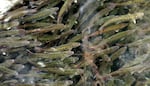
FILE - A file photo of juvenile coho salmon swim in a holding pond at an Oregon hatchery. The Bonneville Power Administration plans to cut $2.4 million in annual support for a salmon hatchery program on the Lower Columbia River.
Gillian Flaccus / AP
A program that raises millions of salmon in hatcheries on the Lower Columbia River each year is in financial peril, according to Oregon’s Department of Fish and Wildlife, after the federal agency that covers a large share of its costs said it’s cutting off funding effective Sept. 30.
The fate of 7 million salmon being raised for release into rivers next spring is now in limbo. It’s also raised the ire of the Northwest Sportfishing Industry Association and has Oregon officials saying recreational anglers could feel the effects of the cuts next year.
In a letter explaining its plan to cut $2.4 million in annual support for the Select Area Fisheries Enhancement, or SAFE, program, the Bonneville Power Administration said the program is not doing enough to boost fish populations harmed by the federal dams it owns and operates.
Related: Dams, power lines and statistics: What the Bonneville Power Administration is and does
“The sole function of the current SAFE program, both in effect and by design, is to augment harvest opportunities for recreational and commercial fishers,” Jason Sweet, executive manager of Bonneville’s fish and wildlife program, told the Oregon Department of Fish and Wildlife in a letter sent Friday.
Sweet’s letter said SAFE has not been shown to help Endangered Species Act-listed salmon populations, and so the federal agency will no longer support the program with dollars designated specifically to help those fish.
Tucker Jones, ocean salmon and Columbia River program manager at the Oregon Department of Fish and Wildlife, said Bonneville is wrong in its assessment of the program.
He agrees that recreational anglers and commercial fishing operations benefit from the SAFE program – which ODFW estimates brought $6 million in economic benefits to fishing communities last year. But the program’s hatchery fish relieves pressure on Endangered Species Act-listed fish populations by giving anglers, gillnetters and commercial fishing operations large numbers of non-protected fish to catch.
“Pulling funding with almost no notice undermines stability for both fishery managers and commercial and recreational fishers,” Jones said.
The Northwest Sportsfishing Industry Association was also sharply critical of Bonneville’s decision to stop funding the SAFE program, according to a report in Northwest Sportsman Magazine.
Linda Hamilton, policy director for the sportsfishing group, called Bonneville’s cuts “nefarious,” adding, “One might think that their efforts to degrade the river for fish and cut hatchery production is aimed right at fisheries,” the magazine reported.
A spokesman for Bonneville noted in an email that it still funds more than $300 million in work to support fish populations across the Columbia River Basin.
Bonneville has supported the SAFE program since 1993 and provided roughly 35-45% of its funding in recent years. ODFW and Washington Department of Fish and Wildlife staff and Clatsop County leaders are trying to assess what the end of that financial support will mean, Jones said.
“Without that funding, the whole program is very much at risk,” he said.