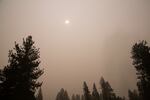
The sun shines through wildfire smoke Saturday, Sept. 12, 2020, near Sisters, Ore. New research from Oregon State University looked at how robins respond to smoky conditions.
Emily Cureton / OPB
Despite wildfires becoming more frequent and intense, little is known about how wildlife responds to the threats they present. Researchers at Oregon State University are attempting to shed some light on the issue.
A recent study looked at how wildfire smoke affected the behavior of robins. Instead of simply fleeing the smoky conditions, the birds often reduced their activity and shortened their flight distances to remain in their home environments.
Jamie Cornelius is an associate professor in the department of integrative biology at OSU and principal investigator of the university’s Little Bird Lab. She joins us to talk about what scientists are learning about how different wildlife species respond to wildfire.
Note: The following transcript was transcribed using AI and validated for accuracy, readability and formatting by an OPB volunteer.
Dave Miller: This is Think Out Loud on OPB. I’m Dave Miller. Even though wildfires are becoming more frequent and more intense, not too much is known about how wild animals respond to the threats they present. Researchers at Oregon State University want to learn more. Jamie Cornelius is the principal investigator of the Little Bird Lab at OSU where she is an associate professor in the department of integrative biology. She recently studied how wildfire smoke affects robins, and she joins us now. It’s great to have you back on the show.
Jamie Cornelius: Hey, thanks so much for having me, Dave. I always love talking about birds.
Miller: And I love talking to people who love talking about anything. How much do you know, as a scientific community, about, broadly, wildlife behavior during wildfires?
Cornelius: We know very little. In 2020, when the big wildfires really affected our area, it had me thinking, as a bird biologist, “What are the birds doing?” So I went to the literature and discovered a giant gaping hole in what we understand about how animals cope with wildfire smoke and the impact of wildfire smoke on their physiology and health.
Miller: Why do you think that is? Why is there a gaping hole?
Cornelius: It’s a good question. I think in part it’s really hard to study something that’s so unpredictable. Historically, what we know about wildfire smoke and animals has been pretty opportunistic. Like someone was doing a field study and they happened to get inundated with smoke, and then they actually risked being out in the smoke in order to take measurements, and so we learned something. But there just hasn’t been,to my knowledge, a concerted effort towards understanding response to smoke, until around the last five years or so.
Miller: Why is that a problem? I mean, why is it important to know how animals will respond to these events?
Cornelius: We can go at that from the animal’s perspective, just understanding how the environment is impacting animals and leading to population contractions or expansions is important. But also, specifically in the context of wildfire smoke, the fires have this relatively small footprint. But smoke from fire can impact literally billions of animals and humans at the same time because of its giant footprint, and the bigger our fires get, the bigger the footprint of that smoke. Yet we know very little about how that is affecting us, and the organisms around us.
Miller: So I want to go back to something you said earlier, as part of an explanation for why there hasn’t been a ton of data or really much at all.You said one of the things is just the challenges of studying this.You don’t know in general when or where a fire is going to happen or what animals or what birds are gonna be affected. So how did you as a bird researcher tackle that when you decide you want to learn more about how at least one bird species is affected?
Cornelius: Well, we focus our effort on the east side of the Cascades, since the prevailing wind pushes smoke that way. More often we can get lucky at some of our long-term monitoring sites, where we catch birds at watering holes, which is one way to catch them, even during smoke.
One of the hypotheses we had was that behavior, they would become less active, move around less, potentially, in contrast to the hypothesis, they might completely flee and leave the area, but we took advantage of those water holes. And then I would just look at the AQI [Air Quality Index] maps, and anywhere that was red or purple, I would try to go and see if I could catch birds, which is really challenging, I’ll just say.
Miller: Oh, so you’d wait until there was a fire and then go to the bad areas of smoke and then look for birds, and what would you do with them?
Cornelius: We had two prongs of the study. The one that was published recently was the behavior component in robins, and for that part of the study, we put satellite transmitters out all the way back in, like, May, when robins are really easy to catch, because if you play a song at them of another robin, they get really angry and they try to attack and we can catch them in mesh nets, so that makes it a lot more feasible to put out the transmitters. And then we program them to turn on during the fire season. So we had to just get lucky or not with where we put those out, and thankfully we did get kind of a variety, a range of smoke exposures, that I think told us something, at least about robins and what they do.
The other arm of the study is looking at physiology. We catch birds and we take a small blood sample and we look at immune responses, stress physiology, energy metabolites – whether or not they have low blood glucose levels… some of the same things we would look at in humans, we look at in birds.
Miller: How big are the sensors that you’re putting on these robins?
Cornelius: They weigh around two grams, so they’re about the size of a penny, and they’re pretty light. But even that is fairly heavy to put on a songbird, which is why we chose robins, cause they’re amongst the bigger of the songbirds, and they can carry a little bit heavier load. Thankfully, satellite technology is getting smaller, so we expect to be able to do these kinds of studies in smaller birds over the next couple of years.
Miller: My understanding is that your team had hypothesized that the birds would basically just go, would try to evade the smoke when air quality got bad. What did you actually find?
Cornelius: Because this was the post-breeding season, and the robins weren’t necessarily tied to a nest and tending a nest, we thought that at least at some level of smoke that they might leave. These birds are migrants and they’re very flexible in their migratory timing, and potentially direction as well. We’re learning about that. So we thought that perhaps when the smoke came into this area post-breeding that they would just go somewhere else, and they didn’t do that.
Instead, they reduced how much distance they were flying. They hunkered down a little more, and we think that was potentially adaptive, to reduce how much they were inhaling. Just like we reduce our activity levels during smoke,the birds seem to do that too, or at least robins.
Miller: Obviously, birds don’t have access to HEPA filters. They don’t have access to indoor air, but are there, I don’t know, nooks and crannies or some kind of hole in a tree that they might seek out, where the air quality is marginally better, where there’s less particulate in the air?
Cornelius: That is definitely something we’re really interested in learning. We couldn’t do that type of fine-scale resolution behavior with the satellite tags. Those are broader movements. But we do have plans and are trying to do a different type of radio telemetry where we follow the bird and we actually observe what they’re doing. It’s more challenging in the smoke because that means we are exercising in bad conditions, so we have to be really careful about that.
Miller: In terms of how you’re looking, you’re doing the opposite of what we as humans are told to do. If we were able to, we looked at the map, and if it went purple, or red or just scary colors, we were supposed to limit outdoor exposure. But you’re going out into the woods at exactly those times.
Corelius: Yeah, I’ve never had so many open campground options as I did in the study.
Miller: I guess that’s one positive way to look at it
Cornelius: Yeah, we have to be really careful about that and how long we’re out there, and we wear PPE and whatnot when we need to, and try to leave at night so that we’re not just breathing this awful air all the time. Animals presumably don’t have that type of flexibility, and what we’re seeing is that they didn’t leave, so they are being exposed to the smoke, but also I think it’s important to remember, too, that many humans don’t have that choice either. They’re working outside and required to work in order to make a living.
Miller: But I want to go back to the behavioral changes that you noticed, the sort of hunkering down. But if they’re moving around less and the hypothesis being that as a conscious bird’s decision to reduce smoke exposure, does that mean that they’re eating less? I mean,are they flying to the ground to eat fewer worms?
Cornelius: I think that they are being more efficient. And this, again, is a guess, we don’t have the data to say this for sure, but birds do have, especially in post-breeding… The days are still long. They actually have a fair bit of what I call scope, to change strategies and make decisions, and I think that they’re just making fewer movements just for the sake of moving. So I think they’re being more efficient.
But I will also say that in the physiology side that includes a lot more species, we are seeing a much more negative impact of wildfire smoke on small insectivores, insect-eating birds, and we suspect that this is because the insects are changing their behavior, which makes it harder for the birds to find food or to find their normal food. And we’re seeing some preliminary results that suggest insectivores in particular are hit pretty hard.
Miller: What other physiological data that you’ve captured can you share now? I mean, what other potential findings do you have?
Cornelius: The insectivore that we caught a lot of is a Yellow-rumped warbler, and what we saw in them compared to, say, an Oregon junco – which is a sparrow that is more of an omnivore, it can eat both vegetation and insects – and then a granivore, a finch that’s mostly a seed eater; we saw that basically the finch showed no effects of smoke on any of the metrics that we measured, whereas the Yellow-rumped Warbler, the insectivore, showed higher stress hormone levels, lower muscle condition, less fat, lower blood sugar levels, and we’re still waiting for some of the immune measures to come back; but all of those things point towards the suggestion that they’re not eating as much and therefore they’re suffering much more negative consequences on their condition.
Miller: You’ve been focusing there on the kinds of either prey or food that the various birds eat to survive as opposed to the size of the birds, but you did note that you chose robins because they’re among the larger songbirds. Do you think there’s any correlation at this point between the size of a bird and their likelihood to be negatively affected by smoke?
Cornelius: Definitely. Size affects so many things in biology, and I would be shocked if size was not really important for the impact of wildfire smoke on birds, both behaviorally… So, there’s one study that was very cool in 2020, and also opportunistic. Cory Overton had a bunch of Tule geese tagged with satellite transmitters, and when they were migrating south, they made these giant movements east, almost 500 miles out of their normal migratory route to go around the smoke plumes. A songbird cannot do that. There’s no way that a songbird can do that. So I think that size, just in terms of mobility, will limit your choices of what you could do, what is feasible for you to do. Size will really matter.
And then physiologically, it’ll matter, too, because small birds have less body reserves to rely on when food declines, and so you see an impact on, say, their muscle tone, much faster than you would in a big bird. And they’re breathing faster. They have a really high respiratory rate, so they’re sucking in those toxins at a much faster rate than a bigger animal is.
Miller: We have about 30 seconds left, but what’s one big question you’re excited to answer next?
Cornelius: There’s so many big questions. I would really like to do the on-the-ground behavior and see what birds are doing, in kind of a minute-by-minute situation. And I would also like to increase how many species we’ve studied. We just need more samples to really make broad conclusions.
Miller: Jamie, thanks very much.
Cornelius: Yeah, thanks so much, Dave.
Miller: Jamie Cornelius is a biologist at OSU and the principal investigator of the university’s Little Bird lab.
“Think Out Loud®” broadcasts live at noon every day and rebroadcasts at 8 p.m.
If you’d like to comment on any of the topics in this show or suggest a topic of your own, please get in touch with us on Facebook, send an email to thinkoutloud@opb.org, or you can leave a voicemail for us at 503-293-1983.