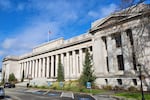
FILE: An undated photo of the Washington State Supreme Court. Five of the nine seats are currently up for grabs. Primary voters will decide the candidates for the November election in four races, with the fifth seat already set to be voted on in November.
Jeanie Lindsay / NW News Network
July 17 is the deadline for Washington counties to mail out ballots to voters. It’s also the first day voters can submit ballots.
In the state’s top two primary, an unusual number of state supreme court judicial candidates appear on the ballot. And five of the nine seats will be decided in November.
We talk with Sarah Mizes-Tan, state government reporter for KUOW and KNKX, about this unusual turn of events and other notable primary races.
Note: The following transcript was transcribed using AI and validated for accuracy, readability and formatting by an OPB volunteer.
Dave Miller: This is Think Out Loud on OPB. I’m Dave Miller. Ballots for Washington’s primary are going out this week. They’ll have plenty of local races in addition to primaries for the state legislature and Congress. Voters will also choose the top two candidates for four seats on the state’s supreme court. With one more seat already on the November ballot, a majority of spots on the state’s highest court are up for grabs this year.
Sarah Mizes-Tan is a Washington state government reporter for KUOW and KNKX. She joins us now. It’s great to have you back on the show.
Sarah Mizes-Tan: Of course. Thanks for having me.
Miller: Let’s start with the Washington Supreme Court. Just like the U.S. Supreme Court, there are nine total justices on it. How is it that five of them – meaning enough to create a new majority – are all up for grabs?
Mizes-Tan: It is a super unusual year. It’s a confluence of different things, mostly judges who have just hit a retirement age so are not able to run for another term. We had a couple of justices who did hit that age already this year and had to have a governor appointee step in for them for the remainder of their term. And then we had one judge who is deciding not to run again for another term. So a couple terms ending, a couple of folks who are not able to run again due to age, and that’s how we get that five that you’re talking about.
Miller: What’s the current ideological makeup of the court? I mean, if one of the big questions here is could it shift, what is it now?
Mizes-Tan: Washington’s [supreme] court is, it’s probably fair to say, center-left, so moderate, liberal and democratic, although of course it’s supposed to be nonpartisan.
Miller: What is turnout for state supreme court seats normally like?
Mizes-Tan: Typically, turnout is very, very low. In general elections research has shown that about a third of voters actually leave supreme court justice ballots just blank. So people get to the supreme court justice section there, and they just literally don’t cast a vote. I think that’s really indicative of just how opaque and strange these races are. That is in a general election. So when it comes to things that have overall lower voter turnout, like primaries, I think it’s fair to say [that] typically for state supreme court seats, it is a very, very low voter participation
Miller: Might this year be different? You wrote about this. I’ve seen other reporting in the last few months about this saying, hey, this is a big deal. Do you get the sense that this year might be different?
Mizes-Tan: Yeah, potentially. I think it’s fair to say that this year in particular, it is certainly higher stakes. There are, as you mentioned, a majority of seats available on the ballot. So there is a chance for voters to really shape the majority decision of the state supreme court, which is highly unusual. And certainly I believe there will be a lot of money behind some of these races, just because of the high stakes on what this court could be deciding in the next year or so.
Miller: I want to get to those high stakes in just a second. But just to stick with the campaigning piece, what has campaigning been like?
Mizes-Tan: Supreme court justice campaigning is very, very opaque. The judges are not partisan in any way and they’re really not supposed to say how they might weigh in on a case that might come before them, if they were to be elected. Washington’s ethics laws are very strict about this in a way that other states maybe are looser. Washington is certainly one of the few states that allows the public to elect their state supreme court judges, and where judges are not supposed to be partisan and are not allowed to weigh in on any issues that they might be ruling on.
In other states around the country, a governor appoints state supreme court justices, or a governor might appoint a state supreme court justice, and the people would affirm that appointment via a vote. But it is pretty unusual to have this kind of open decision process for state supreme court justice.
Miller: OK, so this is a nonpartisan race, and as you were noting, there are restrictions on the kinds of issues that the would-be justices can talk about publicly. But are there ways that they can signal to voters where they stand?
Mizes-Tan: They are not really supposed to do that, based on Washington state ethics laws. So essentially voters have to look at the endorsements the judges are getting, who those endorsements are coming from, and voters will have to do their own research. So they should look up how candidates have ruled on cases in the past, look into their candidates’ statements and look up their state bar rating. But again, they’re not supposed to align themselves with partisan politics at all. And they aren’t supposed to weigh in on how they might rule on a case. These could all be seen as ethics violations. So endorsements tend to be the main way that voters could see how a judge might vote.
Miller: The highest court in any state takes up a whole bunch of issues. It’s a very powerful body, obviously. But one very prominent issue in Washington that could come before this new court in the new term is a so-called millionaires’s tax. Can you remind us what this is?
Mizes-Tan: Yeah, it is the very first income tax passed for the state of Washington. It would levy a 9.9% tax on all incomes over a million dollars. It’s estimated to generate about $3 billion a year in revenue for the state that would go toward the state’s general fund, sales tax breaks and tax breaks for lower income families. It passed in March, but it doesn’t go into effect until 2029. It’s very, very controversial. There are a number of legal challenges that have been mounted against it, the main one being that they say this tax goes against Washington state’s constitution.
That case is currently working its way through lower courts, but it’s expected to eventually work its way to the state supreme court for a decision probably sometime in the next year or so. So I think that’s what a lot of folks are eyeing when they think about these supreme court seats and what these judges might be ruling on in the coming years.
Miller: But “might” is an important word there, because there’s a chance that the tax won’t even get to that legal challenge. Voters could say no to it in November?
Mizes-Tan: Totally, yes. I think it’s fair to say that this tax has encountered quite a lot of challenges from a lot of different directions. But there is, in fact, an initiative on the ballot to defeat it. So voters could just vote to repeal this tax in November. And of course if it’s repealed, I don’t think that particular legal challenge is going to make its way to the supreme court.
Although it’s important to note that this tax’s timeline is pretty long. It doesn’t actually kick in until 2029. So I think there’s probably going to be a chance that you’re going to see some back and forth between the state legislators as they rework that law, if it is repealed by voters. It may still make its way, in some form, to the state supreme court.
Miller: So speaking of the November ballot, even though first we’ve got the August primary, you reported recently on a measure that would ban transgender middle and high school girls from competing in female athletics. This is going to be something voters will consider in November. It comes on the heels of the U.S. Supreme Court’s ruling upholding similar bans in Idaho and West Virginia. What are the specifics of the proposed ban in Washington?
Mizes-Tan: It’s a big initiative year for Washingtonians. November’s ballot, like you mentioned, is gonna feature a ban on transgender athletes participating in girls’ school sports. Similar bans in Idaho and West Virginia, as you said, were recently upheld by the U.S. Supreme Court.
Washington’s ban, or proposed ban, is surprising in a couple ways. One is that if voters do decide to pass it, Washington would be the most liberal state in the country to enact a ban on transgender athletes, and it would be a bellwether of sorts for bans like this across the country. Washington has really led the country in terms of transgender athletes’ rights and acceptance. Washington really hasn’t had any sort of gender or birth sex policy when it comes to school sports. So this would be a landmark ban if it were to be passed by voters.
And I think the other interesting thing to note is that Washington’s ban is a little bit different from the bans that were upheld in Idaho and West Virginia in that it would actually require a physician or a medical professional to verify a student’s birth sex, potentially through a genital exam. This is something that many other states across the country don’t actually require. Other states with bans simply require proof of birth sex via a birth certificate. So two interesting points with that particular initiative.
Miller: OK, but again, that’s November. Let’s go back to the primary for which ballots are about to be mailed out. How is the race for Washington’s 3rd Congressional District – meaning Southwestern Washington – shaping up? This is a famously swingy district. It has switched parties three times starting in 2010. It’s now held by the moderate Democrat Marie Gluesenkamp Perez.
Mizes-Tan: This is a race we’ll all be watching. Marie Gluesenkamp Perez is, as I’m sure many of your listeners know, somewhat unpopular, depending on who you speak to these days. It seems like she isn’t left enough for progressives in the Democratic Party, and she isn’t right enough for Republicans. She does have a progressive challenger to the left of her this election cycle as well. And of course she’s got her Republican challenger, John Braun, who is a former Washington state senator.
Miller: Let’s say that in the end, the top two, John Braun and Gluesenkamp Perez, make it to November. When Gluesenkamp Perez won her first two terms, she won against Joe Kent, a political newcomer and a kind of MAGA-style firebrand. How might a race against a much more established politician who has been a leader in the state legislature for a while now be different?
Mizes-Tan: I think it’s really important to note that John Braun is a longtime Washington state senator and a Washington Republican, which is a different brand. He’s not your classic MAGA Republican. In a national sense, he’s actually a very moderate Republican. So I think it’ll be a really interesting matchup between the two. Recent polling that I just saw from the Northwest Progressive Institute, a nonprofit based in Washington, found Braun was winning with voters by a single percentage point. They mostly deemed the race between the two candidates to be statistically tied. [The Institute] found that, for the November general election, they were predicting that Braun would receive 43% of the vote, and Gluesenkamp Perez would receive 42% of the vote, and 16% of voters were still undecided. So I think it’s fair to say it’s going to be a really, really tight race.
Miller: Again, that’s if those are the two who make it as the top two candidates in August. Finally, what are you paying attention to in the primary at the legislative level?
Mizes-Tan: We’re watching a really interesting trend right now. We’ve seen a record number of races with Democrat-on-Democrat challenges. So we’re seeing sitting Democratic legislators with challengers from their very same party. Sometimes these challengers have stances that are further to the left of the sitting Democrats. They’re more progressive than them. We’re interested to see how these challenges will hold. If they do end up prevailing, and if they do end up winning, I think it might signal a leftward shift for the state’s Democratic Party.
Miller: Sarah, thanks very much.
Mizes-Tan: Of course. Thanks for having me.
Miller: Sarah Mizes-Tan is a Washington state government reporter for KUOW and KNKX in Seattle.
“Think Out Loud®” broadcasts live at noon every day and rebroadcasts at 8 p.m.
If you’d like to comment on any of the topics in this show or suggest a topic of your own, please get in touch with us on Facebook, send an email to thinkoutloud@opb.org, or you can leave a voicemail for us at 503-293-1983.