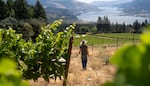
Julia Bailey walks the vineyards of Loop de Loop Winery in Underwood, Wash., on July 14, 2026. There are about three dozen female wine producers, growers and winery owners in the Columbia River Gorge, a region well known for its stunning views but not as famous for its wine as the Willamette Valley.
Saskia Hatvany / OPB
The road to Bethany Kimmel’s land climbs almost eight miles northeast from White Salmon, Washington, winding past hillsides thick with Douglas firs, red cedars and ponderosa pines, to a remote ridge where three-year-old gamay grape vines are slowly reaching maturity. Their still-spindly, woody stalks are buffeted by the famous summer winds of the Columbia River Gorge. But like others who make wine here, Kimmel has learned to turn the weather, the 2,000-foot elevation and the singular geology of the Mt. Adams foothills into assets.
She’s joined about three dozen women producers, growers and winery owners in the striking river canyon that stretches 80 miles east of Portland, straddling two states. To the south lies Oregon’s Willamette Valley, and to the north, Washington’s Columbia Valley — well-known epicenters of Pacific Northwest wine. But a less-than-two-hour drive northeast of the Willamette region, the Gorge’s high-acid, eclectic wines are putting the region on the map. The industry is still finding its footing, leaving plenty of room for a bold, creative cohort of women who see its potential to carve a path they say was closed to them elsewhere.
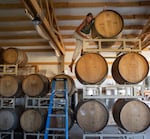
Bethany Kimmel, 41, tops the wine barrels at her home in White Salmon, Wash., on July 14, 2026. Kimmel is the owner of Soča Wine Shop & Bar and is currently making wine with the grapes of other growers while waiting for her vines to reach maturity.
Saskia Hatvany / OPB
“We’re scrappy,” Kimmel said, bending down to break off clusters of tiny grapes on her vines to coax them to grow thicker roots. Farther up the hillside, the 198-square-foot tiny house she bought on Craigslist and hauled up the mountain in a rented trailer finally has electricity. Now 41 and owner of the Soča Wine Shop & Bar in downtown White Salmon, she acknowledged, “I started my own winery well before I should have.”
“But there are badass women in the Gorge,” she said. “It’s a little bit undiscovered. We’re finding our niche in a highly competitive, male-dominated world.”

That world includes the far more established wine regions of the Northwest, along with Napa and Sonoma in California. But that’s changing as more women graduate from viticulture and enology programs and advance into leadership roles, state data from Oregon and Washington shows. The Gorge has a particularly large concentration. “It hasn’t been fully inhabited as far as the industry goes, so there’s still room for women to find a space here,” Kimmel said.
The region has attracted so many ambitious women in wine in large part because its challenging, ever-changing landscape doesn’t lend itself to large-scale vineyard operations, industry leaders say. That’s allowed winemakers who may have only modest capital to get a toehold.
“These are small spaces, smaller places, and a less well-trafficked, proven area for wine,” said Doug Frost, owner of Echolands Winery in Walla Walla, Washington, and president of Best USA Sommelier Association. “Women who have had to prove themselves over and over don’t have to do that in the Gorge.”
Frost said the women’s commitment to sustainable, pesticide-free winemaking appeals to a younger generation of wine drinkers the industry needs to cultivate.
Making wine in the Columbia River Gorge means understanding — and sometimes battling — a landscape of volcanic soil and microclimates in a river canyon that acts as a massive natural wind tunnel, shifting from wet alpine altitudes to dry, sea-level climates. It means taking risks and growing grapes that may not thrive. It means patience and a sense of exploration, the winemakers say. The challenging growing conditions will eventually limit the region’s wine production, Frost said, “But we’re nowhere near reaching the cap.”

All images: Saskia Hatvany / OPB.
While thousands of vineyards dominate the Willamette and Columbia Valleys, fewer than 100 are scattered through the Gorge in south-central Washington and north-central Oregon. Dozens are led by women who contend not only with the climate, but challenges like forest fires that have ruined entire vintages, Trump administration tariffs, grueling, 12-hour days during harvest that interfere with childcare, a nationwide contraction in wine consumption as baby boomers age — and sexism.
“To be a good winemaker, you need to be able to do all of the things” involved in the process, from the winery cellar to the vineyard, said Lauren O’Brien, 48, winemaker for Phelps Creek Vineyards, one of the Hood River Valley’s largest and most-established estates. But women tend to be funneled into a small number of roles, including as the enologist who monitors fermentation and analyzes wine’s chemical properties from a lab — as she did at a previous job in the Seattle-area.
“In general, women are much more likely to be hired to work in the lab than the production floor,” O’Brien said, in part because of a perception that they can’t handle its physical rigors.
Back in Portland in the late 1990s, Julia Bailey, 50, founder of Loop de Loop Wines on Underwood Mountain in Washington, kept getting promoted — but only in tasting rooms, she said. That’s where women have traditionally been represented, often because they were considered too weak to lift wine barrels and other equipment required in winemaking, Bailey said. But she wanted to make wine, not serve it. “One of my bosses said to me, ‘Cute girls just distract the boys in the cellar,’” she recalled. “The dudes were in the cellar. It’s machismo.”


All images: Saskia Hatvany / OPB.
She left her hometown in Iowa in her 20s to play cello in an indie rock band in Portland, then pressed the first grapes that made her own wine in a kiddie pool in the West Bank, where she had settled to work for an international aid organization.
Bailey and her husband Scott Gulstine bought 18 acres in the Gorge in 2019. She relocated her label from the Willamette Valley, where for years she rented space in other winemakers’ cellars to make her own. Loop de Loop celebrated its fifth year in June. Gulstine farms the grapes, Bailey produces the wine, and the couple is finally building a house on their land after commuting to a family cabin 25 miles away in Trout Lake. For now they can only afford to hire seasonal employees. “We pretty much do it all,” Bailey said.
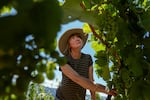
Bailey poses for a portrait among the grape vines at Loop de Loop Winery.
Saskia Hatvany / OPB
The vast majority of Gorge winemakers are small, boutique producers bottling 5,000 cases annually, or far fewer, of light and crisp reds and whites. Many have a lower alcohol content than wine from other regions. The area counts just a handful of estate wineries, which grow, harvest and bottle their wine on the same property, fully controlling the process — another contrast with the high-production Willamette Valley, which has attracted investment groups and corporations.
The six Gorge women OPB interviewed took many paths, some circuitous. They apprenticed in fine restaurants or harvested grapes and worked in the vineyards of internationally-recognized wine-producing regions around the world. Others had careers in different fields before discovering their passion for winemaking. Several took charge of farms they inherited or bought from their elders, businesses that in an earlier generation might have been destined for men in the family.
As a second-generation winemaker, Anaïs Mera’s path was paved by her mother, Rachael Horn, who founded AniChe Cellars in Underwood in 2009.
“She didn’t ask any permission” to start a winery, Mera said of her mother, meaning “social permission” from the men in the industry.
AniChe is a family business, with men serving in multiple roles helping to produce riesling, dolcetto, chardonnay, pinot noir, grüner veltliner and sparkling wine. But the men are not in charge, Mera, 35, said.
“So many women, if they’re going through the formal ladder, the ladder you have to climb in a corporate winery is harder to ascend, versus moving to the Gorge and getting your foot right in the door,” she said.
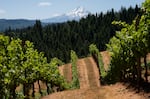
Mount Hood is visible from the slopes of Phelps Creek Winery in Hood River, Ore., on July 14, 2026.
Saskia Hatvany / OPB
With at least 30 women in leadership roles, the percentage of women winemakers and owners in the Gorge is higher than the national average of 18%, according to research done this year by Washington State University. Across Oregon, women hold about 30% of executive winemaker roles, up from 17% in 2017, figures released last year by Women in Wine Oregon.
When Jill House was gifted her family’s century-old, 50-acre fruit farm outside Hood River by her maternal grandmother in 2002, she made a bold decision to follow her dream of planting a vineyard. Her family had farmed pears, apples and cherries on the land for decades.
House planted her first pinot noir vines in 2012 and expanded the vineyard with chardonnay and pinot gris in 2016, creating what is now the Stave & Stone Winery.
Today, she leads the business with an all-women vineyard crew of six. “They think about things twice. Then they cut once. They’re kinder to the vineyard,” House, 58, said.
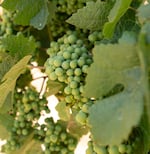
The Gorge’s many microclimates and dramatic shifts in temperature allow for an eclectic mix of varietals, including sauvignon blanc, gewürztraminer, pinot noir, pinot gris, viognier, syrah, chardonnay, riesling and grüner veltliner. The wind that put the area on the map as a windsurfing mecca 40 years ago serves a purpose in winemaking, warding off mildew and creating thicker grape skins.
“All the good stuff is in the skins,” Bailey said.
All images: Saskia Hatvany / OPB.
The Gorge has historically been best known for its fruit production, not its vineyards. The region is the largest pear-growing area in the U.S. and the third largest for sweet cherries. But various economic strains have taken a toll.
When the pear trees her Swiss grandparents planted at the foot of Mt. Hood decades ago started losing money, Katrina McAlexander took a risk and planted chardonnay, pinot noir and gewürztraminer grapes. They grew. A tasting room and homemade beer and cider eventually followed, she said.
“The story of wine in the Gorge is always, ‘Wine won’t grow in your area,’” McAlexander recalled as she thinned the shoots on some vines of pinot gris.
“People in wine are always telling you it won’t work, but what did I have to lose? I decided 12 years ago, ‘I’m going to produce wine in Parkdale.’”
She has kept her day job as a nurse practitioner since buying 50 acres from her parents in 2014 — but the business, The Grateful Vineyard, is profitable, she said.
One driver of her success, she added, is the camaraderie among could-be competitors.
The staff at Grateful Vineyard was in the middle of pressing grapes for sparking riesling in late June when they realized that an expected shipment of bottle caps had not arrived from Canada. The timing was terrible. McAlexander got on the phone. She called Teddi Fuller, founder of Lushington Wines across the river in Lyle. “I’ll sell you some caps,” was how Fuller responded.
“It was such a kind gesture,” McAlexander said. “It would have stopped us from bottling.”
At Loop de Loop, Bailey wanted a wine label that spoke to the collaborative nature of the women winemakers around her.
She called it “Rising Tide.”
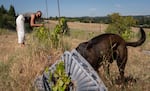
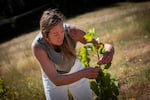
Birdie, Kimmel's dog, hunts for critters under the base of the young vines as Kimmel tends to a vine at her White Salmon, Wash., vineyard on July 14, 2026.
Saskia Hatvany / OPB
Lisa Rein is part of OPB’s rural freelance network.