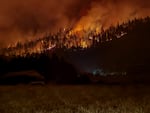
The East Evans Creek Fire burns in Jackson and Jefferson counties on July 18, 2026.
Oregon Department of Forestry Complex Incident Management Team 1
According to the Oregon Department of Emergency Management, wildfires have burned more than 300,000 acres across the state so far. Fire officials say that lightning strikes last week ignited dozens of fires which were fueled by dry vegetation, hot weather and windy conditions. An estimated 1,500 Oregonians are under Level 3 “Go Now!” evacuation orders.
Oregon State Fire Marshal Mariana Ruiz-Temple joins us with an update on the status of the fires and how agencies are responding.
Note: The following transcript was transcribed using AI and validated for accuracy, readability and formatting by an OPB volunteer.
Jenn Chávez: This is Think Out Loud on OPB. I’m Jenn Chávez, in this week for Dave Miller. Fire season is underway in the American West, and Oregon is being hit very hard right now. Over 350,000 acres have burned in the state after lightning strikes ignited multiple clusters of fires last week. All hands are on deck right now to protect Oregonians and try to get these fires under control.
Joining us for an update on where things stand currently is the Oregon State Fire Marshal, Mariana Ruiz-Temple. Mariana, thank you so much for joining us today at what I know is such a busy time.
Mariana Ruiz-Temple: Thanks for having me.
Chávez: At last check, there were 70 fires actively burning right now around the state. I’d love to know what are the fires or complexes causing you and your colleagues the most concern right now?
Ruiz-Temple: Definitely entering into a challenging and dynamic fire season in the West, and certainly in Oregon. When we’re looking at Oregon, Oregon has entered into Preparedness Level 5, which is the highest level of fire activity. It is marked by extreme wildfire activity, in terms of the amount of fires on our landscape and the amount of incident management teams that are out there. As a whole, Oregon is bumping around 450,000 acres burned thus far. I’ll talk a little bit about the three areas we have concern [for]. The Central Oregon area, both the Akawa Butte and the Brewer fires are under unified command between ODF (Oregon Department of Forestry) and OSFM (Oregon State Fire Marshal).
The Akawa Fire, which is burning outside of the town of Sisters, we’re around 10,400 acres, about 3% containment. The Brewer Fire is actively burning, torching and spotting around 25,000 acres and about 1% contained. Both of those fires are of concern due to the close proximity to structures, the fuel and the behavior of those fires, and the potential weather events that we see coming in that area later in the week. So both of those are priority fires for both agencies.
Burning in Eastern Oregon is the Rowe Creek Complex. Those were a series of 11 fires that were burning in Wheeler County that have, for the most part, converged into Oregon’s first megafire. We are around 143,000 acres [with] about 15% containment. We’re starting to feel more comfortable about the impacts to communities and structures, but a lot of coordination between locals, rurals, fire districts, wildland firefighters and the feds on that fire. That is, again, our first megafire in Oregon this year.
We’re also working on the Hagen Fire, which is burning outside of Pendleton. That is impacting communities and structures in the East Umatilla area. That continues to see isolated torching and short-term spotting. The conditions in that area at night, we continue to see fire be active and move downslope in that area. Those flashy fuels are areas of concern, especially with proximity to those structures.
Lastly, I’m happy to report on the East Evans Creek Fire, which is burning outside a Shady Cove in Jackson County. We’re at 15,000 acres, about 20% containment. But what’s important here is that as we continue to see improvements, especially around communities and structures, the Blue Incident Management team is looking to demobilize over the next couple of days, which is a good indicator that is also commensurate with what we’re hearing with EVACs lowering over the next hour. We’re hearing that those that are in Level 3 will likely be going to Level 2. So those are good indicators of good progress, good work around and near communities. That helps us relieve our system and bring more availability into the Oregon Fire Mutual Aid system.
Chávez: OK, thank you so much for that overview. I do wanna ask just a couple questions. You mentioned concerns around the proximity to communities and structures. Are any fires threatening urban centers or rangeland in a way right now that’s concerning you?
Ruiz-Temple: Yeah. In our rangelands, Gilliam County, Sherman County, that last lightning storm had significant efficiency in starting new fires. Earlier this week, over the weekend, a lot of work in our RFPAs, our rangelands, our local landowners in Sherman and Gilliam County. We did have the Hoag Fire which was burning outside of Arlington. [There were] significant impacts and potential to the town of Arlington and really good work during those evenings.
But what we’re seeing in Umatilla Country and in our rangelands, is that when that lightning hits and those fuels are ready, in terms of their ability to ignite, we are seeing those long-term complexes come on more. So they’re being managed by incident management teams and we continue to see good work on containment in those areas.
Chávez: We’ve talked a little bit about how lightning strikes have started some of these fires. Can you speak a little bit more about how weather conditions have affected your efforts and what the outlook is in the days ahead for those conditions when it comes to these fires?
Ruiz-Temple: Sure. As we watched the last lightning storm come in, we had about 8,200 hits across Oregon and Washington. That storm was extremely effective. That is a good indicator of the conditions and the fuels, and their ability to ignite based on lightning.
What’s concerning for us is today and the next few days. We are experiencing a push of monsoonal moisture coming into Oregon today. That is likely to bring thunderstorms, primarily over South Central and into Southeast Oregon. And you overlay that with warming, drying, hotter conditions in the Columbia Basin, then we’re starting to see relative humidities in the teens and in some areas, single digits. With compound high temperatures, lower relative humidity and continued thunderstorms, that is a pretty significant indicator for us.
We’re also going to see increased thunderstorms Wednesday with the best chances of those hitting our Oregon Cascades and Southeast Oregon. Of most concern is that we do expect to see critical windy and dry conditions for most of Eastern Oregon on Thursday and Friday. We expect that this lightning storm will be highly efficient. So when we take a look at conditions on the ground, we take a look at more lightning, and then we take a look at a Thursday and Friday potential windy event, that gives us a lot of concern about maintaining fires that we have currently and the potential for new fires starting.
Chávez: Firefighting resources have been put to the test in recent days. How is your level of resources looking right now, and what kind of help are you getting from collaborations with other agencies either within the state, outside of the state, even from Canada?
Ruiz-Temple: Great question. We rely on a complete system of partners when it comes to wildland response. That is our federal agencies, the Oregon Department of Forestry, the Oregon Department of State Fire Marshal. We use the Oregon Fire Mutual Aid System, which our responsibilities is to protect fires that are impacting communities and structures. The Oregon Department of Forestry, obviously, the wildland fire agency for the state, protects state lands.
We do that through the Northwest Coordination Center where we daily prioritize fire. Then we resource through each agency’s individual resourcing partners. But we come together as one team, one plan, one mission per fire. So the feds mobilize through their system, the Oregon Department of Forestry and OSFM bring our tools. We each have a specific type of tool needed when you look at the types of fires that are impacting Oregon, not only in our forests, but also impacting our wildland urban interface where people live and recreate. So having the ability to bring all of those resources allows for a coordinated response.
Unfortunately, because we are at PL 5 in Oregon, we are also at PL 5 nationally. What that means is a significant drawdown of resources and so many of our agencies rely on interstate agreements. We’ve brought in California, we’ve brought in other states like Washington. Throughout the system, I think other agencies have brought in states from all over the Northwest and our country. Then I also know that, at the federal level, they’re looking at bringing in the possibility of international resources as well. So we really do rely on these interstate, international agreements when we get to this level.
Chávez: Mariana Ruiz-Temple, thank you so much for taking the time to update us today, and for all the hard work you and your colleagues are doing right now in Oregon.
Ruiz-Temple: Thank you for having us and thank you for thinking about them.
Chávez: Mariana Ruiz-Temple is the Oregon State Fire Marshal.
“Think Out Loud®” broadcasts live at noon every day and rebroadcasts at 8 p.m.
If you’d like to comment on any of the topics in this show or suggest a topic of your own, please get in touch with us on Facebook, send an email to thinkoutloud@opb.org, or you can leave a voicemail for us at 503-293-1983.