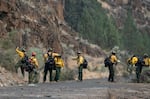
Wildland firefighters create a fire break on the side of Rowe Creek Road near Mitchell, Ore., on Tuesday, July 21, 2026. The Rowe Creek Complex Fire, which spread to 149,000 acres by Tuesday, is a cluster of wildfires that were sparked by lightning storms last week.
Saskia Hatvany / OPB




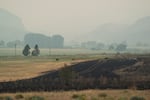
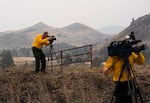
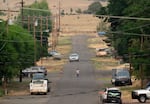
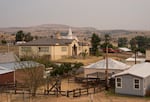
Carl Campbell says he’s lived in eight different houses in Fossil, Oregon — a town that only has about 250 houses — since 1952. He’s seen and fought many fires that have come through Wheeler County, but the Rowe Creek Complex, which has burned nearly 150,000 acres, is one of the largest.
When he was growing up, Fossil was a small but booming community anchored by the nearby Kinzua logging company. “We had three bars!” he said in an interview during a community meeting at the Wheeler High School gymnasium on the evening of July 21.
When fires broke out, Campbell said, Kinzua would send a 100-person crew to extinguish them. After the company shut down in 1978, many of the residents left. So did the firefighting infrastructure.

From left, town residents Paul Britt and Carl Campbell attend a fire information meeting in Fossil, Ore., on Tuesday.
Saskia Hatvany / OPB
The largest blazes in Oregon right now are in areas that have burned before. Many of the communities, like Fossil, are sparsely populated. They have limited resources, but locals’ knowledge of the challenging terrain — rangeland valleys surrounded by steep cliffs of dry grassland — has helped state and federal firefighters. In Wheeler County, relationships forged two years ago are shaping how private landowners and public land managers work together now.
The last several days have been “a lot of work and no sleep,” for Terry Harris, a rancher who volunteers with the Wheeler County Rangeland Fire Protection Association. Harris, who lives in nearby Spray, said the work has consisted of everything “from running shovels to running hoses, to directing people, whatever we gotta do to get stuff done.”
RFPAs are volunteer-run groups of local landowners and ranchers who help protect private property and rangelands from fire. They’ve been working in coordination with the Oregon Department of Forestry and firefighters from various federal and state agencies throughout the Rowe Creek Complex.
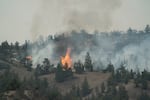
A stand of juniper trees torches at the head of the Rowe Creek Complex Fire near Mitchell, Ore.
Saskia Hatvany / OPB
“ Whenever these big teams come in, we try to help,” Harris said. “We join together, and we all work together. We can show them so they can get their crews in to help us.”
The relationship between local RFPAs and state and federal agencies hasn’t always been harmonious though.
In July 2024, the Lone Rock Fire torched nearly 135,000 acres across Gilliam, Wheeler and Morrow counties. More than 1,000 firefighters were deployed in that effort.
“There’s always a mating dance when organizations get together that have to respond to something,” said John Szulc, incident commander with Northwest Team 2, in Tuesday’s meeting. Szulc was also an incident commander for the Lone Rock Fire.
“Even in wildland fire emergency management, teams have to coalesce quickly, right?” he said. “And sometimes that’s difficult with personalities, different training, different ways of doing business, different equipment, and it takes some time, even on the fly.”
Szulc and Harris both said the relationship between the RFPAs and outside firefighters has improved a lot since the 2024 wildfire season.
“ I think the home people are realizing that we can’t do it by ourselves,” Harris said, “and the state’s realizing that we’re gonna do whatever we have to do to put the fires out…We both have to realize that we have our own limitations.”
While the collaboration among local volunteers and state and federal firefighters has helped containment efforts for the Rowe Creek Complex, the circumstances remain challenging.
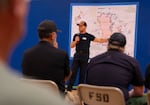
Scott Stearns, meteoroligist with the National Weather Service Storm Prediction Center, attends a fire information meeting in Fossil, Ore., on Tuesday.
Saskia Hatvany / OPB
“ The resources are stretched thin,” said Damon Simmons, a line safety officer for the Oregon State Fire Marshal, during a tour of the wildfire zone on Tuesday. “ There’s that constant prioritization of resources that’s going on. We’re pulling from one fire and going to the next fire.”
One of the areas that burned recently is the Pine Creek Conservation Area, a 34,000-acre property southwest of Fossil managed by the Confederated Tribes of Warm Springs for fish and wildlife habitat. Almost the entire property burned in the Rowe Creek Complex, said Kevin Pullen, a project lead for the conservation area.
“This event is going to have quite an impact,” he said. “We’re going to have to restart a lot of things as far as restoration work.”
Still, he said, fire is a natural process.
“It’s just becoming more prevalent nowadays. With climate change, things are getting warmer and drier, earlier,” he said. “We just have to take it in stride and do what we can.”
With another series of dry thunderstorms and lightning forecasted this week, Wheeler County residents and firefighters are bracing themselves.
“ Fire is fire,” said Harris, with the RFPA, “and we’ll fight it every time it comes.”
Saskia Hatvany contributed reporting.