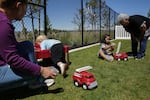
FILE - In Central Oregon, (from left) Alex Olivas guides Callum in play while Waukeen uses a spray bottle with teacher Miriam Romero at The Children's Learning Center in Jefferson County, on June 4, 2026. Daycare shortages are a challenge across many rural communities in the state, and a new effort in Eastern Oregon's Malheur County hopes to support more options.
Kathryn Styer Martínez / OPB
Educators in Eastern Oregon’s Malheur County are trying to grow the number of Spanish-language childcare providers in a region with a large Latino community.
Malheur Education Service District plans to launch a Spanish-language business accelerator program next year near the Oregon-Idaho border, where more than one-third of residents identify as Hispanic or Latino. Despite the size of the community, Amelia Fernandez, quality improvement specialist for the district, said only six Spanish-speaking providers operate in the area.
“Parents are looking for childcare,” she said.
The accelerator program will be designed to guide participants through the state daycare licensing process, provide training on how to run a business and offer one-on-one support for more specific questions.
Fernandez said that while the district’s English-language program is already open to Spanish-speaking providers, a Spanish cohort will offer another option for those who may feel more comfortable receiving training and support in their language and with cultural context.
“It’s important, especially for families, to feel seen and heard and they have material in their own language,” she said. “Not that an English provider can’t, but there might be a harder communication barrier there if languages are different.”
Fernandez hopes the program will benefit farmworkers who are looking to build up another source of income by offering childcare during the months when agricultural work slows down.
The district is in the process of recruiting participants.
For John Breidenbach, CEO of the Ontario Area Chamber of Commerce, the effort also reflects the history of the community. He said many families in the area have longstanding ties to Latino agricultural workers. This includes connections to the Bracero Program, a U.S.-Mexico guest worker program that brought millions of Mexican workers to the United States to fill agricultural labor shortages from the 1940s through the 1960s.
Today, he said, the county is home to fourth- and fifth-generation Latinos.
“If you’re Latino and you want your child to be able to be where they’re kind of familiar with the language and not have to guess what’s being said — I think that’s very important,” Briedenbach said.