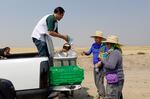
Eddie Melendrez, community organizer for Oregon Food Bank, hands farmworkers resources on July 24, 2026, in Ontario, Ore., as smoky conditions and soaring temperatures continue.
Monica Carrillo-Casas / OPB
A haze of wildfire smoke hung in the distance as the pungent smell of onions drifted through the air in an Eastern Oregon field on Friday.
Wearing a straw hat and a bandana, Rosa Mendoza was picking onions when a white truck arrived on the far side of the field, kicking up dirt and dust. She stopped her work — the kind she’s been doing for the last 20 years in Ontario — to walk toward the truck, wiping sweat off her forehead and fanning herself with her hand. The fields stretched out behind her, disappearing into the smoke.
“We are here out of necessity. We have to work,” Mendoza said in Spanish.
She was among more than a dozen workers greeted by the two men in the truck — Eddie Melendrez and Angel Miranda. They had just arrived with supplies to support workers facing another long day in sweltering conditions.
“I just want to show the community as much as I can that these people are very important,” said Melendrez, community organizer for the Oregon Food Bank. “They’re the backbone of this community. They’re the essential workers.”
Air quality warnings from the Oregon Department of Environmental Quality have expanded across Oregon this wildfire season, with conditions that directly affect farmworkers and others working outdoors.
On the ground, Melendrez and Miranda, who’s with the non-profit aid group Oregon Human Development Corporation, were driving to the fields to provide water, N95 masks, sunscreen, and show support directly to workers.
Miranda said growing up in Eastern Oregon meant he’s watched farmworkers pay the price for unhealthy working conditions before.
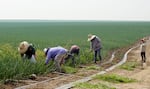
Wildfire smoke hangs over farmworkers as they work in the onion fields on July 24, 2026, in Ontario, Ore.
Monica Carrillo-Casas / OPB
“We’ve seen people get hurt. We’ve seen people get exposures, cancers, a lot of these things, so this is where it really hits home for me and giving back to the community,” he said.
Their efforts came as wildfires continued to burn more than 1 million acres of Oregon. Interstate 84 was closed in both directions between Baker City and Ontario Monday morning, as the Fox Fire in Baker County burned more than 43,000 acres with no containment. The City of Huntington near the Snake River was issued a Level 3 “GO NOW” evacuation order.
Ontario, a hub for interstate commerce and the largest city connecting Oregon and Idaho, has been blanketed with wildfire smoke, with conditions reaching the “very unhealthy” category, which could cause serious health problems for all groups of people.
Melendrez said multiple organizations across the Oregon-Idaho border are working together to adequately help farmworkers cope with worsening heat and smoke summer after summer. This includes the Oregon Food Bank, the Idaho Organization of Resource Councils and the Ontario Rapid Response Team, he said.
An artist and former Ontario city councilor, Melendrez said he began working in Minnesota fields at 9-years-old, alongside his father. He recalled one day when workers were still picking as a plane flew overhead and began spraying pesticides onto the fields.
“When I worked in the fields, I didn’t see anybody coming to help or giving support,” he said.
Miranda shared a similar story from growing up in Eastern Oregon. His father worked in the fields of Adrian, Ore., about 30 minutes outside of Ontario, where Miranda said farmworkers often lacked protections from pesticides or training and supplies to deal with wildfire smoke.
Miranda and Melendrez said they plan to make a few more trips to the fields before summer ends, hoping to continue reducing health risks for workers in the area.