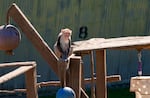
FILE - A Japanese macaque at OHSU’s Oregon National Primate Research Center in Beaverton, Ore., April 17, 2025.
Kristyna Wentz-Graff / OPB
OHSU’s leadership appears to have found a way forward for the Oregon National Primate Research Center that is rooted in compromise.
A draft proposal for the center’s future, published last week, earned cautious praise from both the facility’s scientists and their critics. OHSU’s board is set to discuss the resolution in a special meeting today.
The Oregon National Primate Research Center is one of the largest facilities dedicated to breeding primates for researchers working with the National Institutes of Health. It currently houses about 4500 rhesus macaques and other primates.
The proposal would allow OHSU researchers to continue conducting experiments using primates, while charting a path to reduce the size of the facility’s colony and eventually dissolving its affiliation as part of a consortium of National Primate Research Centers.
If approved, OHSU’s plan would seek to transition the facility over time into a national leader in innovative approaches that reduce the use of animals in research, like human stem cell-based research, computational biology and AI-powered modeling.
That’s a shift in direction from the board. In February, OHSU’s board authorized talks with the National Institutes of Health about the possibility of ending research at the facility altogether and transitioning it to a primate sanctuary.
The new, more phased-in approach has been a relief for scientists at the center.
Dr. Rachael Wolters, ONPRC research professor and veterinarian, said the new proposal strikes a good balance, recognizing that science is evolving and OHSU should be part of that, while affirming the ongoing role of monkeys in research.
“This initial idea of, ‘end the research mission now,’ did not reflect what was known in the scientific community about the state of new approach methodologies and their readiness,” she said.
Wolters, who is CEO of the group Oregon Voices for Biomedical Research, spoke in her role as an advocate, not on behalf of OHSU.
The board resolution also notes that the special grant funding OHSU receives from the NIH to breed monkeys for federally funded research has not kept pace with the actual cost of operating the facility.

FILE - Monkeys in the sheltered housing units at OHSU’s Oregon National Primate Research Center in Beaverton, Ore., April 17, 2025.
Kristyna Wentz-Graff / OPB
It promises a significant reduction in the size of the primate colony, and lays out some of the conditions that will likely be necessary to get there: ending its role as a national supplier of research primates and removing its designation as a National Primate Research Center.
Representative David Gomberg, (D-Newport), a longtime animal welfare advocate influential in state politics, said OHSU’s proposal supports many of his goals: better research, balanced budgets and fewer monkeys.
“I think it’s initial steps down the right road,” Gomberg said.
Gomberg noted the devil is often in the details. The board’s resolution provides a “strategic framework” but includes no hard targets or timelines. Instead, it directs the president of OHSU to develop a comprehensive plan and cost estimates for the changes.
“There’s always the potential for legislation, come January, if those details don’t accomplish some of the aspirations that are laid out in this document,” he said.
In an emailed statement, NIH’s press team said the agency is committed to advancing new human-based approaches, alongside continued support for primate research “in areas where no scientifically valid alternative currently exists.”
The agency said it is still working closely with OHSU and will need to review and approve any changes to the primate center’s direction, infrastructure and federal designation.
The proposal to close the primate research center followed a multi-year campaign by animal welfare activists who claimed the facility’s research outcomes did not justify its continued operation. That drew pushback from scientists at the center who complained of political interference in their work.
Activists gained momentum after President Donald Trump took office. His administration promoted a number of policies to reduce the use of animals in research and promote new approach methodologies.
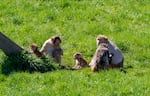
FILE - Japanese macaques at OHSU’s Oregon National Primate Research Center in Beaverton, Ore., April 17, 2025.
Kristyna Wentz-Graff / OPB
In February, as news broke that OHSU and the NIH were pursuing talks, NIH director Jay Bhattacharya told Politico he was working to transition at least one of the nation’s seven primate centers into a sanctuary.
Earlier this month, The Oregonian reported that the sanctuary option had been dropped due to a lack of federal funding. A consultants’ report for OHSU estimated the sanctuary option would cost in excess of $200 million.
The NIH declined to answer questions from OPB about how much it would cost to transition the ONPRC to a primate sanctuary and why the parties dropped that option. OHSU also declined to comment.
But there is some evidence that cost was a hurdle.
Advocates of the sanctuary plan, including the Physicians Committee for Responsible Medicine, have suggested that some funding for operating the proposed sanctuary might come from NIH research grants.
They pointed to a change in policy the administration announced in 2025 that appeared to allow federal research grants to be used to pay for the retirement of research animals.
OHSU’s board resolution cites more recent guidance from the NIH that clarifies the limits of that policy change. NIH grant funding can be used to cover the legal and veterinary costs of preparing an animal for transfer to a sanctuary, but cannot be used to support the daily care and upkeep of the animals, the guidance says.
Wolters told OPB she and other researchers are interested in finding ways to fund retirement for research animals, but believe it would take an act of Congress to change that policy.
One area the resolution is silent on, according to Wolters and a second ONPRC faculty member, is financial support for better living conditions and continuous improvements to the care of animals used in scientific research.