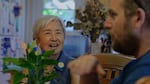
The seeds of trees that survived the atomic bomb have been planted and are now growing in more than 55 trees around Oregon. The new documentary "Seeds of Peace" tells the story of Hiroshima survivor Hideko Tamura Snider, pictured with urban forestor Michael Oxendine, and her peace work.
Courtesy David-Paul B. Hedberg
On August 6, 1945, the U.S. dropped the first atomic bomb on the Japanese city of Hiroshima, killing an estimated 140,000 people.
Hideko Tamura Snider was 10 years old at the time of the devastating blast and suffered unspeakable loss. She tells her story and her work for peace and reconciliation in the new documentary, “Seeds of Peace.” She recently revised and updated her 1998 memoir “One Sunny Day” to include this work.
The film documents her involvement in the years-long effort taking seeds from trees that survived the atomic bomb to grow dozens of new trees in Oregon.
The communities chosen have ties to “World War II memory, Japanese American incarceration, veterans’ experience, and reconciliation.”
We talk with historian David-Paul B. Hedberg, producer and director of “Seeds of Peace.” The film is screening around the state, including at Portland’s Tomorrow Theater on the August 6 anniversary of the atomic bombing of Hiroshima.
Note: The following transcript was transcribed using AI and validated for accuracy, readability and formatting by an OPB volunteer.
Dave Miller: This is Think Out Loud on OPB. I’m Dave Miller. It will be 81 years this Thursday since the U.S. dropped an atomic bomb on the Japanese city of Hiroshima. The bomb killed about 70,000 people instantly. An estimated 70,000 more died in the months that followed from injuries and radiation sickness. Several years ago, the seeds of two trees that survived that blast, a ginkgo and a persimmon, were harvested and brought to Oregon. Now, 55 trees from those seeds are growing in communities all around the state. This story is told in the new documentary “The Seeds of Peace.” David- Paul B. Hedberg is a director and producer of the film, and he joins us now. It’s great to have you on the show.
David-Paul B. Hedberg: Yeah, thanks for having me, Dave.
Miller: When did you first hear about this project to grow new trees from ones that had survived the bomb blast?
Hedberg: I first heard about this in 2019, through some work I do for the Oregon Heritage Tree Program. It was in one of those meetings where someone mentioned that Hideko Tamura Snider and Mike Oxendine were gathering these seeds and germinating them, and that they were looking for help. I have a background in oral history so I just asked the question, “is anybody documenting this?” The answer was no, and the call was, “you should do it.”
Miller: Hideko Tamura Snider survived the bomb as a 10-year-old in Hiroshima and eventually came to the U.S. She lives in Southern Oregon now. She was on our show 10 years ago. What do you remember about meeting her?
Hedberg: The first time I met her was actually in 2020. There was this thing called COVID that really disrupted our lives. It was in the fall of 2020 after the Labor Day wildfires, and she and Mike dedicated a tree that day. So I remember meeting her on a very rainy day. She was wearing a mask and a face shield, and out in her yellow rain parka, planting a tree. She was just full of joy and optimism, in a time that most people were feeling very deep despair.
Miller: As I mentioned, she was on our show 10 years ago to commemorate what was then the 71st anniversary of the bombing. She mentioned searching for her mother, searching and searching unsuccessfully after the blast, and I asked her what that search was like. I want to play a three-minute excerpt from that interview now with a warning that this is a pretty graphic description of injury and death.
Hideko Tamura Snider [taped excerpt from a 2016 Think Out Loud interview]: I don’t discuss these things very easily, so excuse me as I sort of wiggle my sitting position and have a drink of water. It was unbearable. I went from one rescue station to another and I saw dying people singed, bloating, and after a few days, maggots crawling and unrecognizable. I didn’t wish for me to find my mother in that condition, although I would say, “Is there someone here by the name of Kimiko Tamura?” And no one would call out to answer me. But I think that most of these people were not in a position to have enough energy.
And I would go to the next station. But the people would stir as I walked, and I just couldn’t bear looking at each person, or turning them to see if it had anything close resembling my mother, or had clothes, as if she wore that morning when she left the house. So out of desperation … and I was a very vivacious, open child, very easy to talk to, and dance around and skip around, and sunny disposition. I could not bear it another step to go to the next place. And my thought was, “Mama, where are you? I can’t help you. I have no idea where you are. And if you’re suffering like this, I don’t know what to do because I don’t know where you are.”
I said, “God, I want to comfort my mother if she is in that kind of a condition, but there is nothing I can do. So I’m going to hum a little song that she used to love. Would you please carry it in the wind and deliver the sound to her to comfort her?” So I started to hum her favorite tunes. I was very, very austere to that point, but the tears started to roll through my cheeks, and that was the only time I wept, even as a child. Other times I held everything in and went on to do what one had to do, even as a child.
Miller: Again, that was Hideko Tamura Snider, a Japanese-American Oregonian who survived the atomic bomb that the U.S. dropped on Hiroshima. She was on our show 10 years ago. She’s featured in the new documentary, “The Seeds of Peace,” which was made by my guest, David-Paul Hedberg.
What can you tell us about the trees that survived the atomic blast?
Hedberg: Many of the trees in Hiroshima pushed out buds in the coming months after the bomb. The scientific community had said, “we don’t know what to expect after this bomb.” The general consensus was nothing would grow for 75 years. So for those trees to push out those new buds, for young people like Hideko and the victims of the bomb, this gave a symbol of hope. Those trees became revered symbols of hope and resilience to the people of Hiroshima as they rebuilt their city.
Miller: And they were given special care and attention?
Hedberg: Yes. The trees are kind of like revered cultural landmarks, so they’ve received care from a master arborist. We actually were able to meet with him for the film and he took us around to see many of these trees. Through a translator, [he] was able to tell us how he cares for them and collects those seeds. It’s a real project through the United Nations. They started gathering these seeds and distributing them to communities across the globe as a kind of symbols of hope and resilience.
Miller: You went to Hiroshima as part of this project, right? What was it like for you to be there?
Hedberg: Our trip to Hiroshima was intense. I went to follow the Oregon Community Trees board members that had led this project and document their work. But I also brought a work in progress of the film and I screened that at the Hiroshima Peace Museum. That was honestly one of the most intense things I’ve ever done, screening a work in progress, at the site that it took place. I kind of had this out-of-body experience. I’m a white guy American that’s made a film about people in this community.
I’m looking out at the room and realizing there are many Hibakusha, many A-bomb survivors that are there. And I’m asking them for feedback. And they gave me feedback. It was, at times, very direct.
Miller: What was the heart of what they were saying to you?
Hedberg: They were saying don’t ignore the tragedy, the devastation and the horrificness of the atom bomb. I was making a film about these trees and this effort in Oregon, and at times it’s optimistic and hopeful. But they really wanted to make sure that audiences knew how terrible that experience was.
Miller: Don’t focus only on the hope. Don’t sugarcoat this?
Hedberg: Yeah, don’t sugarcoat horror.
Miller: How did some of those seeds from trees that survived end up in Oregon?
Hedberg: So Hideko learned about this project through the United Nations and really wanted to bring them to Oregon. It’s through Mike Oxendine, who’s an arborist down in Ashland. She was able to convince him to germinate those seeds. I think she had tried with many other nurseries and propagators, and they had all said no, and he was kind of like her last hope.
Miller: You don’t say this in the movie. It seems like it’s a little bit more seamless, but she actually struggled to find people to do this?
Hedberg: Yeah, that’s right, she actually struggled. When you meet Mike, he just says yes and is endless energy. So when she found him, it really kicked the project into high gear, and they were able to germinate the seeds.
Miller: I want to play a short excerpt from the film. This is from a section in which Hideko is talking about one of the trees that survived the bomb and the project that came from it.
Hideko Tamura Snider [taped excerpt from “The Seeds of Peace”]: [Piano background music] Isn’t it like a miracle that there is this peace tree that came back from an impossible assault on life. I can’t grow my mother. I can’t grow my cousin. But the tree, I could.
Miller: Where have these trees been planted in Oregon?
Hedberg: I think it’s fantastic that they are geographically distributed all across the state. Just a few weeks ago, I was in the far Eastern Oregon community of Ontario, where there’s a peace tree. There’s several on the coast.
Miller: A peace tree there, and a large Japanese American community?
Hedberg: Yes. A very large Japanese American community that embraced that message and planted a peach tree there. We have them up into the north in Elgin, Hood River, Southern Oregon, the Oregon Coast – really across the entire state.
Miller: You’ve been at these events all over the state. What are they like?
Hedberg: The planting dedications really varied a lot. Each community took Hideko’s message of peace and nuclear nonproliferation, and molded a ceremony that was reflective of their own community. Oregon is home to a lot of Japanese American communities, so I really saw these peace trees having a deep, deep resonance in those communities. We also had dedications that were centered around veterans groups, school kids doing history projects on Hiroshima, writing haiku. So they really varied quite a bit.
Miller: Can you tell us about the one at the Oregon State Penitentiary?
Hedberg: One of the most intense experiences of making this film was going to film inside the Oregon State Penitentiary. The adults in custody there have a Japanese garden that they fundraised and built on their own. So they invited us to come in and we interviewed the curator of the garden and some of the adults in custody there. They received a peace tree as well. These were some of the most present people I’ve ever met. There’s no phones in prison, so they have a lot of time to think about the mistakes they’ve made in their life. They see this tree as kind of like a phoenix rising from the ashes, and giving them a symbol of hope and maybe the possibility of a future outside of prison.
Miller: Two trees were planted at Klamath Union High School, which is near the site of the Tule Lake internment camp from World War II. I want to play a clip from the movie from a woman who you talked to, named Gayle Yamasaki, who is a teacher there.
Gayle Yamasaki [taped excerpt from “The Seeds of Peace”]: [Ambient background music] But I think that there’s something different about having these peace trees at a school, as a daily reminder of the possibilities of our actions, and the choices we make, and the way we look at the world. So this was an opportunity to provide reconciliation for different parts of our community. I had done oral histories from women and men who had graduated from the Tule Lake Segregation Center in 1945. It really made me think about how young people’s lives can be changed and affected. What might it be like if we shared that with middle school and high school students? The majority of those that were incarcerated, their families came from Hiroshima.
Miller: Again, that was Gayle Yamasaki, a teacher at Klamath Union High School, a site where two trees from this project were planted.
If people are just driving or walking around Oregon and they chance upon these trees, what will they know? Is there always a plaque? What does it say?
Hedberg: One of the requirements from the United Nations is that these trees carry a plaque denoting that they are Hiroshima survivor trees. So they all have a plaque. Many of them have a QR code that will take you back to an oral history clip of Hideko explaining what they are.
Miller: I wanna go back to the message that you said the survivors of the blast told you when you were in Hiroshima: Don’t sugarcoat this, make sure you talk about the horror as well. How have you thought about this? Obviously, the name of the movie is “The Seeds of Peace,” and there is something beautiful and hopeful about rebirth embedded in the mission of this. I’m just wondering how you think about the balance between hope and horror as you’ve been working on this?
Hedberg: Throughout the process of making this film, there have been pandemics. There’s been wildfires. There’s been civil unrest. There’s been a mass effort to erase parts of our history. So I very much look at this film, and the truth telling and storytelling that comes along with it, as an essential part of my work as a documentarian. But also, we have to have symbols of hope. We have to have a reason to get up in the morning and continue on. So we can’t just wallow in despair.
I think about Hideko’s effort and the experience of being a 10-year-old girl. I think about that now with all conflicts. I think about all wars, and how we can’t justify war and ignore the impact that it has on children. They have no choice in this matter, and war, regardless, is terrible. Ask any veteran. They know that. And ask any innocent bystander, and they know that as well. So I feel like the film itself is this nice balance between acknowledging the terrible things in our past, while also having some optimism for the future.
Miller: Dave, thanks very much.
Hedberg: Yeah, thank you very much.
Miller: David-Paul Hedberg is the director of the new documentary, “The Seeds of Peace.” The next screening is gonna be in two days, August 6, at the Tomorrow Theater in Portland.
“Think Out Loud®” broadcasts live at noon every day and rebroadcasts at 8 p.m.
If you’d like to comment on any of the topics in this show or suggest a topic of your own, please get in touch with us on Facebook, send an email to thinkoutloud@opb.org, or you can leave a voicemail for us at 503-293-1983.