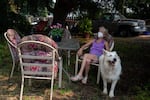
Fawnda Buck looks up to the smoky sky, wearing a KN95 mask her neighbor gave her, as she rests in the yard of her home Airbnb, accompanied by one of her dogs, Porsche, in Sandy, Ore., on Aug. 5, 2026.
Eli Imadali / OPB
Wildfire smoke continued to blanket much of Oregon on Wednesday, a result of several fires burning across the Pacific Northwest. All but two counties in Oregon were under some sort of air quality advisory as of Wednesday afternoon.
And it’s part of a yearslong trend. For the past decade, nearly every region of Oregon has seen an increase in wildfires and smoke as a result. Communities that rarely saw smoke at the start of the 21st century now see at least several days of smoke per year, according to a study by the Oregon Department of Environmental Quality.
Ali Mirzakhalili, the air quality administrator for the DEQ, said Wednesday that the impacts of climate change — less rain combined with hotter summers — have led to more widespread fires and smoke.
“We think the patterns of the past have changed,” Mirzakhalili said. “We’re going to have to deal with an increased number of smoky days. The wildfire seasons are starting earlier and lasting longer and spreading farther.”
Every city included in the study has seen a large uptick in the number of days with unhealthy air. Bend, for example, had 10 days from 2000 to 2015 with air considered unhealthy for sensitive groups. In the last 10 years, that number has jumped to 97.
Mirzakhalili said that while the Willamette Valley used to be spared the worst effects of wildfire season, that’s no longer the case. Since 2016, Portland has had five times the number of days with unhealthy smoke, compared to the previous decade.
“No area in the country is protected from smoke,” he said, referring to smoky conditions in places from Boston to Minnesota.
Some Oregon cities are experiencing extremely poor air quality. Prineville in Central Oregon has an air quality index of 439 as of 4 p.m. Anything above 300 is considered hazardous to human health.
And that’s forced many camps and other activities to shut down until the smoke clears. Camp Namanu, a 103-year-old summer camp located near the base of Mount Hood, sent campers home early on Tuesday due to the smoke.

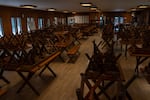
Bunk beds in an open-air cabin lay empty at Camp Namanu, which temporarily closed due to the poor air quality from wildfire smoke, ending a camp session three days early.
Eli Imadali / OPB

All images: Eli Imadali / OPB.
Executive Director Gina Sander said it became clear almost immediately that it would be impossible to have normal outdoor activities for the week.
“The skies were orange, the sun had that spooky, haunting glow to it, and the [air quality index] levels were solidly in the unhealthy category,” Sander said.
The decision was made to send the children home early, rather than keep them indoors for the entire week. Sander said they typically expect smokier conditions in September.
“It’s hard because this is the first time I’ve seen the AQI be so bad at this time of year,” she said. “Is this the new normal or is this just a really bad year?”
Wildfire smoke contains several different chemicals that can be dangerous to a person’s health, with particles that can easily enter someone’s lungs and bloodstream. Gabriela Goldfarb of the Oregon Health Authority said hospitals across the state are reporting an increase in smoke-related visits in the past few days.
Portlanders might see a reprieve sooner than others. Noah Alviz, a meteorologist with the National Weather Service in Portland, said a wind shift coming from the west will help push smoke back out east starting as early as Wednesday night.
“But not all the smoke is going to go away all at once,” he said. “It’s going to be a gradual process.”
Much of the wildfire smoke across western Oregon is expected to clear out Thursday night, although the eastern parts of the state will likely still have smoky skies through the weekend, Alviz said.

The Bull Run River runs on a smoky day in Sandy, Ore., on Aug. 5, 2026.
Eli Imadali / OPB