
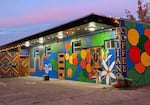
The Hybrid Gallery creates a safe community space for LGBTQ+ artists and the greater Eugene community. It offers art and special interest classes, open mic nights, and more. November 8, 2025 photo provided by The Hybrid Gallery.
Courtesy The Hybrid Gallery
For the last five years, The Hybrid Gallery in Eugene has welcomed and showcased creatives of all kinds into its space. The art collective has diversified its offerings over the years, adding more classes, groups and space for local bands to play. General manager Geneva Vincent says The Hybrid is providing a safe space, not just for artists but for everyone in the community. Events include weekly open mic nights where anyone can share comedy, music, poetry and storytelling. And last year they added a monthly queer and trans figure drawing class. Mars Cantrell teaches that class in addition to one that focuses on body positivity. He and Vincent join us to share more about the art collective and how these figure drawing classes support both those who take them and those who model for them.
Note: The following transcript was transcribed using AI and validated for accuracy, readability and formatting by an OPB volunteer.
Geoff Norcross: This is Think Out Loud on OPB. I’m Geoff Norcross. The Hybrid Gallery is a space for all kinds of Eugene creatives. It’s a performance space and art gallery that welcomes everybody to come in and make art, regardless of the form that takes, or the bodies the artists inhabit. The gallery has diversified its offerings over the past few years, and last year they added a queer and trans figure drawing class. Geneva Vincent is the general manager for The Hybrid Gallery, and Mars Cantrell is an art instructor there, and he teaches that drawing class, and they both join us now from Eugene. Welcome to both of you. It’s good to have you.
Mars Cantrell: Hi, great to be here.
Geneva Vincent: Yeah, thanks for having us.
Norcross: Geneva, you’re first. How did you get involved in The Hybrid?
Vincent: Oh, gosh, that is kind of a long story. I’ll just give you the short version. Originally I had my art up there. A friend of mine had recommended to the gallerist that my art be shown there, so I had my art up there for about, I think, six months or so before I started working there in marketing, and then I just stayed. It evolved and I had a lot of passion for the space, so I’m really, really happy to be there. It’s a dream job I did not know I was looking for.
Norcross: What kind of art do you do when you’re not doing the administrative stuff and running the gallery?
Vincent: I do large scale abstract art, usually in acrylic and oil pastels.
Norcross: Can you describe the space for me? Put me there. When I’m at The Hybrid, what do I see? What does it feel like?
Vincent: Well, you’re driving down a quiet, shady little residential street in The Whit, about a block or two off of the main drag, and if you’re not familiar with Eugene, the Whiteaker is a really vibrant, beautiful neighborhood with lots of public art and really great people. But as you’re driving down the street, you see this really cool house that belongs to Ron LaFond, a local artist who – you should go see his house if you have the chance. It’s open every last Friday. His whole house is painted, and we are right next to it in a vibrantly painted building. We have Equiano Coffee Roasters that rents the front part of the building, and they have, also, Brown Hornet Records right next to it. And then in the back, it’s us, The Hybrid Gallery.
You enter into our retail space, which has lots of art from local artisans and recycled and upcycled clothing, and vintage stuff, and a bar. And then you enter into the hallway, and that’s where the art starts. So we have a hallway, where currently we have an exhibition up of instant Polaroids, and it’s very, very cool, and then you keep going and you go into the main gathering hall, and that’s a really large room. It’s set up with comfy booths and sofas and seating and lots of fun stuff to do like art supplies and board games. It’s a great place to come and read, draw, paint, just hang out, body double, and in that room we also usually have a show up. Right now we have a show with Santiago Uceda, a local illustrator.
Norcross: Yeah, and there are lots of different activities and lots of different art that’s being created in the space. Is there something that binds it all together? Is there a theme that runs through the art that’s created at The Hybrid?
Vincent: Not that binds the art together, but I would say that binds the people together. We are an inclusive community that is really just focused on creativity. Creativity is a guiding focus in the life of most of the people who go to The Hybrid Gallery, whether that’s their job, whether it’s just their hobby, whether they just love to draw, or knit, or whatever.
Norcross: As I mentioned, you had, a little while ago, pioneered new classes, the queer and trans figure drawing class. Why was that necessary?
Vincent: Well, we really wanted to uplift marginalized bodies. We noticed in Eugene that there’s a lot of figure drawing at some really great places, but it’s all pretty normative bodies that are representative. We actually originally started with body-positive figure drawing, so that’s like plus size, disabled, anything out of the realm of “normal” is what we tried to uplift, and then Mars actually approached us and asked if he could turn one of our sessions into a queer and trans figure drawing, and we thought that was just the most fantastic idea and fit perfectly with our vision.
Norcross: Mars, it sounds like you didn’t have to do a lot of convincing, but what was your pitch for that class?
Cantrell: I used to run a queer and trans figure drawing group in rural North Idaho, where I lived before I moved here – or moved back to Eugene, I grew up here – and was running figure drawing, queer and trans figure drawing sessions at the Oregon Country Fair. Someone who attended that session approached me and said, “You know, this is great. I would love to be doing this more regularly,” and asked me if I knew there were similar classes in Eugene. I had just moved back to Eugene and didn’t know if there were, so we were looking at classes around town, making sure we didn’t reinvent the wheel and found the body-positive figure drawing class at The Hybrid Gallery.
After one of the sessions that we attended just as artists, we approached Geneva and approached the staff there, and asked if we could add another queer and trans figure drawing class to the body-positive session, and they were really happy to collaborate with us. I think we had really similar visions, thinking about the ways that we can uplift marginalized bodies and have a really wide variety of artists and models.
Norcross: You know, when you consider any kind of figure drawing for the human body, there are a lot of considerations around safety and comfort. How is it different with queer and trans bodies and not “normal” bodies? What are the extra considerations that you need to bring into a class like that?
Cantrell: Part of it is making sure that it’s a really supportive environment. I think of figure drawing, and think about our class in particular, as one that’s really a collaboration between the models and the artists. It really starts with understanding and making sure that the artist feels really supported and safe, and understanding that it is often a vulnerable thing to do, especially with people who have non-normative bodies in a variety of different ways. To make sure that that is both supported, celebrated, and also seen as a really normal part of just the wide variety of human experience.
We have all of our artists fill out an etiquette form to make sure that everyone’s on the same page about being respectful to the model, and also I regularly check in with the model to make sure that they’re feeling supported and safe and that they’re also feeling in control.
Norcross: Has anybody created something in one of your classes that just blew you away or surprised you in some way?
Cantrell: I mean, certainly, we have a pretty large array of artists. Something I think is really lovely about the queer community and about figure drawing in particular is that it draws people from a really broad range of experience. We have people who come regularly, who have been figure drawing for 20 years, and people who it’s their first time figure drawing, and they wanted to come to a queer and trans event and try something new.
I think I’m often really blown away by people who come, and this is their first ever figure drawing class. I’m always really impressed by the different ways that people are creating and seeing the art, seeing the model, and bringing their own touch to the art that they’re creating.
Norcross: How do you find the models?
Cantrell: Mostly they find me. I’ve been really thrilled by the interest in modeling. We have a model interest form, like a Google Doc form that people fill out, and I have enough models to book me probably all the way through next year. And pretty regularly artists will come up to me after a class and ask if they could model, which is always really lovely.
Norcross: Geneva, we’ve been zeroing in on this figure drawing class. Can you talk more about how it figures into the overall mission of The Hybrid Gallery?
Vincent: Sure. As I think I mentioned before, the guiding principles of The Hybrid Gallery are just community and creativity. So when people approach me and they wanna hold things in our space, if they fit those two things, we’re pretty game to try it out, usually. We have such a crazy wide variety of things happening, but they all go back to being creative in some way and building community in some way.
We have like a jazz jam that happens, it’s all about community. We have lots of art workshops and writing workshops and writing circles, especially a specifically queer safe space for writing and storytelling. I’m gonna forget so many things cause we just do so much. But we have an open mic weekly, every Wednesday, that is community-led and community-focused. So our hosts are all local community volunteers who are creatives themselves, and it’s a really beautiful space where we come together and uplift each other. There’s no heckling allowed. It’s all just really beautiful, vulnerable sharing.
Probably one of my favorite events that we’ve had was called “Unlovely,” and it was a variety show focused on heartbreak. And even knowing what it was gonna be about, the impact that it had on me that night was just unlike anything I could have imagined. It was just this incredible experience of people coming together and sharing in whatever medium they use, there was a lot of poetry, there was music, there was comedy, there was all kinds of stuff, but it was just grief, and you’re able to kind of feel and move through this grief with people collectively, and it was just gorgeous. I think that that event is one really perfect example of what we’re trying to accomplish there.
Norcross: Geneva, you’re giving me the impression that you just take all comers, as long as they’re coming to you in the spirit of creativity and inclusivity, but have you ever had to turn somebody away and just say, yeah, this isn’t what we do here?
Vincent: There’s definitely things that don’t fit into our ethos, and I’ve also unfortunately booked a few things and then come to find out that the producers are problematic in some way in the community and had to unfortunately walk things back. But that’s another thing we really value is the safety of our community, and I get to have those uncomfortable conversations sometimes, but it’s always worth it.
Norcross: Mars Cantrell, I’d like to know what a space like The Hybrid Gallery means for you as an artist and as a trans man and as a member of the Eugene creative community.
Cantrell: It means a lot to me. Something that I’ve really enjoyed is getting to meet so many people who have a similar interest to me. It’s really fun. There are a lot of people who I have met, and met in other places, and seen around town and gone to other events with, and said, “Oh yeah, you’re a familiar face, it’s nice to see you here.”
And on the other end of that, I’ve encountered people through figure drawing and through other events I’ve been to at The Hybrid who, if we didn’t have this shared interest in art and in drawing, that I probably would have never connected with. So it’s really lovely to be able to build community, both with people that I would expect to see, who are similar in age or in demographic to me, and also people who I would have maybe never encountered before, but have something in common with and get to share space with them.
Norcross: Well, Mars Cantrell and Geneva Vincent, it was great to hear about this space, and thank you so much for coming on the show.
Vincent: Thank you for having us.
Cantrell: Thank you so much. It was a pleasure.
Norcross: Geneva Vincent is the general manager of The Hybrid Gallery in Eugene, and Mars Cantrell is an art instructor there.
“Think Out Loud®” broadcasts live at noon every day and rebroadcasts at 8 p.m.
If you’d like to comment on any of the topics in this show or suggest a topic of your own, please get in touch with us on Facebook, send an email to thinkoutloud@opb.org, or you can leave a voicemail for us at 503-293-1983.
