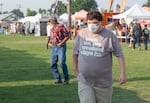
A fairgoer wears an N95 respirator while walking the grounds of the Crook County Fair in Prineville, Ore., on Aug. 5, 2026. Wildfire smoke settled over the fairgrounds on opening day, prompting some attendees to mask up against the haze.
Eleanor Moseman for OPB
Oregon’s wildfire season has been severe, resulting in smoky air in communities all over the state.
Central Oregon now ranks among the worst air quality in the nation, with wildfire smoke significantly affecting the region.
We’ll hear from Crook County Public Health Director Katie Plumb about how people can help keep themselves safe from the smoke.
Note: The following transcript was transcribed using AI and validated for accuracy, readability and formatting by an OPB volunteer.
Geoff Norcross: This is Think Out Loud on OPB. I’m Geoff Norcross, in for Dave Miller. At the moment, Central Oregon has some of the worst air quality in the world. Smoke from nearby wildfires has sent air quality index values soaring. The city of Prineville is in the top 10 for worst air quality in the country right now – that’s according to AirNow.gov. We’re going to start the show by checking in with Crook County, Oregon. Katie Plumb is the Health and Human Services director for the county, and she joins us now. Katie, welcome to the show.
Katie Plumb: Good afternoon. Thank you for having me.
Norcross: How is the air in Prineville right now? What does it look like, smell like, taste like?
Plumb: It’s beautiful. We’re getting some relief today. I can see blue sky, and it’s a welcome break from the smoke for sure. We’re taking it!
Norcross: How’s it different than what it has been?
Plumb: There’s definitely been more days than not [when] it’s hard to see distances, you can’t see across town. So the blue sky is a welcome sight.
Norcross: What are you hearing about how folks in Crook County are being affected by the smoke when it’s there?
Plumb: People are definitely seeking out spaces that have cleaner air. We’re distributing a lot of air purifiers, a lot of do-it-yourself filters so that people can get some relief when they’re inside. I think a lot of people are limiting their outside activities, those who can. Even our indoor air quality is affected, so there’s a lot of work being done to provide spaces that are safe for folks.
Norcross: You mentioned those who can stay inside are being advised to, but of course many people are forced to be outside, maybe because they work outside or because they’re experiencing homelessness. What resources are available to them?
Plumb: We do have public spaces that are available for people who are unhoused, so that they can get in, get some cooler air. It’s really hot right now too, so getting some relief both from the temperature and the air quality. For folks who are working, we do have N95 masks available that we’re distributing to employers. And a lot of employers, they have guidance where they’re increasing breaks, limiting exertion. If we can make adjustments for folks’ schedules who are outside, we’re doing so, maybe [by] delaying projects or modifying them so people are staying healthy.
Norcross: Who are the most vulnerable people in Crook County right now?
Plumb: The unhoused, certainly, because it’s hard to get out of the smoke when you don’t feel like maybe you have a safe place to do so. Our children, infants [and] those who are pregnant are definitely more sensitive to the effects of poor air quality. And those who are elderly, those who have chronic conditions already, can certainly feel more of an impact by being outdoors in this.
Norcross: How are you getting information to people in the county who don’t speak English?
Plumb: Now, we have partner organizations that are doing a lot of that outreach for us. They’re already working with, say, our Spanish-speaking population. We’re really grateful to be able to provide both resources and information to them so that there are people that are already trusted and know the culture and the language to be able to get the information and the resources out.
Norcross: Katie, are you from Crook County?
Plumb: I’m from Central Oregon. I live right next door in Redmond.
Norcross: So you’ve seen the trends: more wildfires, more smoky days. Are you seeing that play out on the ground there?
Plumb: Yes, absolutely. It is more common across Central Oregon where the fires are more intense. They’re affecting populated areas more often, especially in the last eight to 10 years, in my observation here in Central Oregon.
Norcross: Do you feel that you have the money you need, the support you need from the Crook County Board of Commissioners or the state legislature to do your job?
Plumb: We have received an influx of support from private foundations, from state entities. We were able to receive FEMA funding recently. We have good resources and are putting them to use as quickly as possible.
Norcross: If folks who are in a position to be able to help, want to help and can help, what can they do to help other vulnerable people in the county?
Plumb: Time and resources are most valuable in emergency situations. So connecting with organizations that are already here and doing the work on the ground is a great option, supporting organizations that can open up space for the public. We have really generous businesses in town who are making meals for firefighters and opening their doors for folks to come in and get out of the smoke. If you don’t know a specific way to maybe contribute to the effort, supporting our local businesses is one way because they also turn around and invest in our community.
Norcross: And Central Oregon, of course, is a destination in the summer. For anybody who might be thinking about coming to your county, what’s your message to them?
Plumb: Come on over. Like I said, it’s beautiful today. Look at the forecasts. The air quality can change quickly, and it can be drastically different in one part of Central Oregon than it is in another. So if you’re coming this way, maybe have a couple options in mind for things that you wanna do. You might adjust accordingly once you get here. And also, look at forecasts. It might be totally different in a couple of hours too.
Norcross: What is the most important preventative measure that everybody in Crook County can take right now?
Plumb: Monitor yourself, monitor your body and maybe those you care for – your neighbors, your children. Look for symptoms, because everyone reacts a little bit differently, has different tolerance for poor air quality. Be aware of symptoms that might indicate a need to either take more breaks or find additional resources to be able to prevent from potentially feeling like you have to go get care from a provider, go into urgent care. We’re really encouraging people to monitor their heart rate, their ability to take deep breaths, and adjust accordingly.
Norcross: What is the best way for folks in Crook County to get information, resources or support right now if they’re feeling the effects of the smoke?
Plumb: There’s a couple local websites. They can call 211. They can go online to the Crook County website, and we have resources available there, as well as on our social media.
Norcross: Katie Plumb, thank you so much for the time and best of luck.
Plumb: Of course, thank you.
Norcross: Katie Plumb is the Health and Human Services director in Crook County Oregon.
“Think Out Loud®” broadcasts live at noon every day and rebroadcasts at 8 p.m.
If you’d like to comment on any of the topics in this show or suggest a topic of your own, please get in touch with us on Facebook, send an email to thinkoutloud@opb.org, or you can leave a voicemail for us at 503-293-1983.