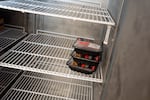
Three packages of ground beef remain on one side of a fridge at the Dallas Food Bank in Dallas, Ore., on July 30, 2026. Volunteers say this fridge would normally be full of meat.
Eli Imadali / OPB
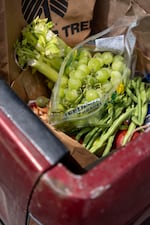
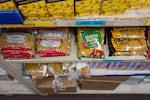
The shelves in the food bank in Dallas, Oregon, are stocked with canned tuna, ramen, rice and beans, tortilla chips and more. Fresh fruit — peaches, plums, bananas, cantaloupe — cover a table beside bags of hot dog buns.
But taped to a wall is a list with items crossed out, signaling what’s gone: shredded chicken, garlic knots, chile verde.
“Usually it’s pretty full,” said food bank manager Eddie Nelson as she opened a beef freezer. “But as you can tell our freezers are getting empty.”
The hunger crisis gripping Oregon is on full display at food banks like this one, which serve as a respite from the grocery costs that have soared more than 30% since 2019. Here, in the Willamette Valley countryside, the line stretches out the door and around the corner at the end of the month, when federal food stamp benefits dry up and families struggle to fill their pantries.
But what’s facing this facility — its flood of visitors, its crammed quarters and dwindling supply of food — highlights a series of challenges coalescing today on the state’s food assistance network as visits to food banks surge to record levels.
It’s a network being reshaped as the federal government ushers in sweeping changes to the Supplemental Nutrition Assistance Program, or SNAP, at the same time that food prices are rising.


All images: Eli Imadali / OPB.
A growing number of people are losing SNAP benefits or are dropping out of the program. In June, there were 126,000 fewer Oregonians receiving federal food stamp benefits compared to the same time last year.
“These families that are coming into our food bank haven’t been to our food bank before,” said Nelson, who attributes the increase in visitors in part to the cuts to food stamps. “The cost of food is outrageous. It’s just out of control.”
More than 646,000 people in the state receive SNAP, according to June data from the Oregon Department of Human Services. The program fuels Oregon’s grocery stores, farmers and food economy with $1.6 billion annually.
The Trump administration is shrinking the program and adding new work requirements that make it harder to qualify. Republicans have long said that SNAP has grown too large, making it vulnerable to fraud and abuse while discouraging work by keeping people reliant on the government.
Democrats say the latest cuts to the program are deepening the strain on struggling families. They hope that seizing on the bill’s changes and the nation’s affordability crisis under President Trump will help their quest to flip Congress in the midterm elections.
The changes come as families across Oregon face a punishing combination of high costs: housing, gas, utilities, healthcare and groceries. One in six people face hunger in Oregon, according to Feeding America, a nonprofit that addresses hunger through a vast network of food banks.
The problem was inescapably clear through the line forming outside the Dallas Food Bank on a muggy July afternoon. Alexis Arechiga, 28, struggles to afford snacks for church and sporting events with her two kids. Corrina Campbell, 32, visits the food bank twice a week, and says feeding her two kids means that, some nights, she goes hungry.
“Sometimes, when I don’t have any food, I just eat peanut butter and that’s what keeps me,” said Jennifer Bullis, a former limousine driver who lives in a trailer nearby. “My food stamps are never enough for the whole month. I wouldn’t eat if this weren’t here.”

All images: Eli Imadali / OPB.
Most people OPB interviewed had their benefits reduced or cut entirely. Many are caught in a quandary that encapsulates the frustration for working families in today’s high-cost economy: They make too much to qualify for food stamps, but hardly enough to afford the rising cost of just about everything.
“How is everybody else getting food stamps and I can’t when I’m a single mom?” said Esther Bodine, a 43-year-old direct support professional, a specialized form of caregiver, who has three children, each of whom has disabilities. “It’s kind of heartbreaking.”
Historically, the U.S. Department of Agriculture has purchased and delivered food to food banks, but last year the federal government canceled millions of dollars worth of deliveries. Now some providers across the state say they are struggling to find enough food to stock shelves and freezers, raising a question: Can they keep pace with the rising tide of visitors?
“We absolutely are not prepared,” said Lindsay Grosvenor, a regional food bank manager in Malheur and Harney counties, where food pantries in some of the state’s most rural and SNAP-dependent areas are reporting increased visits.
“Our pantries are already saying they’re already running out of food,” she said.

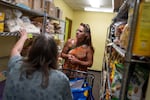
Esther Bodine, left, receives her ticket, marking how many people there are in her household, after she and her sister, Rachel Cooper, right, check into the Dallas Food Bank. The food bank has two intake stations now due to increased need.
Eli Imadali / OPB
Higher costs spur hunger crisis
The Dallas Food Bank sits in the back of the Main Street Plaza beside a car wash and a state highway. Volunteers guide visitors through a series of crammed rooms that offer everything from de-icer to dog food to birthday cakes.
But lately the food bank has been trying to do more with less. There have been so many visitors that volunteers had to use the women’s bathroom as an extra check-in area. With their food supply shrinking, Nelson says she’s having to buy more food in addition to the donated items, like the diced tomatoes and tuna sitting on the food bank’s shelves.
“We’re a country of abundance,” Nelson said. “And I have a hard time with the abundance being so controlled and restricted.”
The pandemic exacerbated the nation’s longstanding hunger problems, disrupting the supply chain and worsening inflation while many people lost their jobs and remained at home. The Biden administration responded by temporarily increasing food stamp spending nationwide.

People enjoy a free community meal at James 2 Community Kitchen, a free weekly community meal hosted at Dallas United Methodist Church in Dallas, Ore., on Aug 1, 2026.
Eli Imadali / OPB
But for many families, food insecurity — the struggle to consistently find affordable and healthful food — is a persistent part of their lives. From 2020 to 2024, the average number of Oregonians enrolled in the food stamp program surged by more than 100,000 people.
Meanwhile, as grocery costs have increased, visits to food banks, pantries and other sites in Oregon and Southwest Washington jumped from 1.5 million in 2019 to 2.9 million in 2025.
Today, the rising cost of living is making things even harder. Rental costs have outpaced wages. Evictions have risen year after year. Healthcare costs remain stubbornly high. More families are now relying on credit to pay for everyday expenses, including groceries.
The latest financial wellness scorecard released by the Oregon State Treasury paints a bleak picture. In 2024, average household debt in Oregon rose to more than $67,000, exceeding the national average and reaching the highest total on record. In 2025, bankruptcy filings jumped by 25%.
And while median income rose in 2024, Treasurer Elizabeth Steiner noted that the report’s findings came before the war in Iran pushed gas prices through the roof.
“People are running out of money,” said Steiner, a Democrat who was elected in 2024. “Inflation is vastly outstripping wage increases. And that’s been true for a while and it’s going to get worse again.”

All images: Eli Imadali / OPB.
A network of local food providers seeks to fill the need, picking up food from grocery stores, delivering food to schools and filling rooms in churches. In the mid-Willamette Valley, the Marion Polk Food Share, the regional food bank, distributed 9 million pounds of food last year, including at 10 pantries and meal sites in Polk County, such as the food bank in Dallas.
More than 15,000 people face food insecurity in Polk County. Dallas Food Bank volunteers managed to serve nearly 5,000 people last year, about one-third of whom were children.
Ray Sambuceto, a 69-year-old retired plumbing retail manager, is among those volunteers. He visited the food bank over the years as a customer. Now he sees people from all walks of life: those with disabilities, the old and the young, the working and unemployed. He rushes back and forth as temperatures increase, lifting bags into people’s cars.
“It seems like each month goes on, and there’s more of a need,” Sambuceto said.
SNAP cuts ripple through Oregon safety net
It’s been more than a year since Congressional Republicans passed their tax and spending cut bill, popularly known as “The One Big Beautiful Bill.” The legislation slashed safety net programs like SNAP, enacting some of the largest changes made in program history. The goal: reduce waste and pay for President Trump’s tax breaks on tips and overtime, among other things.
Republicans maintain that the legislation will provide relief to taxpayers’ pocketbooks and spur business investment. Opponents say those cuts are disproportionately benefiting the wealthy at the expense of the poorest families.
To keep money flowing monthly to their debit cards, recipients must show proof that they did some combination of 80 hours of work, volunteering or job training each month. The rules apply to adults aged 64 or younger who aren’t sharing food with a child under 14 years old.
Other exemptions also apply, such as if a recipient lives in a county that doesn’t have a Worksource Center. Those counties are Crook, Gilliam, Jefferson, Lake, Morrow, Sherman and Wheeler.



All images: Eli Imadali / OPB.
There are many reasons why the number of SNAP recipients are dropping. More than 36,500 people in Oregon lost benefits because they didn’t meet work requirements, according to the Oregon Department of Human Services.
Others didn’t meet requirements around documentation. Still more are dropping out of the program due to concerns about immigration enforcement, including how their personal information is being used.
But the biggest changes are yet to come. Last summer, the state Department of Human Services estimated that Oregon would need an additional $340 million annually to accommodate the bill’s changes to SNAP. State lawmakers passed a bill during this year’s short legislative session allocating $111 million and nearly 400 positions to start implementing the bill.
To soften the blow, Oregon is one of several dozen states that are seeking to lower its “error rate,” or the percentage of benefits paid either above or below what people should have received.
States with error rates that exceed 10% could be required to pay up to 15% of the cost of benefits. Those with especially high rates, like Oregon — which had an error rate of more than 14% in 2025 — will have a one-year delay before having to shoulder the cost of the program.
It’s so far unclear how state leaders plan to fill the funding gap, and whether that could include cuts to food assistance or additional changes that could save money by making it harder for people to qualify.
State Sen. Wlnsvey Campos, co-chair of the Legislature’s joint human services committee, said state leaders are meeting regularly, but noted there are still months to go before the next legislative session.
“Right now, we’re working to understand the impact, the data, connecting with community members, community organizations, and trying to determine where state action can make a difference,” said Campos, a Democrat from Aloha.
However, she added: “I don’t think anyone is out there saying that there’s any single solution.”
The Kindness Club

Jennifer and Wes Miller unload a summer meal bag, delivering to eight families while on their countryside route in Falls City, Ore., July 31, 2026.
Mía Estrada / OPB
On a recent Friday, Jennifer Miller, an elementary school aide, and Wes Miller, a local pastor, piled bags of juice boxes, macaroni and cheese, Ritz crackers and more into their car. They headed toward Falls City, a rural town of about 1,200 tucked away in the forests of the Coast Range, where one in five children face poverty.
The couple volunteer for a nonprofit called “The Kindness Club,” which gathers at a Dallas church and brings food to schoolchildren. In the summer, volunteers deliver to families’ doorsteps. When the program started nine years ago, it served 11 children. Now it serves about 250.
The paved road became gravel as the Millers drove into the rolling hills of the countryside. Deer, turkeys and horseback riders flitted past the windows. They arrived at their first stop: a blue house where Stephanie Yates-LaPlante lives with her partner and five kids.
Yates-LaPlante works at a local Safeway and gets by with help from Social Security survivor benefits. Her husband, who was 31, died of heart problems in 2018. They held his celebration of life 10 days later. It was his birthday.

Stephanie Yates-LaPlante and two of her kids, Tempy and Hunter
Mía Estrada / OPB
This winter, she lost her SNAP benefits because she made too much money. At work, she’s watched the price of beef rise to as much as $9 per pound, and a bag of chips soar to $5. The cost of watermelon is currently “insane,” she said.
“You can’t even buy junk food for a decent price anymore,” she said. The Millers handed her bags of donated food over a metal gate.
“Food costs so much, even with working at the grocery store,” she said. “I get a discount. But minimum wage only goes so far when you have so many mouths to feed.”
Yates-LaPlante headed inside with two of her kids, passing the American Flag hanging by potted flowers out front. A busy day lay ahead: her daughter’s piano lesson, her son’s jiu-jitsu class and a visit to a local school for free lunch. On Fridays, they often serve pizza.
The Millers said goodbye. They hopped in their car and took off down the road. Their day wasn’t over — far from it. They had seven stops to go.