Oregon state Rep. Greg Smith has been a rarity over the last 13 years. In a Legislature dominated by Democrats, the Heppner Republican has been one of the few members of his party to wield a gavel as co-chair of a legislative committee.
That ended Friday, the same day the Oregon Government Ethics Commission found Smith used his role running a Morrow County economic development organization to win an improper pay increase, among other violations.
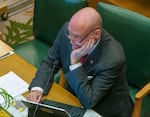
FILE — Oregon state Representative Greg Smith, R-Heppner, on Feb. 5, 2024, during the opening of the legislative short session at the Oregon state Capitol in Salem, Ore.
Kristyna Wentz-Graff / OPB
Smith had already agreed to pay a $12,000 fine because of those findings, while not admitting intentional wrongdoing. Then another penalty emerged: House Speaker Julie Fahey, D-Eugene, removed the longtime lawmaker as co-chair of a subcommittee responsible for crafting the budgets of a broad array of state agencies — including the ethics commission.
Fahey tapped state Rep. Farrah Chaichi, a Beaverton Democrat, to take Smith’s place. The speaker made clear the move was tied to findings that Smith had used a public position for personal gain, and failed to declare a conflict of interest in dozens of instances where it was required.
“Given those violations, I made the decision to remove him as co-chair of the General Government Subcommittee of Joint Ways and Means,” she said in a statement Friday.
Smith has long drawn scrutiny for holding dual roles: on one side helping write the state budget as a lawmaker, and on the other accepting contracts from agencies that receive that money as an economic development consultant.
He’s also been named in an ongoing lawsuit by the Oregon Department of Justice that accuses Morrow County officials of concocting a scheme to purchase a local broadband company at an artificially cheap price. Smith has denied wrongdoing.
But until the formal findings last week, Smith’s position of influence in the Legislature had seemed bulletproof. That may be in part because he has proved a useful vote on Democratic priorities over the years.
Now, Smith’s sway is somewhat diminished — but certainly not gone.
While Fahey removed his role as a co-chair of one subcommittee, Smith still has a seat on the most influential of the Legislature’s budgetary subgroups: the Capitol Construction Subcommittee, which picks winners among hundreds of public and private interests vying for state cash each budget cycle.
Smith is also still a vice-chair of the state’s central budget body, the Joint Ways and Means Committee.
And he noted in a text message to OPB that his role has actually expanded somewhat recently.
Last month, Fahey tapped him to serve on a subcommittee tasked with emergency spending on health care and social services — potentially important as the state prepares to grapple with the impacts of President Donald Trump’s so-called Big Beautiful Bill.
“This additional assignment allows me to focus on Oregon’s impending Medicaid issues,” Smith wrote. “I will continue to work in a bipartisan manner to bring balance to Oregon’s budgetary process.”
The longest-serving lawmaker in the state House, Smith took office in 2001 and is one of a fast-dwindling group of lawmakers who served during a time when Republicans held power in the Capitol.
Even as Democrats developed a stranglehold on the Legislature that shows no signs of fading, Smith has proved adept at cutting deals with the majority party.
The lawmaker won his budget subcommittee gavel in 2013, the first year then-Speaker Tina Kotek controlled the chamber. Kotek took away that power in 2020, after Smith participated in a legislative walkout. She eventually returned him to the role.
Two Republicans maintain gavels in positions typically held by majority party lawmakers. State Sen. Fred Girod, R-Silverton, is co-chair of the influential Capital Construction budget subcommittee, and state Rep. Mark Owens, R-Crane, helps run a House committee on water and agriculture policy.