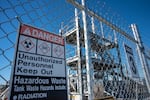
Caution signs warn of radioactive materials outside a tank farm holding waste on the Hanford Nuclear Reservation. The DOE is now narrowing the size and scope of the advisory board that has provided input on the cleanup. This photo was taken on September 24, 2024 as part of an OPB-NWPB collaboration for a week of "Think Out Loud" shows about Hanford, broadcast live from the WSU, Tri-Cities campus.
Courtesy Annie Warren/NWPB
For decades, a wide array of groups have had representatives on the Hanford Advisory Board. They’ve provided input on a variety of issues around the cleanup of waste and contamination from the nuclear reservation in central-southeast Washington.
Now, the Department of Energy under President Trump is curtailing the board.
The advisory board is going from 70 members, including alternates, to 20. The new members will be selected by the government, and any group members or representatives of tribal nations will no longer speak for a constituency but only for themselves.
Critics say these changes will reduce representation and accountability, while the DOE says the changes standardize the board and “enhance engagement with those that live closest to Hanford.”
We talk with Anna King, senior correspondent for Northwest Public Broadcasting, who’s covered the Hanford Nuclear Reservation cleanup for the last 20 years, to learn more about the impact of this change.
Note: The following transcript was transcribed using AI and validated for accuracy, readability and formatting by an OPB volunteer.
Dave Miller: This is Think Out Loud on OPB. I’m Dave Miller, coming to you all this week from Hermiston. We are less than 40 miles from the Hanford Nuclear Reservation, the site of the largest radioactive waste cleanup project in the United States. For decades, a wide array of groups have had representatives on the Hanford Advisory Board. They’ve provided input on a variety of issues around the cleanup effort. Last week, the U.S. Department of Energy announced major changes to the board, reducing both its size and its ability to engage with state agencies.
Anna King is a senior correspondent for Northwest Public Broadcasting. She has covered the Hanford Nuclear Reservation cleanup for nearly 20 years, and she joins us now. Welcome back to the show.
Anna King: Thank you, Dave.
Miller: Before we get to the change in this advisory board, I want to start with the big picture. The last time you and I spoke, almost a year ago, the Department of Energy was finally about to start operating the vitrification plant to process some of Hanford’s nuclear waste into solid glass forms and then put them in metal canisters. How has it been going?
King: There are 56 million gallons of radioactive waste in aging underground tanks. There’s 177 of those tanks. Think of each of those tanks like a two-story house that’s buried under the ground, that’s made of aging steel and concrete. That’s what we’re dealing with. Since October of last year, they have treated 185,000 gallons of that waste. That’s as of Sunday, Dave. So far, that means that the plant has kicked out more than 125 containers of treated radioactive waste. Tank waste is the leftovers of the Cold War and of World War II. It’s hazardous stuff.
Just the fumes from these tanks have sickened workers in the past. The plant that I’ve been in several times that treats that waste, it’s just in the middle of the sagebrush. It’s just like these massive, massive buildings. It looks like downtown Portland amid the sage. There’s these huge buildings that are like several Costcos all stitched together. And they’re making this place work. The whole place is crawling with over 3,200 workers.
Miller: Is there more clarity now on where this glassified radioactive waste is actually going to be stored long term?
King: No. It was supposed to be stored at a place called Yucca Mountain in Nevada, but that deep geologic repository was just stymied after senior Nevada Senator Harry Reid demanded a permanent pause on that project, and Congress hasn’t funded it since the Obama administration. So it’s just been sitting.
And with the tank waste, there are two separate streams, Dave. There’s high-level waste, and there’s low-level waste. The high level has to be stored in a deep geologic repository. High-level waste is supposed to come online for treatment in about 2033. And the interim storage facility would be built at Hanford for that waste, if we don’t have a repository. Whether they can get any of that waste off the Hanford site, we’re not sure.
Miller: So let’s turn to the news of last week that you’ve been reporting on: the Hanford Advisory Board and changes to it. What is this board?
King: The Hanford Advisory Board (HAB) is about a 70-member group, including alternates, that help advise the Department of Energy. The U.S. Environmental Protection Agency and Washington state’s Department of Ecology all collaborate on the Hanford Advisory Board to help guide the cleanup.
The members of this board are diverse – tribal nations, environmental watchdogs, Hanford labor unions, cities, the state of Oregon’s Department of Energy are all some of them. But the advice the group comes to consensus on has to be responded to by those agencies, by DOE, by the EPA and by the Department of Ecology. So they’ve written more than 320 pieces of advice over about 30 years. Even just this year, they’ve written five pieces of advice.
Miller: What changes did the U.S. Department of Energy announce last week?
King: DOE announced, at the Hanford Advisory Board meeting, that starting in October, the board would just snap down the positions from 70 positions with alternates to just 20 positions. And those 20 positions would be hand-selected by the White House, Dave. Each of those 20 people would be talking on the board as an individual, not as an agency. So, for instance, if Sally was on the board, she would be talking just as Sally, not representing the Yakama Nation.
Miller: How has the U.S. Department of Energy justified this change?
King: DOE controls these boards. It’s called a Discretionary Advisory Committee, administered under the Federal Advisory Committee Act that was passed back in the 1970s. The HAB was one of the first of several of these types of boards around the country. There’s other boards like it, in other Manhattan era and Cold War era sites. But the state said it’s been reviewing these DOE decisions that were announced, but it hasn’t made up its mind whether it’s going to protest these decisions.
Miller: What did you hear from longtime members of the board about this change?
King: Some were just resigned, Dave. They say DOE has been trying to weaken the board’s influence for so many years. DOE hasn’t approved new people to get on the board since October 1, 2024. That means the board has diminished a number of its members to do work right now. And then I met with Susan Leckband, who I’ve known for a long time, who helped lead the board for nearly two decades. She says:
Susan Leckband [recording]: Do I think the public will be hurt? I think those people who have a real concern about the environment and how’s money being spent, yeah. Yeah, I think they will be hurt. Do I think questions will be asked that are really hard? No. Do I think if they were asked, would they be answered? No.
Miller: You reported that the change won’t just shrink the makeup of the board but reduce the number of agencies the board reports to. Can you explain that?
King: DOE also announced that it was scrapping the MOU (Memorandum of Understanding) between itself, EPA and Washington’s Ecology Department. So now the board will only report to DOE, not the other two agencies that work on cleanup matters. I spoke at length with Ryan Miller, a spokesman with Washington state’s Ecology Hanford Office. He said:
Ryan Miller [recording]: For 32 years, the Hanford Advisory Board has provided 326 pieces of advice to all three of our agencies on a myriad of cleanup issues. And these issues have ranged from anything from public involvement to tank waste cleanup to remediation of facilities and soil and groundwater. And we have really, really gotten so much value from the HAB out of getting this advice, as a state agency, because we get to hear directly from the communities most impacted by Hanford cleanup.
King: I also spoke with Tom Sicilia, who’s with Oregon’s Department of Energy:
Tom Sicilia [recording]: What we’re losing is the collaboration and the coalition building to amplify the message that the Columbia River needs to be protected.
Miller: Do we know yet who will actually be on the smaller board when it takes over on October 1?
King: It’ll be made up of 20 people hand selected by DOE and the White House. We don’t know the names yet, and it’s unclear when these names will be even presented.
Miller: So maybe you can’t answer this, but another way to ask that last question is, do we know who’s not going to be on it?
King: Yeah, about 50 people or positions and alternates won’t be included, Dave.
Miller: What could this mean for Native tribes in particular?
King: It means that their elevated role, that of a sovereign nation, won’t be recognized. Multiple different nations and tribes have always been represented on the HAB. And now, how many tribal voices will end up on the HAB is still in question. And they won’t be representing their entire government, just themselves and their own concerns. DOE has said that tribes will have liaison seats, but that means they won’t be a voting member of the HAB.
Miller: OK, so the big concern here, boiled down, is that there’re gonna be many fewer people at the table and that they’re not gonna be official representatives of agencies, states or sovereign Native nations. But I’m still curious what those groups have been able to do in the past, because they did have seats at the table. In other words, what has this advisory board actually accomplished?
King: They have made 326 official pieces of advice. The agencies that report to the HAB about the progress and the problems of the site, as journalists, this is often the first glimpse that we get of problems or arising concerns at Hanford. We’ve learned that from the HAB meetings. And if there are generally less people on the HAB, there could be fewer questions to those government agencies.
Institutional knowledge is another huge thing. Where waste is buried, who made the decisions, what the board has already looked at … If you don’t have as many members that know those things, you don’t have this bulk of Hanford knowledge and interest pulling into the future.
Miller: I want to go back to the big picture here. We are nearing the end of the second year of President Trump’s second term. How would you describe this administration’s approach overall to Hanford?
King: There’s a dearth of information. Many of my requests and other press requests go unanswered, or they are sometimes written comments back that are very short statements. A lot of these requests have to go all the way back to Washington, D.C. and take a long time to get back. Not very many times are we able to go out to Hanford anymore. It used to be that there was a Hanford bus every several weeks that I would be on. And now, it’s few and far between, the times that we’re invited to the site.
But I will say that the Vit Plant is a remarkable accomplishment. They’ve been working on that for decades and decades. And they finally launched it recently. DOE is not also sharing even the good things that are happening at the site as often as in other administrations.
Miller: You have been reporting on this cleanup for nearly 20 years. How do you feel like it’s going?
King: I’ve been through some really flush times at Hanford, and I’ve been through some really lean times at Hanford. I can remember during the Obama Recovery Act money that hit Hanford [and] swelled the budget, people were downing oysters and sloshing back drinks on Tuesdays and Wednesdays at Anthony’s. Kind of almost like a gold rush type of atmosphere. But there also have been times when work at Hanford has slowed because there’s not enough money to do the cleanup beyond just keeping the lights on and keeping everything in the infrastructure and maintenance of the site going.
So finally, I’d say it just all takes a lot of time, Dave. I’ve been here 20 years. It’s likely that I won’t see the end of cleanup in my lifetime. Humans will have to be careful at this site for thousands and thousands of years to avoid hazardous waste.
Miller: Anna, thanks very much. Anna King is a reporter for Northwest Public Broadcasting. She has covered the Hanford Nuclear Reservation cleanup for nearly 20 years.
“Think Out Loud®” broadcasts live at noon every day and rebroadcasts at 8 p.m.
If you’d like to comment on any of the topics in this show or suggest a topic of your own, please get in touch with us on Facebook, send an email to thinkoutloud@opb.org, or you can leave a voicemail for us at 503-293-1983.