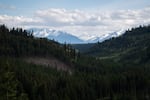
Ponderosa pines, Douglas firs and other trees cover the slopes of the Blue Mountains, north of Enterprise, Ore., as the afternoon sun hits the Wallowa Mountains on May 20, 2026.
Eli Imadali / OPB
The Blue Mountains — nearly 5 million acres that span the Malheur, Umatilla and Wallowa-Whitman national forests — are long overdue for a new management plan. The current plan was developed in 1990, but efforts to revise it have proved so contentious that they have failed twice.
The management plan was supposed to be revised every 15 years to respond to changes in forest conditions.
The latest proposal was published in early July, and the period for public comment will wrap up at the end of September. The issue has remained controversial, as public lands stakeholders have conflicting priorities for the area.
We’ll hear from three different groups for their perspective on the new proposal: Jamie Dawson, the conservation director with the Greater Hells Canyon Council; Andy Geissler, the director of forest policy for the American Forest Resource Council; and Tyler Dungannon, the conservation director for the Oregon Hunters Association.
Note: The following transcript was transcribed using AI and validated for accuracy, readability and formatting by an OPB volunteer.
Dave Miller: This is Think Out Loud on OPB. I’m Dave Miller, in Hermiston. The Blue Mountains, nearly 5 million acres that span the Malheur, Umatilla, and Wallowa-Whitman national forests, are long overdue for a new management plan. The current plan was developed in 1990 and it was supposed to be revised every 15 years to respond to changes in forest conditions, but efforts to revise it have proved so contentious that they have failed twice. The latest proposal was released last month, and the period for public comment wraps up at the end of September. We’re going to get three perspectives on the proposed revision today. In a few minutes, we’ll hear from the timber industry and from the Oregon Hunters Association. We start with Jamie Dawson. She is the conservation director at the Greater Hell’s Canyon Council. Jamie, welcome to Think Out Loud.
Jamie Dawson: Hey, thanks for having me. I’m happy to be here.
Miller: I want to start with a little bit of historical context because I gave the very short version just now. Maybe you can give us a slightly longer one. What happened the last two times that the Forest Service tried to revise the plan? What got in the way?
Dawson: I think you summarized it pretty well. I think that at the end of the day we have a lot of issues that are relatively contentious out here, but the flip side of that means that we have a lot of people who care a lot about this landscape and what happens here. And so I think the last two go arounds, maybe the Forest Service wasn’t ready to take that conflict and make it productive. And so I think we were all hoping third time’s a charm, maybe this time they can take that conflict and make it productive, come ready to meet with communities and come ready to know what we were facing. And I feel like they’ve kind of whiffed that, unfortunately, and we’re sort of back in the same place that we were last time.
Miller: You said you feel like they’ve whiffed that, they missed that opportunity?
Dawson: Yes, exactly.
Miller: Well, what has this process been like from your perspective?
Dawson: I was feeling a lot more optimistic when they got going at early 2022 and even in 2023. It seemed like there was an intention to actually meet with communities out here in Eastern Oregon, where I live, and meaningfully interact with us and get our input and try and work that into whatever the draft plan was going to be. And then as the years have passed, it seems like there’s been more and more pressure, especially from DC, to get something done as quickly as possible and to sort of remove any barrier of getting it done as quickly as possible. So it feels like having meaningful discussions with community or having any discussions about any issue that may be perceived as controversial, even if there is a lot of common ground out here, all of that hasn’t gone well. They’ve kind of just avoided any contagious conversation.
Miller: Let’s get to some of the specifics in the current draft. The agency put forward three possibilities. Its preferred one is called Alternative 2. How would this alternative change current logging rules?
Dawson: That’s a great question. Alternative 2, or the agency’s preferred option, it sort of to me feels like maybe they handpicked some of the issues and resources that the public cares the most about, and then they chose the most controversial direction for some of those issues and resources. So we’re looking at a possible return to a completely unregulated old growth logging like we have never seen in my lifetime. We’re looking at the proposed removal of protections for over 700,000 acres of really important landscapes, inventoried roadless areas, including a place that I hunt every single year and is so meaningful to me.
And of course a wholesale removal of protections for elk, which are both ecologically and economically super important out here. So it’s taking a plan that in the past was conservative but still had timber output, and now it’s aiming for maximum flexibility, which is not ideal if you’re trying to maintain the public’s trust that you’re not gonna sell everything off to the highest bidder.
Miller: As I mentioned, we’re gonna have a representative from the American Forest Resource Council on after you. One of the timber industry’s big goals in a plan revision is to reliably increase timber harvests on these lands. Is that possible without allowing larger diameter trees to be cut, 21 inches and over?
Dawson: Can you ask that question one more time?
Miller: Well, one of the issues that your organization has said is a real problem in the agency’s preferred alternative, is removing prohibitions on harvests of trees 21 inches and over. Is it possible to increase timber harvests on these lands without allowing those larger diameter trees to be cut?
Dawson: Oh, I see what you’re saying. Yeah, I mean, sure, and I think there’s also a world in which, currently, under the forest plans that we have from the 90s, those trees – trees over 21 inches in diameter – are being cut. And so I feel like the current plans that we have often get a little misconstrued as a completely hands off, we can never touch trees over 21 inches, but that, at least as someone who reviews logging proposals out here where these plans are actually affecting public lands, they can and do cut trees over 21 inches. So I think that there’s multiple ways to increase local community economic benefits and more ways to get more logs to mills. And I feel oftentimes we get caught in this kind of binary conversation that at least that this Alternative 2 is kind of pushing us into, should we log more? Yes or no. But it’s not that simple, right?
I feel like logging more is an option and the discussion that should be happening that I feel like this plan is kind of missing the boat on is like, if the Forest Service is going to log more, which they’re absolutely getting pressure from many angles to do right now, the conversation should be if they log more, how are they going to do it in a way that also cares for all of the other resources that they’re responsible for managing? On behalf of the public and also on behalf of, like, tribal nations who the federal government has treaties signed with. So I think there are many different ways to skin that cat. My concern is just, is the Forest Service meaningfully considering all the resources that they are responsible for, which includes things like elk habitat and salmon habitat, in addition to providing economic benefits to local communities.
Miller: Your organization has said that the Blue Mountains are a connectivity corridor of continental importance. What does that mean?
Dawson: Yeah, there’s a bunch of really interesting data that you can look at from basically any big charismatic animal that’s ever had a GPS collar on it. This is one of the only east-to-west or west-to-east forested corridors in the western United States, and so any number of animals that are dispersing between the Rockies and Idaho and the Cascades in Oregon and Washington, a lot of them travel through here.
And so I think it’s really important that that ideally is taken into account when we’re planning for the future of the forests up here. And that I feel is a missed opportunity that I’m hoping maybe the Forest Service can still get their hands around because usually forest plans are done like one at a time, and we are actually revising all three forest plans for the three forests that act as that kind of integrated connective tissue in Oregon. And it’s a great opportunity, but it’s not something that has been taken advantage of yet.
Miller: Just briefly, and before we say goodbye, given the many different, sometimes overlapping, sometimes contradictory human interests here – recreation, habitat conservation, hunting, logging, off-roading – do you think that any plan revision can thread that needle, would be OK enough that a majority of stakeholders would say some version of, I don’t love it, but I can live with it?
Dawson: Absolutely. I think that what this planned revision needs is more time. We had the benefit of doing this two times in the past, and honestly, a lot of the conflicts have not changed. So I think I was really optimistic that the Forest Service was going to come to the table, like ready to kind of get down in the weeds with people and meet with people in our communities and meaningfully figure out how can everybody get what they need? It is possible, but it can’t happen on this very compressed timeline that we seem to be experiencing this go round.
Miller: Jamie, thanks very much.
Dawson: Thank you.
Miller: Andy Geissler joins us now. He is the Director of Forest Policy for the American Forest Resource Council, which represents the timber industry. Andy, welcome to the show.
Andy Geissler: Hi Dave, thanks for having me.
Miller: What were your organization’s main priorities going into this plan revision?
Geissler: Well, our main priority was getting an updated plan that aligns with the current needs and threats facing our forests and communities. Namely the risk of wildfire, and these national forests face some of the highest wildfire, insect and disease risk in the West. And there’s a connection between wildfire mitigation and a healthy supply of timber products. We need to have healthy forests, we need to have forests that are resilient to wildfire, if we expect to have a reliable timber program, which is what our members rely on. So we’re also excited to see a plan that reflects the needs of the local communities, the local forest products industry that helps support those. We’ve been steadily losing sawmills, we’ve been losing logging contractors, we’ve been losing a skilled workforce that’s needed to carry out active forest management. And we want to maintain the infrastructure we have and we’d love to see a plan that helps support that.
Miller: How much of your priorities that you were just outlining do you think ended up in the Forest Service’s preferred plan revision?
Geissler: I think a lot of them. The proposed action, it’s pretty clear from reading the draft EIS, it increases resilience to high severity wildfire greater than the current plan, greater than the other action alternative. It also creates desired conditions, forest conditions that we think will support a healthy supply of timber products, which is often an output of other objectives when the Forest Service is managing their land, which is OK. Forest Service is a multiple use agency.
Timber products are one use, and they need to be delivered while meeting all these other objectives. And we think that the proposed action removes some of these restrictions that provides flexibility to the Forest Service to meeting their desired end results, and the desired end results are built around this concept known as natural range of variation where the Forest Service is required to manage based on a specific amount of old growth forest, a specific amount of early seral forest, a specific amount of middle-aged forest. And if they do that, and they’re not overly restricted, it’s gonna result in a predictable and stable supply of timber products and reduce wildfire risk, which is what we’re looking for.
Miller: What’s your response to what we just heard from Jamie Dawson that essentially her argument, one of them if you boil it down, is that the Forest Service has gone too far in the direction of the desires of the log industry or timber products industry and has not paid enough attention to other users or uses of these forests?
Geissler: Well, like I said, I mean, I think that the proposed action, based on providing multiple habitat types across a natural range, if implemented, should meet wildlife objectives. I believe elk was mentioned, fish, those things should be natural outputs if the Forest Service manages based on this natural range. Now it is definitely true by reading the proposed action that the Forest Service is anticipating an increase in timber outputs compared with the existing plans. Those numbers aren’t really targets, they’re not binding.
They’re estimations of where the Forest Service could land, but it’s worth noting that even those numbers are still less than the sustained limit of what these forests can produce. In other words, even if the Forest Service implemented the timber output numbers outlined in the proposed action, they’d still be harvesting far less than what the forest is growing. So hopefully, again, timber outputs are one result of the Forest Service meeting its desired condition of varied set of forest conditions.
Miller: I’m curious about some practical questions here. Given the loss of mills in the area and logging operations as you were talking about before – these are things that we’ve talked about a lot on this show, the huge drop in the number of mills in the area over the last 20-30 years – do you think that the Forest Service can meet those output numbers in the preferred alternative?
Geissler: I think so, and I think if they prove that they can be reliable and stable in delivering those numbers, there’s a higher chance that local purchasers are gonna invest in those timber sales. The Forest Service typically sells what they put up to offer unless it’s simply uneconomical. Our members are willing to travel long distances, particularly on the east side, to purchase these timber sales. And our members are aware that, again, these timber sales are going to result in improved resilience to wildfire, and they’re going to do what they can to buy them, purchase them, operate them. And if it’s a reliable supply, it’s more likely that it’s going to be successful, so we’re we’re hopeful that despite the reduction in manufacturing facilities over there, that we’re going to step up and purchase and implement those sales, but our main focus is not losing any more of the infrastructure because it is very sparse out there.
Miller: I wanna turn, before we say goodbye, to the issue of the rescission of the roadless rule, which is not exactly tied to, or embedded in the rule change that we’re talking about, but it’s happening sort of at the same time. And the preferred rule, as I understand it from the Forest Service, basically assumes that the roadless rule, which has been in place for decades now, would be removed. In just a few minutes we’re gonna hear some concerns that elk hunters in particular have about that. What’s your response to their concerns?
Geissler: In terms of the roadless rule, yeah, the proposed action assumes that the roadless rule will be rescinded. I think the Forest Service is trying to be nimble here. It’s difficult when you have a planned revision happening at the same time the roadless rule is being reconsidered. So I think they’re trying to be nimble and adaptable based on how this other effort plays out.
Ultimately, we want to see more active management on the ground. We want to see more wildfire resilience treatments implemented. In order to do that, in order to do thinning, prescribed fire, we need access. It’s an economic truth. These treatments can’t be implemented without access. And if some of these restrictions can be lifted in these areas to provide a larger land base where we can go out and reduce the risk of wildfire, we’re supportive of it.
Also, hopefully, an increased amount of access will assist in wildfire suppression. If you look at any of the big wildfires any year, one of the reasons that the Forest Service or other wildland firefighting agencies list for issues is access. It’s very difficult to access some of these remote areas and conduct initial attack on nascent wildfires. Having access out there should assist firefighters from conducting initial attacks to suppress these fires while they’re small.
Miller: Andy Geissler, thanks very much.
Geissler: Thanks for having me.
Miller: Andy Geissler is the Director of Forest Policy for the American Forest Resource Council. For one more perspective on the Trump administration’s proposal to revise the management plan for the Malheur, Umatilla, and Wallowa-Whitman National Forests, I’m joined by Tyler Dungannon. He is the conservation director for the Oregon Hunters Association. Tyler, welcome to the show.
Tyler Dungannon: Hey Dave, thanks for having me.
Miller: Yeah, thanks for joining us. What has your organization been most focused on when it comes to this plan revision?
Dungannon: You bet, yeah. OHA, Oregon Hunters Association, is working to ensure that the Blue Mountains Forest Plan is specifically focusing on deer and elk herds, and the two things that immediately come to mind are habitat quality and habitat security. Like it’s been discussed today, I think it’s important that we cut trees and we open the forest canopy so sunlight can hit the ground and improve forage quality for deer and elk. There are also many other species that will benefit from some more active management on our forests. I think for too long, we’ve allowed our forest canopy to close and that precludes forage from growing on our landscape. But on the habitat security aspect, it’s also imperative that open roads don’t cover the landscape.
Without secure acreage on public lands, for example, we talk about elk a lot here. Elk will leave our national forests and elk distribution has become a massive issue in the Blue Mountains. We have too many elk being displaced from public lands, largely due to disturbance, but also due to habitat quality. There’s not enough food on our national forests here today. So elk are meandering down to private lands where they can cause damage, and then we experience conflicts with landowners, which often increases in antlerless elk tags, right, harvest.
So we’re seeing roughly 40% of our wildlife management units for elk below population management objectives, and that’s for population size. And displacing elk from public lands with increased access, as we’ve been talking about with the potential rescission of the roadless rule, is only going to exacerbate that issue. So it’s important, it’s a tough issue, but OHA is working to balance road access with habitat security to retain elk in particular on the forest where they’re desired.
Miller: It seems like what the two active alternatives that the Forest Service is talking about, that they give you some interesting, a kind of conundrum that their preferred solution, preferred alternative, would theoretically, with more logging, give you more of the habitat that that you say elk desperately need on these lands. But it would also create the possibility of many more roads in the area. Meanwhile, Alternative 3 would have an increase in logging, but not to the same extent, and it would retain the current version, as I understand it, of the roadless rule. So you can either have more logging or you can have more roadless areas. So as a hunter, which one do you choose?
Dungannon: Yeah, you hit the nail on the head there, Dave. OHA is accustomed to there not being an alternative in these forest plans and these environmental impact statements that fit our position. The reality is that we’re often dealt extreme perspectives and we’re forced to try to blend alternatives to end up with a product that will support wildlife, their habitat, and hunters as well. That’s exactly what we’re looking at here with the Blue Mountains Forest Plan draft EIS.
We support aspects of Alternative 2, again their proposed alternative, and we also support aspects of Alternative 3, and we oppose certain aspects of each of those two alternatives. And frankly, if there was an option to support Alternative 2.5, we’d be somewhere in there. That’s where OHA’s perspective would land. And to be specific, in Alternative 2, we support efforts to increase timber harvest, thinning, prescribed fire, more active management to open the forest canopy to benefit deer and elk, to benefit early sterile obligate species.
However, we oppose the rescission of the roadless rule. And we want to retain our roadless areas because these areas are critical. You can implement hundreds of thousands of acres of quality habitat work for the benefit of wildlife, but if our road densities are high, if our disturbance is high, wildlife won’t receive the benefit of those treatments because they won’t use it. If they’re being disturbed, they won’t use those areas as much.
So yeah, it’s a really difficult position for OHA to be in, but again, the Forest Service has the ability to modify alternatives and our hope is that the Forest Service will implement Alternative 2, but then retain some of these roadless areas. It’s my perspective that the Forest Service can accomplish much of what they want to in Alternative 2 while still retaining roadless acres.
Miller: I’m curious about your response to that same question I asked Jamie Dawson, the conservation director from Greater Hells Canyon Council. Do you think that there is some kind of version of a revision that would be OK enough for a majority of stakeholders to say some version of, I don’t love it, but I can live with it?
Dungannon: Yeah, I do. I certainly believe there’s opportunity here to thread the needle. One play that I see is perhaps we temporarily open roads to manage our forests, to reduce some of that high conifer canopy cover, but then decommission those roads, keep them accessible for a period of time to get the work done and then close the roads when you come out. To me, that’s the way that we can achieve the goals of Alternative 2, but also retain some habitat security for elk and other wildlife.
Miller: Tyler Dungannon, thanks very much. That’s Tyler Dungannon, conservation director for the Oregon Hunters Association.
“Think Out Loud®” broadcasts live at noon every day and rebroadcasts at 8 p.m.
If you’d like to comment on any of the topics in this show or suggest a topic of your own, please get in touch with us on Facebook, send an email to thinkoutloud@opb.org, or you can leave a voicemail for us at 503-293-1983.